Home of English Grammar

Grammar Guide
  • Home
  • Exercises
  • Matches
  • Posts
  • Rules
  • Social Media Archive
  • Tools
    • Grammar Checker
    • Very Replacer
    • Word Counter
  • Vocabulary
  • Writing Guides
  • Explore Pro

What “in a pickle” means, and where it comes from

September 10, 2026 - pdf

The origin of "in a pickle"

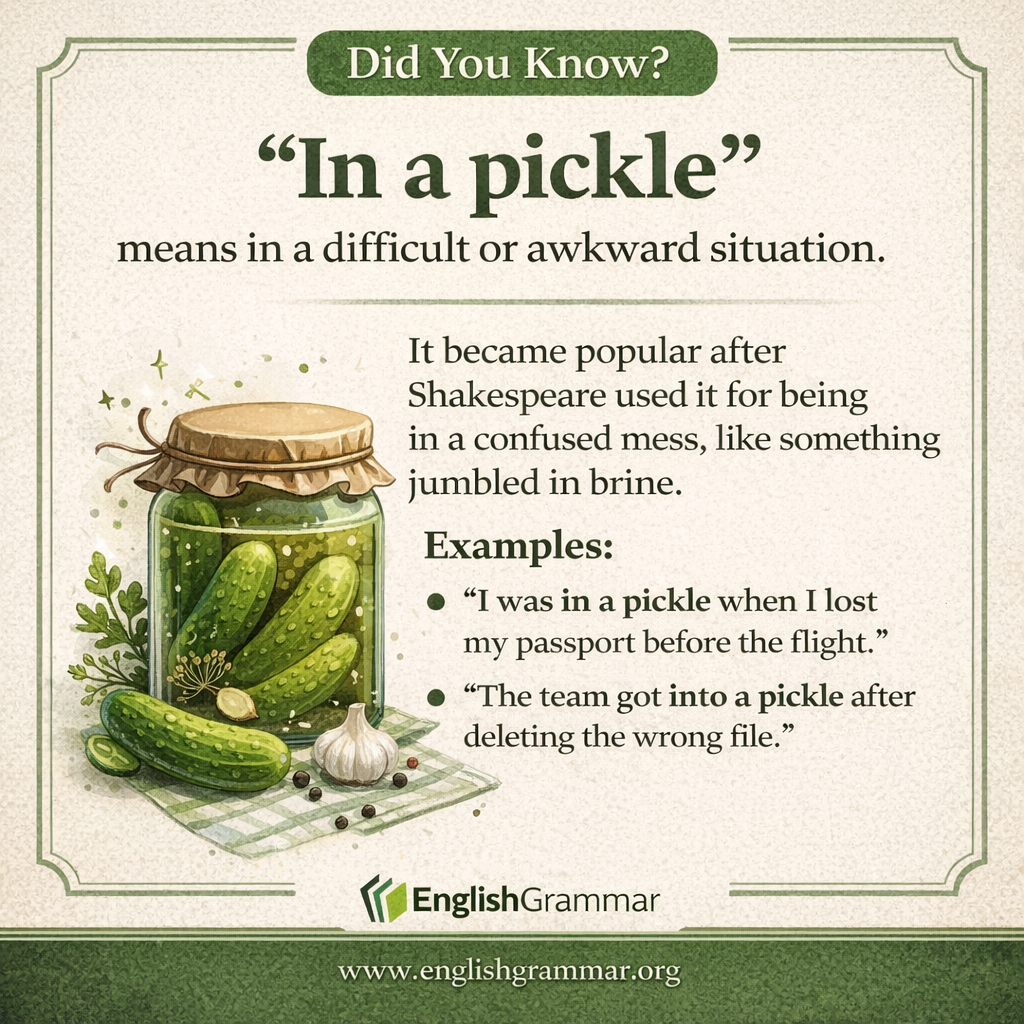
In a pickle means being in a difficult, awkward, or complicated situation. People use it when a problem is annoying, confusing, or hard to solve.

The expression became well known after Shakespeare used it in The Tempest. In that play, the word pickle suggested a muddled or confused state. That helps explain the modern meaning: when you are in a pickle, you are stuck in a mess.

Today, the phrase is common in everyday English. It often describes ordinary problems rather than serious disasters.

  • I was in a pickle when my car would not start and I was already late for work.
  • She found herself in a pickle after sending the email to the wrong person.
  • We are in a pickle now because the tickets were booked for the wrong date.

This idiom is usually informal. It fits conversation and casual writing well. If you want a more formal alternative, you might say in a difficult situation or in a bind.

  • Share
  • Post
  • Post
  • Reddit
  • Email
  • WhatsApp

NEW: Improve your English grammar in just 15 minutes a day with EnglishGrammar Pro →

2,485,429 
761,532 
Improve Your English
  • Download 2026 Grammar Guide (PDF)
  • Free Weekly Exercises & Vocabulary
  • Join over 3 Million English Learners
We respect your privacy. Unsubscribe anytime.
Grammar Checker - Try Now

Latest Posts

  • 100 Best Synonyms for “Objectives” October 8, 2026
  • Captivating vs. enthralling vs. exciting vs. thrilling October 8, 2026
  • 100 Best Synonyms for “Pervasive” October 8, 2026
  • 100 Best Synonyms for “Deceived” October 8, 2026
  • Crisis vs. crises: How to choose the right form October 8, 2026
  • Combining Forms Exercise October 8, 2026
  • 100 Best Synonyms for “Major” October 8, 2026

Copyright © 2026 · EnglishGrammar.org
Contact · Disclaimer · Privacy Policy · Refund Policy · Sitemap · Terms

Improve Your English
  • Download 2026 Grammar Guide (PDF)
  • Free Weekly Exercises & Vocabulary
  • Join over 3 Million English Learners
We respect your privacy. Unsubscribe anytime.