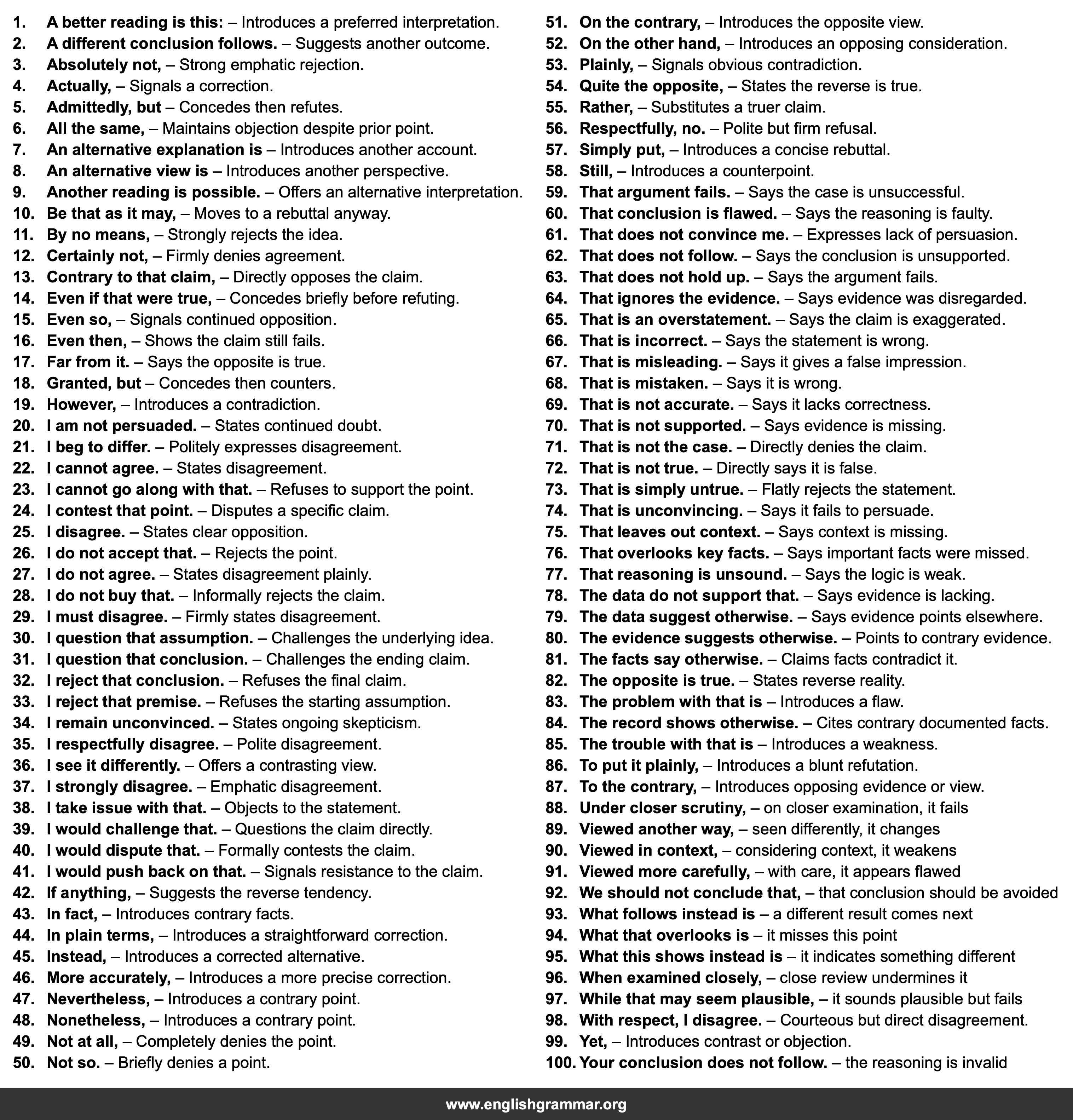
| No. | Item | Definition |
|---|---|---|
| 1. | A better reading is this: | Introduces a preferred interpretation. |
| 2. | A different conclusion follows. | Suggests another outcome. |
| 3. | Absolutely not, | Strong emphatic rejection. |
| 4. | Actually, | Signals a correction. |
| 5. | Admittedly, but | Concedes then refutes. |
| 6. | All the same, | Maintains objection despite prior point. |
| 7. | An alternative explanation is | Introduces another account. |
| 8. | An alternative view is | Introduces another perspective. |
| 9. | Another reading is possible. | Offers an alternative interpretation. |
| 10. | Be that as it may, | Moves to a rebuttal anyway. |
| 11. | By no means, | Strongly rejects the idea. |
| 12. | Certainly not, | Firmly denies agreement. |
| 13. | Contrary to that claim, | Directly opposes the claim. |
| 14. | Even if that were true, | Concedes briefly before refuting. |
| 15. | Even so, | Signals continued opposition. |
| 16. | Even then, | Shows the claim still fails. |
| 17. | Far from it. | Says the opposite is true. |
| 18. | Granted, but | Concedes then counters. |
| 19. | However, | Introduces a contradiction. |
| 20. | I am not persuaded. | States continued doubt. |
| 21. | I beg to differ. | Politely expresses disagreement. |
| 22. | I cannot agree. | States disagreement. |
| 23. | I cannot go along with that. | Refuses to support the point. |
| 24. | I contest that point. | Disputes a specific claim. |
| 25. | I disagree. | States clear opposition. |
| 26. | I do not accept that. | Rejects the point. |
| 27. | I do not agree. | States disagreement plainly. |
| 28. | I do not buy that. | Informally rejects the claim. |
| 29. | I must disagree. | Firmly states disagreement. |
| 30. | I question that assumption. | Challenges the underlying idea. |
| 31. | I question that conclusion. | Challenges the ending claim. |
| 32. | I reject that conclusion. | Refuses the final claim. |
| 33. | I reject that premise. | Refuses the starting assumption. |
| 34. | I remain unconvinced. | States ongoing skepticism. |
| 35. | I respectfully disagree. | Polite disagreement. |
| 36. | I see it differently. | Offers a contrasting view. |
| 37. | I strongly disagree. | Emphatic disagreement. |
| 38. | I take issue with that. | Objects to the statement. |
| 39. | I would challenge that. | Questions the claim directly. |
| 40. | I would dispute that. | Formally contests the claim. |
| 41. | I would push back on that. | Signals resistance to the claim. |
| 42. | If anything, | Suggests the reverse tendency. |
| 43. | In fact, | Introduces contrary facts. |
| 44. | In plain terms, | Introduces a straightforward correction. |
| 45. | Instead, | Introduces a corrected alternative. |
| 46. | More accurately, | Introduces a more precise correction. |
| 47. | Nevertheless, | Introduces a contrary point. |
| 48. | Nonetheless, | Introduces a contrary point. |
| 49. | Not at all, | Completely denies the point. |
| 50. | Not so. | Briefly denies a point. |
| 51. | On the contrary, | Introduces the opposite view. |
| 52. | On the other hand, | Introduces an opposing consideration. |
| 53. | Plainly, | Signals obvious contradiction. |
| 54. | Quite the opposite, | States the reverse is true. |
| 55. | Rather, | Substitutes a truer claim. |
| 56. | Respectfully, no. | Polite but firm refusal. |
| 57. | Simply put, | Introduces a concise rebuttal. |
| 58. | Still, | Introduces a counterpoint. |
| 59. | That argument fails. | Says the case is unsuccessful. |
| 60. | That conclusion is flawed. | Says the reasoning is faulty. |
| 61. | That does not convince me. | Expresses lack of persuasion. |
| 62. | That does not follow. | Says the conclusion is unsupported. |
| 63. | That does not hold up. | Says the argument fails. |
| 64. | That ignores the evidence. | Says evidence was disregarded. |
| 65. | That is an overstatement. | Says the claim is exaggerated. |
| 66. | That is incorrect. | Says the statement is wrong. |
| 67. | That is misleading. | Says it gives a false impression. |
| 68. | That is mistaken. | Says it is wrong. |
| 69. | That is not accurate. | Says it lacks correctness. |
| 70. | That is not supported. | Says evidence is missing. |
| 71. | That is not the case. | Directly denies the claim. |
| 72. | That is not true. | Directly says it is false. |
| 73. | That is simply untrue. | Flatly rejects the statement. |
| 74. | That is unconvincing. | Says it fails to persuade. |
| 75. | That leaves out context. | Says context is missing. |
| 76. | That overlooks key facts. | Says important facts were missed. |
| 77. | That reasoning is unsound. | Says the logic is weak. |
| 78. | The data do not support that. | Says evidence is lacking. |
| 79. | The data suggest otherwise. | Says evidence points elsewhere. |
| 80. | The evidence suggests otherwise. | Points to contrary evidence. |
| 81. | The facts say otherwise. | Claims facts contradict it. |
| 82. | The opposite is true. | States reverse reality. |
| 83. | The problem with that is | Introduces a flaw. |
| 84. | The record shows otherwise. | Cites contrary documented facts. |
| 85. | The trouble with that is | Introduces a weakness. |
| 86. | To put it plainly, | Introduces a blunt refutation. |
| 87. | To the contrary, | Introduces opposing evidence or view. |
| 88. | Under closer scrutiny, | on closer examination, it fails |
| 89. | Viewed another way, | seen differently, it changes |
| 90. | Viewed in context, | considering context, it weakens |
| 91. | Viewed more carefully, | with care, it appears flawed |
| 92. | We should not conclude that, | that conclusion should be avoided |
| 93. | What follows instead is | a different result comes next |
| 94. | What that overlooks is | it misses this point |
| 95. | What this shows instead is | it indicates something different |
| 96. | When examined closely, | close review undermines it |
| 97. | While that may seem plausible, | it sounds plausible but fails |
| 98. | With respect, I disagree. | Courteous but direct disagreement. |
| 99. | Yet, | Introduces contrast or objection. |
| 100. | Your conclusion does not follow. | the reasoning is invalid |
