
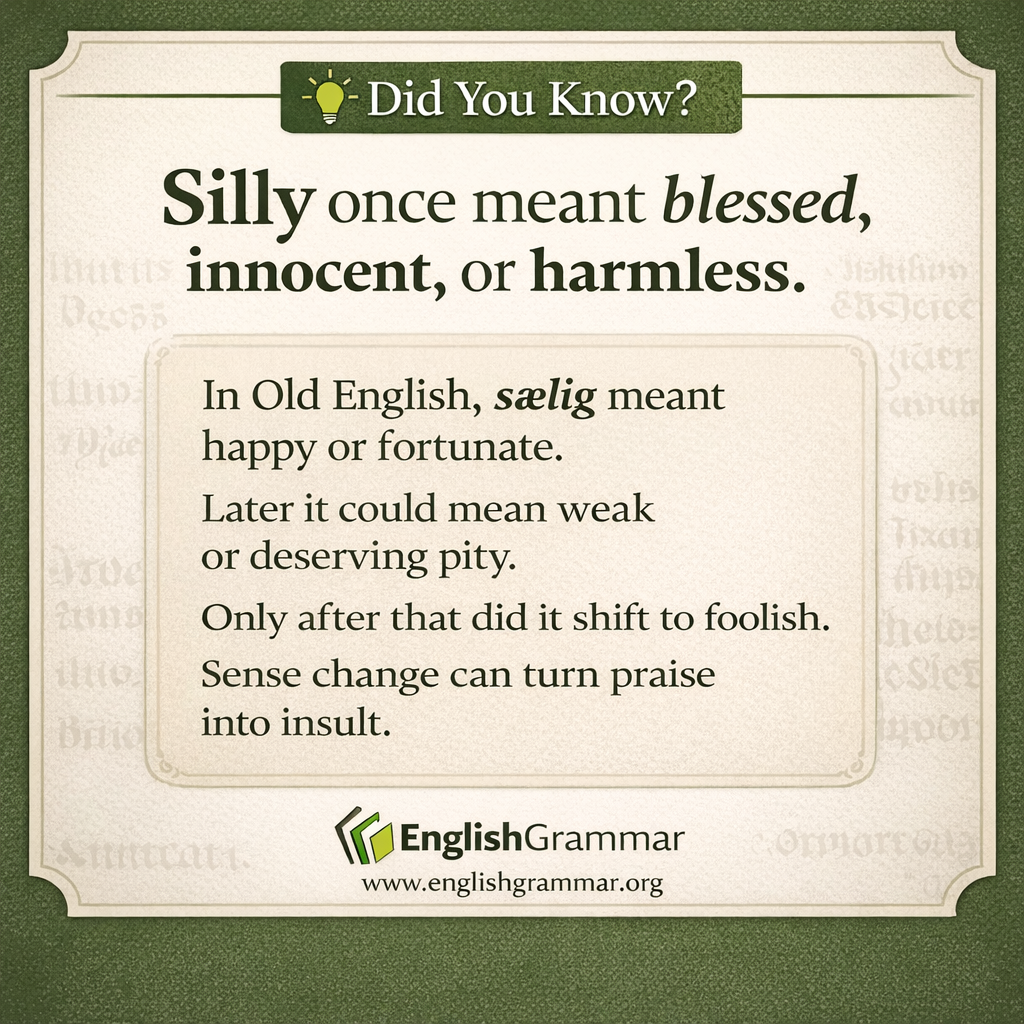
Silly has not always meant foolish. In early English, it came from Old English sælig, a word meaning happy, fortunate, or blessed. That made it a positive word at first.
Over time, the meaning softened and changed. A word that once suggested innocence or holiness could also suggest harmlessness. From there, it began to lean toward weakness or simplicity. Eventually, that opened the door to the modern sense, foolish.
This is a good example of how word meanings drift across centuries. The path was gradual, not sudden:
- Early sense: blessed, happy, fortunate
- Later sense: innocent, harmless
- Later still: weak, pitiable
- Modern sense: foolish
So when we call something silly today, we are using a word with a surprisingly gentle history. Its older meanings were much kinder than the one we usually mean now.
English is full of shifts like this. A word can start as praise, become pity, and end up as criticism. Silly is one of the clearest examples.
