
• Skip to primary navigation
  • Skip to main content
  • Skip to primary sidebar
Home of English Grammar
  • Home
  • Course
  • Exercises
  • Grammar Rules
  • Matches
  • Posts
  • Tools
    • Grammar Checker
    • Very Replacer
    • Word Counter
  • Vocabulary Lists
  • Archives
    • Social Media Posts
    • Writing Guides
  • Sign in
  • Join free

How “spam” got its internet meaning from Monty Python

April 14, 2026

How “spam” got its internet meaning from Monty Python

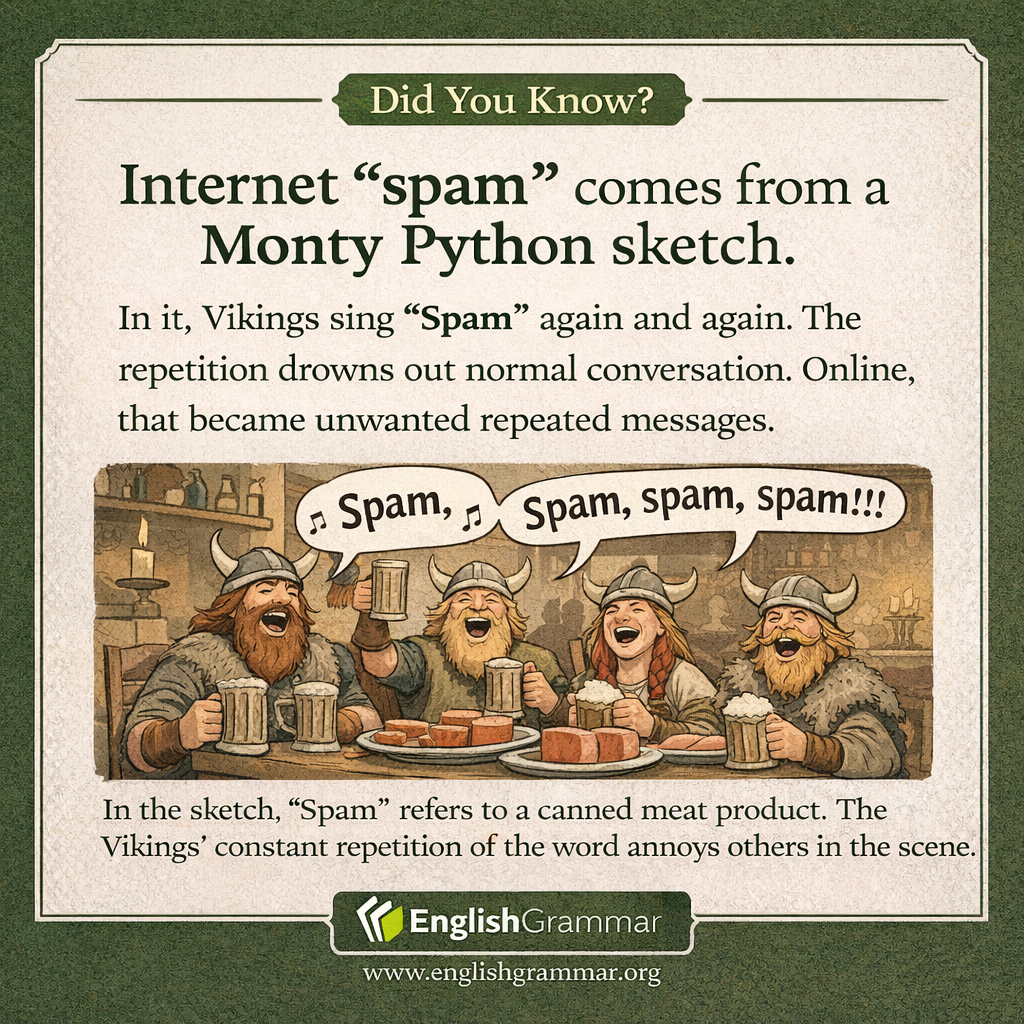
The internet meaning of “spam” comes from a famous Monty Python sketch. In the scene, a café menu includes Spam in almost every dish, while a group of Vikings keeps singing “Spam, Spam, Spam…” louder and louder. The joke is that the repeated word overwhelms ordinary conversation.

Early internet users saw a clear parallel. When unwanted messages were posted again and again, they buried real discussion in the same way the song drowned out the dialogue. That is how spam became the standard term for repetitive, unwanted online content.

  • Email spam: bulk ads sent to huge numbers of inboxes.
  • Comment spam: the same promotional message pasted under many posts.
  • Forum spam: repeated off topic posts that make genuine replies harder to see.

The word did not originally mean all junk communication. Its core idea was excessive repetition that crowds out normal conversation. Over time, the meaning broadened, but that original image still explains why the term fits so well.

Improve your English grammar, vocabulary and writing

We take you step by step from beginner to advanced, even if you struggled with English at school or have always had trouble remembering the rules.

  • 10 modules, 112 lessons and 730 questions
  • Just log in and learn anytime and anywhere
  • Your progress is saved in your account
  • Download the 2027 Grammar Guide (PDF)
Join free

Already have an account? Sign in

See what’s in the course

Primary Sidebar

2.4M760.9K165.9K

Free 2027 Grammar Guide

  • Download Grammar Guide (PDF)
  • Online grammar course, A1 to C2
  • Weekly exercises and vocabulary
  • Join over 3 million English learners

We respect your privacy. Unsubscribe anytime.

Already have an account? Sign in

Grammar Checker - Try Now

Matches Rankings

    No results yet. Be the first to finish today’s Daily.

      No results yet. Be the first to finish today’s Daily.

        No results yet. Be the first to finish today’s Daily.

          No results yet. Be the first to finish today’s Daily.

          Play Matches

          Latest Posts

          • 100 Phrases for Moving a Meeting Along November 4, 2026
          • 100 Best Synonyms for “Weakness” November 4, 2026
          • 100 Best Synonyms for “Revolting” November 4, 2026
          • 100 Best Synonyms for “Infrastructure” November 4, 2026
          • Persuasive, convincing, cogent, compelling, conclusive and irrefutable: How to choose November 4, 2026
          • Defining and Non-Defining Relative Clauses Exercise November 4, 2026
          • 100 Best Synonyms for “Warm” November 4, 2026
          • Passive Voice Exercise November 4, 2026
          • 100 Best Synonyms for “Informative” November 4, 2026
          • 100 Best Synonyms for “Revel” November 4, 2026
          Home of English Grammar

          Free English grammar exercises, rules and vocabulary lists, with new exercises every week. Join the leading English grammar site with over 3 million followers.

          Join free

          Learn

          • Exercises
          • Matches
          • Grammar rules
          • Vocabulary lists
          • Writing guides
          • Online tools

          More

          • Top social media posts
          • Various posts
          • Contact

          Account

          • Join free
          • Grammar Course
          • Free grammar guide (PDF)

          Copyright © 2026 EnglishGrammar.org

          • Disclaimer
          • Privacy policy
          • Terms
          • Sitemap