
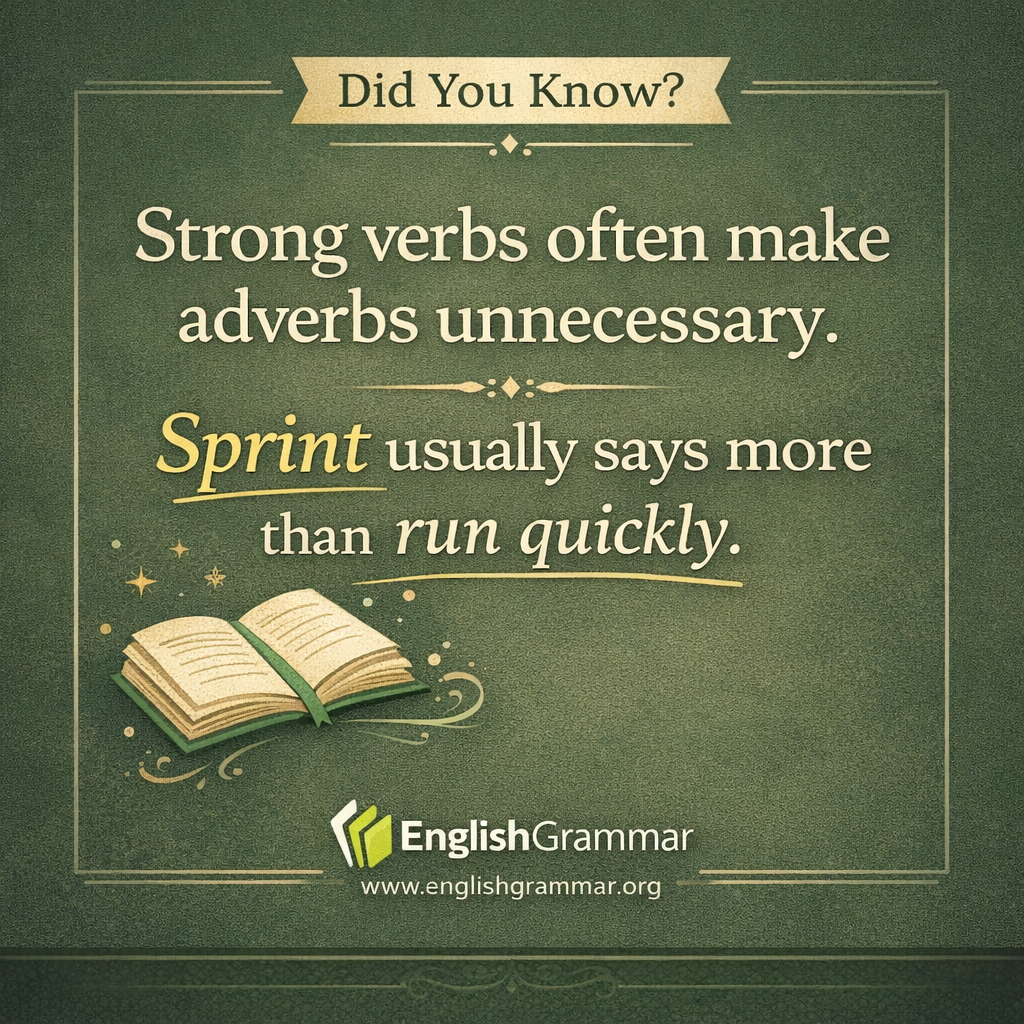
Strong verbs often make sentences clearer, shorter, and more vivid. Instead of pairing a general verb with an adverb, you can often choose one precise verb that already carries the meaning.
For example, run quickly can become sprint. Speak softly can become whisper. Look carefully can become examine. In each case, the stronger verb gives the reader a sharper picture with fewer words.
This does not mean adverbs are wrong. Adverbs are useful when they add a detail the verb alone does not express. But in many sentences, an extra adverb only repeats information that a better verb can handle more naturally.
- Weak: She walked slowly to the door.
- Stronger: She crept to the door.
- Weak: He said angrily that he was leaving.
- Stronger: He snapped that he was leaving.
A good test is simple: if the adverb explains the verb instead of adding a new idea, try replacing both with one stronger verb. Your writing will often sound more confident, concise, and memorable.
