
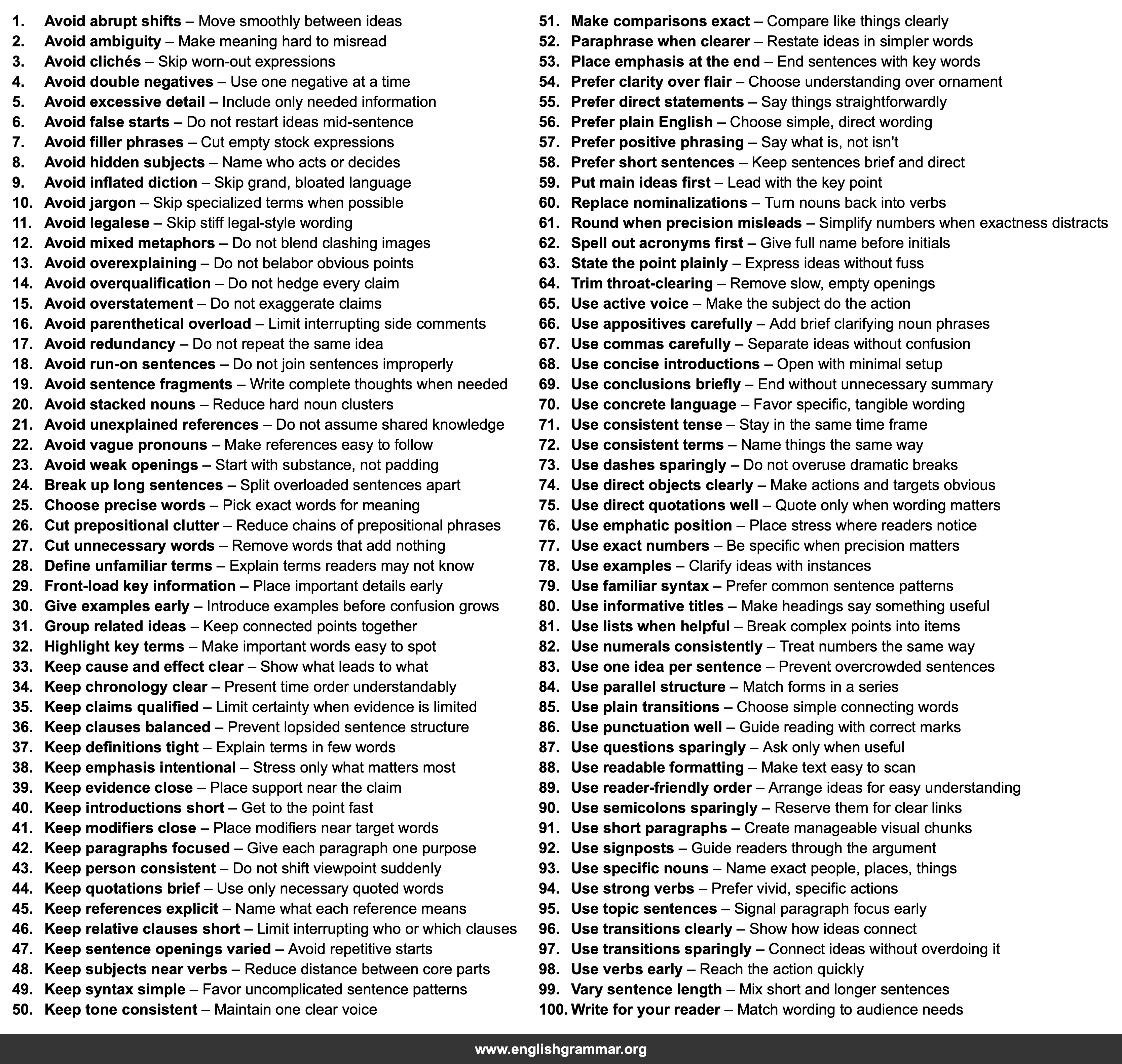
| No. | Item | Definition |
|---|---|---|
| 1. | Avoid abrupt shifts | Move smoothly between ideas |
| 2. | Avoid ambiguity | Make meaning hard to misread |
| 3. | Avoid clichés | Skip worn-out expressions |
| 4. | Avoid double negatives | Use one negative at a time |
| 5. | Avoid excessive detail | Include only needed information |
| 6. | Avoid false starts | Do not restart ideas mid-sentence |
| 7. | Avoid filler phrases | Cut empty stock expressions |
| 8. | Avoid hidden subjects | Name who acts or decides |
| 9. | Avoid inflated diction | Skip grand, bloated language |
| 10. | Avoid jargon | Skip specialized terms when possible |
| 11. | Avoid legalese | Skip stiff legal-style wording |
| 12. | Avoid mixed metaphors | Do not blend clashing images |
| 13. | Avoid overexplaining | Do not belabor obvious points |
| 14. | Avoid overqualification | Do not hedge every claim |
| 15. | Avoid overstatement | Do not exaggerate claims |
| 16. | Avoid parenthetical overload | Limit interrupting side comments |
| 17. | Avoid redundancy | Do not repeat the same idea |
| 18. | Avoid run-on sentences | Do not join sentences improperly |
| 19. | Avoid sentence fragments | Write complete thoughts when needed |
| 20. | Avoid stacked nouns | Reduce hard noun clusters |
| 21. | Avoid unexplained references | Do not assume shared knowledge |
| 22. | Avoid vague pronouns | Make references easy to follow |
| 23. | Avoid weak openings | Start with substance, not padding |
| 24. | Break up long sentences | Split overloaded sentences apart |
| 25. | Choose precise words | Pick exact words for meaning |
| 26. | Cut prepositional clutter | Reduce chains of prepositional phrases |
| 27. | Cut unnecessary words | Remove words that add nothing |
| 28. | Define unfamiliar terms | Explain terms readers may not know |
| 29. | Front-load key information | Place important details early |
| 30. | Give examples early | Introduce examples before confusion grows |
| 31. | Group related ideas | Keep connected points together |
| 32. | Highlight key terms | Make important words easy to spot |
| 33. | Keep cause and effect clear | Show what leads to what |
| 34. | Keep chronology clear | Present time order understandably |
| 35. | Keep claims qualified | Limit certainty when evidence is limited |
| 36. | Keep clauses balanced | Prevent lopsided sentence structure |
| 37. | Keep definitions tight | Explain terms in few words |
| 38. | Keep emphasis intentional | Stress only what matters most |
| 39. | Keep evidence close | Place support near the claim |
| 40. | Keep introductions short | Get to the point fast |
| 41. | Keep modifiers close | Place modifiers near target words |
| 42. | Keep paragraphs focused | Give each paragraph one purpose |
| 43. | Keep person consistent | Do not shift viewpoint suddenly |
| 44. | Keep quotations brief | Use only necessary quoted words |
| 45. | Keep references explicit | Name what each reference means |
| 46. | Keep relative clauses short | Limit interrupting who or which clauses |
| 47. | Keep sentence openings varied | Avoid repetitive starts |
| 48. | Keep subjects near verbs | Reduce distance between core parts |
| 49. | Keep syntax simple | Favor uncomplicated sentence patterns |
| 50. | Keep tone consistent | Maintain one clear voice |
| 51. | Make comparisons exact | Compare like things clearly |
| 52. | Paraphrase when clearer | Restate ideas in simpler words |
| 53. | Place emphasis at the end | End sentences with key words |
| 54. | Prefer clarity over flair | Choose understanding over ornament |
| 55. | Prefer direct statements | Say things straightforwardly |
| 56. | Prefer plain English | Choose simple, direct wording |
| 57. | Prefer positive phrasing | Say what is, not isn’t |
| 58. | Prefer short sentences | Keep sentences brief and direct |
| 59. | Put main ideas first | Lead with the key point |
| 60. | Replace nominalizations | Turn nouns back into verbs |
| 61. | Round when precision misleads | Simplify numbers when exactness distracts |
| 62. | Spell out acronyms first | Give full name before initials |
| 63. | State the point plainly | Express ideas without fuss |
| 64. | Trim throat-clearing | Remove slow, empty openings |
| 65. | Use active voice | Make the subject do the action |
| 66. | Use appositives carefully | Add brief clarifying noun phrases |
| 67. | Use commas carefully | Separate ideas without confusion |
| 68. | Use concise introductions | Open with minimal setup |
| 69. | Use conclusions briefly | End without unnecessary summary |
| 70. | Use concrete language | Favor specific, tangible wording |
| 71. | Use consistent tense | Stay in the same time frame |
| 72. | Use consistent terms | Name things the same way |
| 73. | Use dashes sparingly | Do not overuse dramatic breaks |
| 74. | Use direct objects clearly | Make actions and targets obvious |
| 75. | Use direct quotations well | Quote only when wording matters |
| 76. | Use emphatic position | Place stress where readers notice |
| 77. | Use exact numbers | Be specific when precision matters |
| 78. | Use examples | Clarify ideas with instances |
| 79. | Use familiar syntax | Prefer common sentence patterns |
| 80. | Use informative titles | Make headings say something useful |
| 81. | Use lists when helpful | Break complex points into items |
| 82. | Use numerals consistently | Treat numbers the same way |
| 83. | Use one idea per sentence | Prevent overcrowded sentences |
| 84. | Use parallel structure | Match forms in a series |
| 85. | Use plain transitions | Choose simple connecting words |
| 86. | Use punctuation well | Guide reading with correct marks |
| 87. | Use questions sparingly | Ask only when useful |
| 88. | Use readable formatting | Make text easy to scan |
| 89. | Use reader-friendly order | Arrange ideas for easy understanding |
| 90. | Use semicolons sparingly | Reserve them for clear links |
| 91. | Use short paragraphs | Create manageable visual chunks |
| 92. | Use signposts | Guide readers through the argument |
| 93. | Use specific nouns | Name exact people, places, things |
| 94. | Use strong verbs | Prefer vivid, specific actions |
| 95. | Use topic sentences | Signal paragraph focus early |
| 96. | Use transitions clearly | Show how ideas connect |
| 97. | Use transitions sparingly | Connect ideas without overdoing it |
| 98. | Use verbs early | Reach the action quickly |
| 99. | Vary sentence length | Mix short and longer sentences |
| 100. | Write for your reader | Match wording to audience needs |