
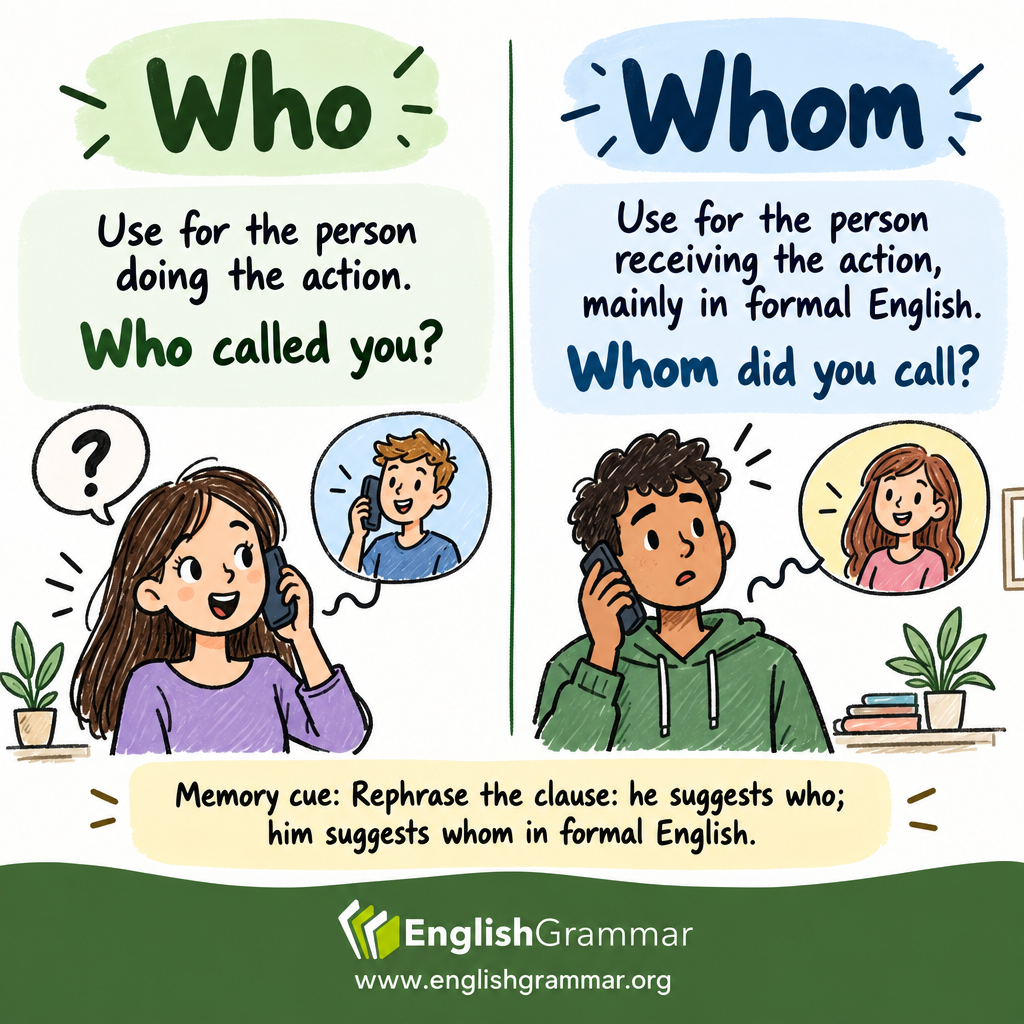
Who and whom both ask about or identify people, but their roles differ. Use who as the subject—the person doing the action. Use whom as the object—the person receiving the action or following a preposition.
- Subject: Who sent the email?
- Object: Whom did Maya invite?
- After a preposition: To whom should I address the letter?
Word order can hide the distinction. In “Whom did Maya invite?”, Maya is the person doing the inviting, while whom is the person invited. To check, answer or rephrase the clause with he or him. “He sent the email” points to who; “Maya invited him” points to whom.
In present-day conversation, many speakers use who where traditional formal grammar calls for whom. “Who did Maya invite?” sounds natural and is widely used. Whom remains more likely in formal writing and immediately after a preposition: “To whom should I speak?” In less formal English, the preposition often moves to the end: “Who should I speak to?”
The same pattern applies in relative clauses. Compare “the teacher who called” with “the teacher whom we called.” In the first, the teacher called; in the second, we called the teacher. Focus on the word’s role inside the clause, not simply on where it appears.