
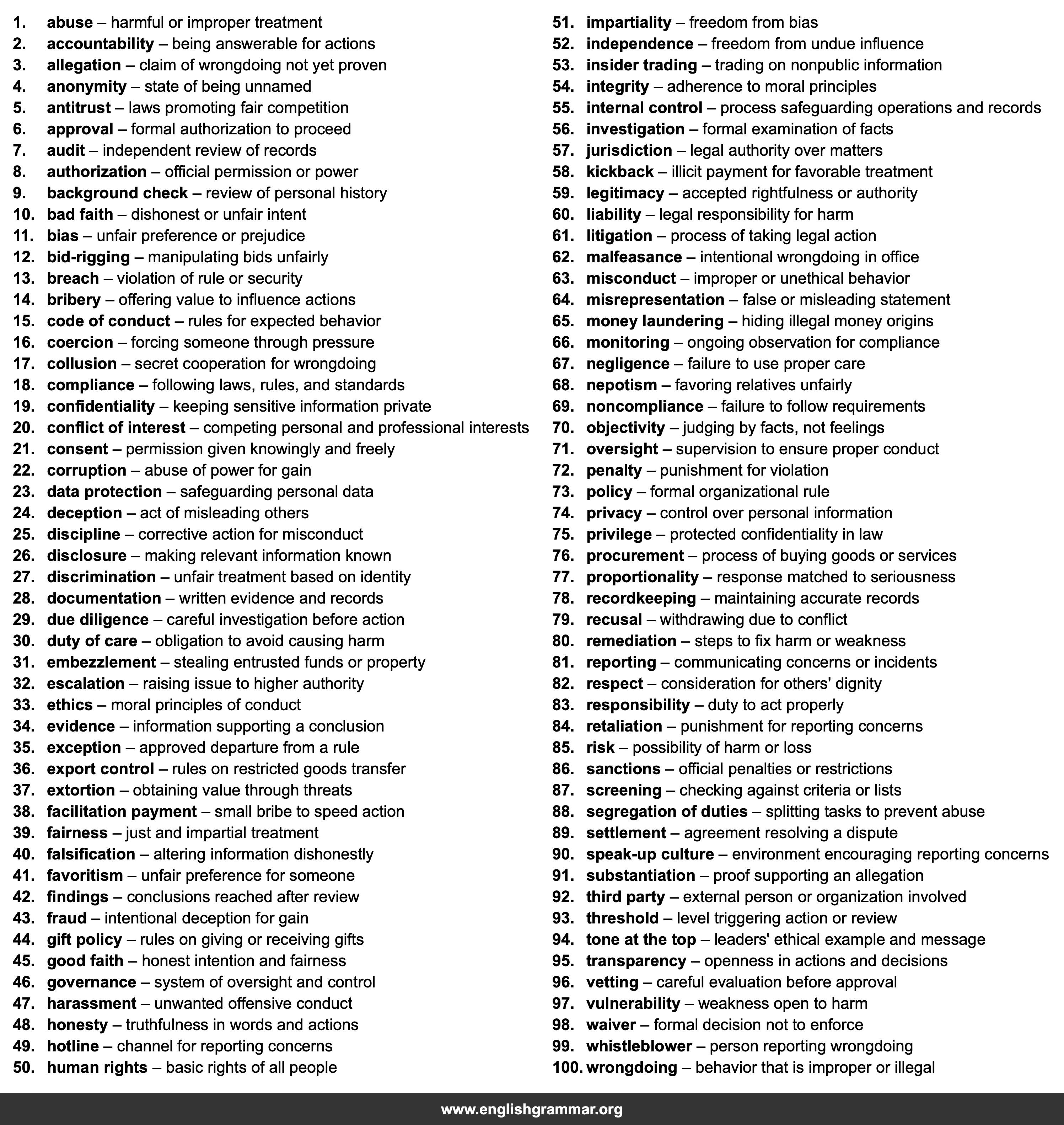
| No. | Item | Definition |
|---|---|---|
| 1. | abuse | harmful or improper treatment |
| 2. | accountability | being answerable for actions |
| 3. | allegation | claim of wrongdoing not yet proven |
| 4. | anonymity | state of being unnamed |
| 5. | antitrust | laws promoting fair competition |
| 6. | approval | formal authorization to proceed |
| 7. | audit | independent review of records |
| 8. | authorization | official permission or power |
| 9. | background check | review of personal history |
| 10. | bad faith | dishonest or unfair intent |
| 11. | bias | unfair preference or prejudice |
| 12. | bid-rigging | manipulating bids unfairly |
| 13. | breach | violation of rule or security |
| 14. | bribery | offering value to influence actions |
| 15. | code of conduct | rules for expected behavior |
| 16. | coercion | forcing someone through pressure |
| 17. | collusion | secret cooperation for wrongdoing |
| 18. | compliance | following laws, rules, and standards |
| 19. | confidentiality | keeping sensitive information private |
| 20. | conflict of interest | competing personal and professional interests |
| 21. | consent | permission given knowingly and freely |
| 22. | corruption | abuse of power for gain |
| 23. | data protection | safeguarding personal data |
| 24. | deception | act of misleading others |
| 25. | discipline | corrective action for misconduct |
| 26. | disclosure | making relevant information known |
| 27. | discrimination | unfair treatment based on identity |
| 28. | documentation | written evidence and records |
| 29. | due diligence | careful investigation before action |
| 30. | duty of care | obligation to avoid causing harm |
| 31. | embezzlement | stealing entrusted funds or property |
| 32. | escalation | raising issue to higher authority |
| 33. | ethics | moral principles of conduct |
| 34. | evidence | information supporting a conclusion |
| 35. | exception | approved departure from a rule |
| 36. | export control | rules on restricted goods transfer |
| 37. | extortion | obtaining value through threats |
| 38. | facilitation payment | small bribe to speed action |
| 39. | fairness | just and impartial treatment |
| 40. | falsification | altering information dishonestly |
| 41. | favoritism | unfair preference for someone |
| 42. | findings | conclusions reached after review |
| 43. | fraud | intentional deception for gain |
| 44. | gift policy | rules on giving or receiving gifts |
| 45. | good faith | honest intention and fairness |
| 46. | governance | system of oversight and control |
| 47. | harassment | unwanted offensive conduct |
| 48. | honesty | truthfulness in words and actions |
| 49. | hotline | channel for reporting concerns |
| 50. | human rights | basic rights of all people |
| 51. | impartiality | freedom from bias |
| 52. | independence | freedom from undue influence |
| 53. | insider trading | trading on nonpublic information |
| 54. | integrity | adherence to moral principles |
| 55. | internal control | process safeguarding operations and records |
| 56. | investigation | formal examination of facts |
| 57. | jurisdiction | legal authority over matters |
| 58. | kickback | illicit payment for favorable treatment |
| 59. | legitimacy | accepted rightfulness or authority |
| 60. | liability | legal responsibility for harm |
| 61. | litigation | process of taking legal action |
| 62. | malfeasance | intentional wrongdoing in office |
| 63. | misconduct | improper or unethical behavior |
| 64. | misrepresentation | false or misleading statement |
| 65. | money laundering | hiding illegal money origins |
| 66. | monitoring | ongoing observation for compliance |
| 67. | negligence | failure to use proper care |
| 68. | nepotism | favoring relatives unfairly |
| 69. | noncompliance | failure to follow requirements |
| 70. | objectivity | judging by facts, not feelings |
| 71. | oversight | supervision to ensure proper conduct |
| 72. | penalty | punishment for violation |
| 73. | policy | formal organizational rule |
| 74. | privacy | control over personal information |
| 75. | privilege | protected confidentiality in law |
| 76. | procurement | process of buying goods or services |
| 77. | proportionality | response matched to seriousness |
| 78. | recordkeeping | maintaining accurate records |
| 79. | recusal | withdrawing due to conflict |
| 80. | remediation | steps to fix harm or weakness |
| 81. | reporting | communicating concerns or incidents |
| 82. | respect | consideration for others’ dignity |
| 83. | responsibility | duty to act properly |
| 84. | retaliation | punishment for reporting concerns |
| 85. | risk | possibility of harm or loss |
| 86. | sanctions | official penalties or restrictions |
| 87. | screening | checking against criteria or lists |
| 88. | segregation of duties | splitting tasks to prevent abuse |
| 89. | settlement | agreement resolving a dispute |
| 90. | speak-up culture | environment encouraging reporting concerns |
| 91. | substantiation | proof supporting an allegation |
| 92. | third party | external person or organization involved |
| 93. | threshold | level triggering action or review |
| 94. | tone at the top | leaders’ ethical example and message |
| 95. | transparency | openness in actions and decisions |
| 96. | vetting | careful evaluation before approval |
| 97. | vulnerability | weakness open to harm |
| 98. | waiver | formal decision not to enforce |
| 99. | whistleblower | person reporting wrongdoing |
| 100. | wrongdoing | behavior that is improper or illegal |