
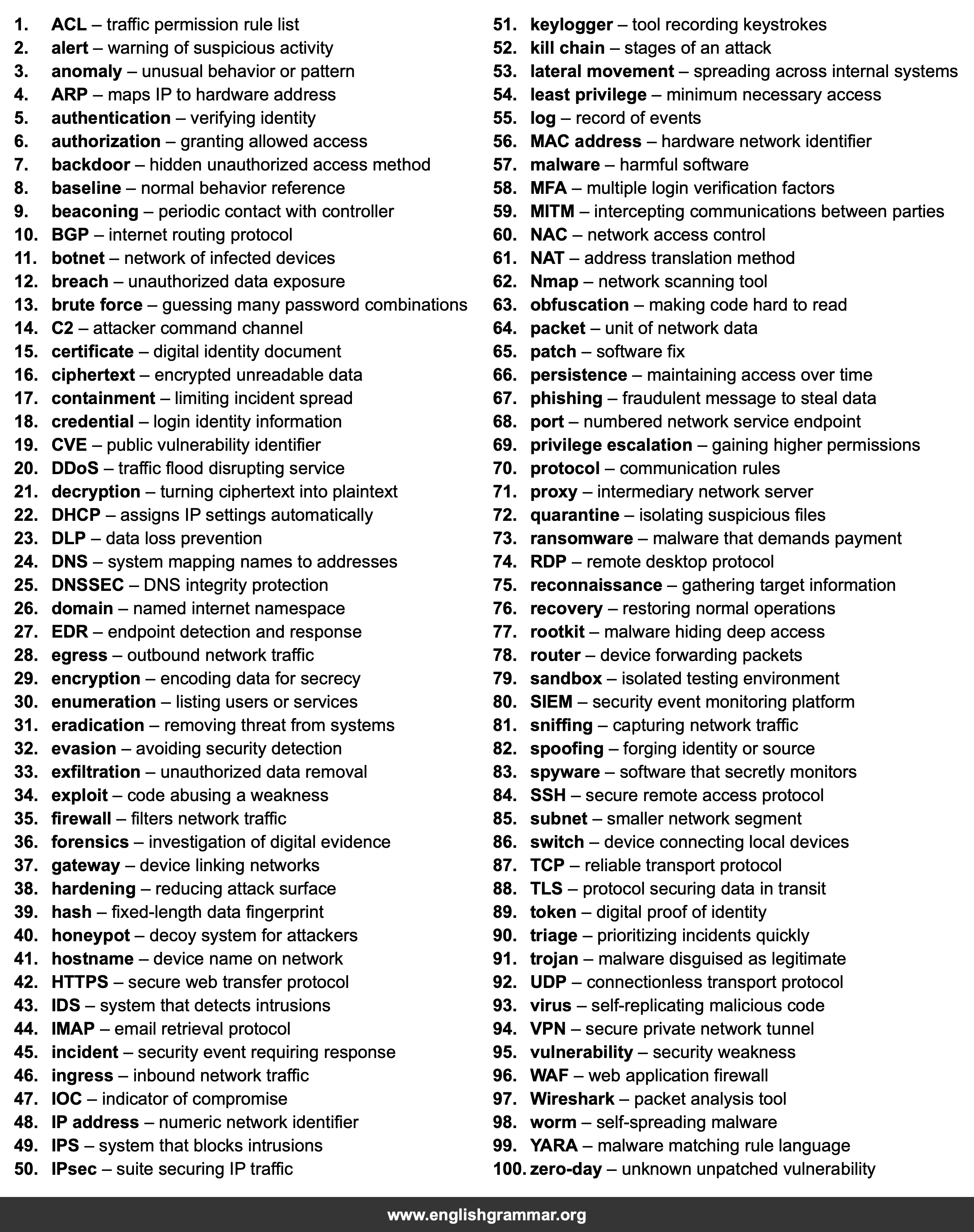
| No. | Item | Definition |
|---|---|---|
| 1. | ACL | traffic permission rule list |
| 2. | alert | warning of suspicious activity |
| 3. | anomaly | unusual behavior or pattern |
| 4. | ARP | maps IP to hardware address |
| 5. | authentication | verifying identity |
| 6. | authorization | granting allowed access |
| 7. | backdoor | hidden unauthorized access method |
| 8. | baseline | normal behavior reference |
| 9. | beaconing | periodic contact with controller |
| 10. | BGP | internet routing protocol |
| 11. | botnet | network of infected devices |
| 12. | breach | unauthorized data exposure |
| 13. | brute force | guessing many password combinations |
| 14. | C2 | attacker command channel |
| 15. | certificate | digital identity document |
| 16. | ciphertext | encrypted unreadable data |
| 17. | containment | limiting incident spread |
| 18. | credential | login identity information |
| 19. | CVE | public vulnerability identifier |
| 20. | DDoS | traffic flood disrupting service |
| 21. | decryption | turning ciphertext into plaintext |
| 22. | DHCP | assigns IP settings automatically |
| 23. | DLP | data loss prevention |
| 24. | DNS | system mapping names to addresses |
| 25. | DNSSEC | DNS integrity protection |
| 26. | domain | named internet namespace |
| 27. | EDR | endpoint detection and response |
| 28. | egress | outbound network traffic |
| 29. | encryption | encoding data for secrecy |
| 30. | enumeration | listing users or services |
| 31. | eradication | removing threat from systems |
| 32. | evasion | avoiding security detection |
| 33. | exfiltration | unauthorized data removal |
| 34. | exploit | code abusing a weakness |
| 35. | firewall | filters network traffic |
| 36. | forensics | investigation of digital evidence |
| 37. | gateway | device linking networks |
| 38. | hardening | reducing attack surface |
| 39. | hash | fixed-length data fingerprint |
| 40. | honeypot | decoy system for attackers |
| 41. | hostname | device name on network |
| 42. | HTTPS | secure web transfer protocol |
| 43. | IDS | system that detects intrusions |
| 44. | IMAP | email retrieval protocol |
| 45. | incident | security event requiring response |
| 46. | ingress | inbound network traffic |
| 47. | IOC | indicator of compromise |
| 48. | IP address | numeric network identifier |
| 49. | IPS | system that blocks intrusions |
| 50. | IPsec | suite securing IP traffic |
| 51. | keylogger | tool recording keystrokes |
| 52. | kill chain | stages of an attack |
| 53. | lateral movement | spreading across internal systems |
| 54. | least privilege | minimum necessary access |
| 55. | log | record of events |
| 56. | MAC address | hardware network identifier |
| 57. | malware | harmful software |
| 58. | MFA | multiple login verification factors |
| 59. | MITM | intercepting communications between parties |
| 60. | NAC | network access control |
| 61. | NAT | address translation method |
| 62. | Nmap | network scanning tool |
| 63. | obfuscation | making code hard to read |
| 64. | packet | unit of network data |
| 65. | patch | software fix |
| 66. | persistence | maintaining access over time |
| 67. | phishing | fraudulent message to steal data |
| 68. | port | numbered network service endpoint |
| 69. | privilege escalation | gaining higher permissions |
| 70. | protocol | communication rules |
| 71. | proxy | intermediary network server |
| 72. | quarantine | isolating suspicious files |
| 73. | ransomware | malware that demands payment |
| 74. | RDP | remote desktop protocol |
| 75. | reconnaissance | gathering target information |
| 76. | recovery | restoring normal operations |
| 77. | rootkit | malware hiding deep access |
| 78. | router | device forwarding packets |
| 79. | sandbox | isolated testing environment |
| 80. | SIEM | security event monitoring platform |
| 81. | sniffing | capturing network traffic |
| 82. | spoofing | forging identity or source |
| 83. | spyware | software that secretly monitors |
| 84. | SSH | secure remote access protocol |
| 85. | subnet | smaller network segment |
| 86. | switch | device connecting local devices |
| 87. | TCP | reliable transport protocol |
| 88. | TLS | protocol securing data in transit |
| 89. | token | digital proof of identity |
| 90. | triage | prioritizing incidents quickly |
| 91. | trojan | malware disguised as legitimate |
| 92. | UDP | connectionless transport protocol |
| 93. | virus | self-replicating malicious code |
| 94. | VPN | secure private network tunnel |
| 95. | vulnerability | security weakness |
| 96. | WAF | web application firewall |
| 97. | Wireshark | packet analysis tool |
| 98. | worm | self-spreading malware |
| 99. | YARA | malware matching rule language |
| 100. | zero-day | unknown unpatched vulnerability |