
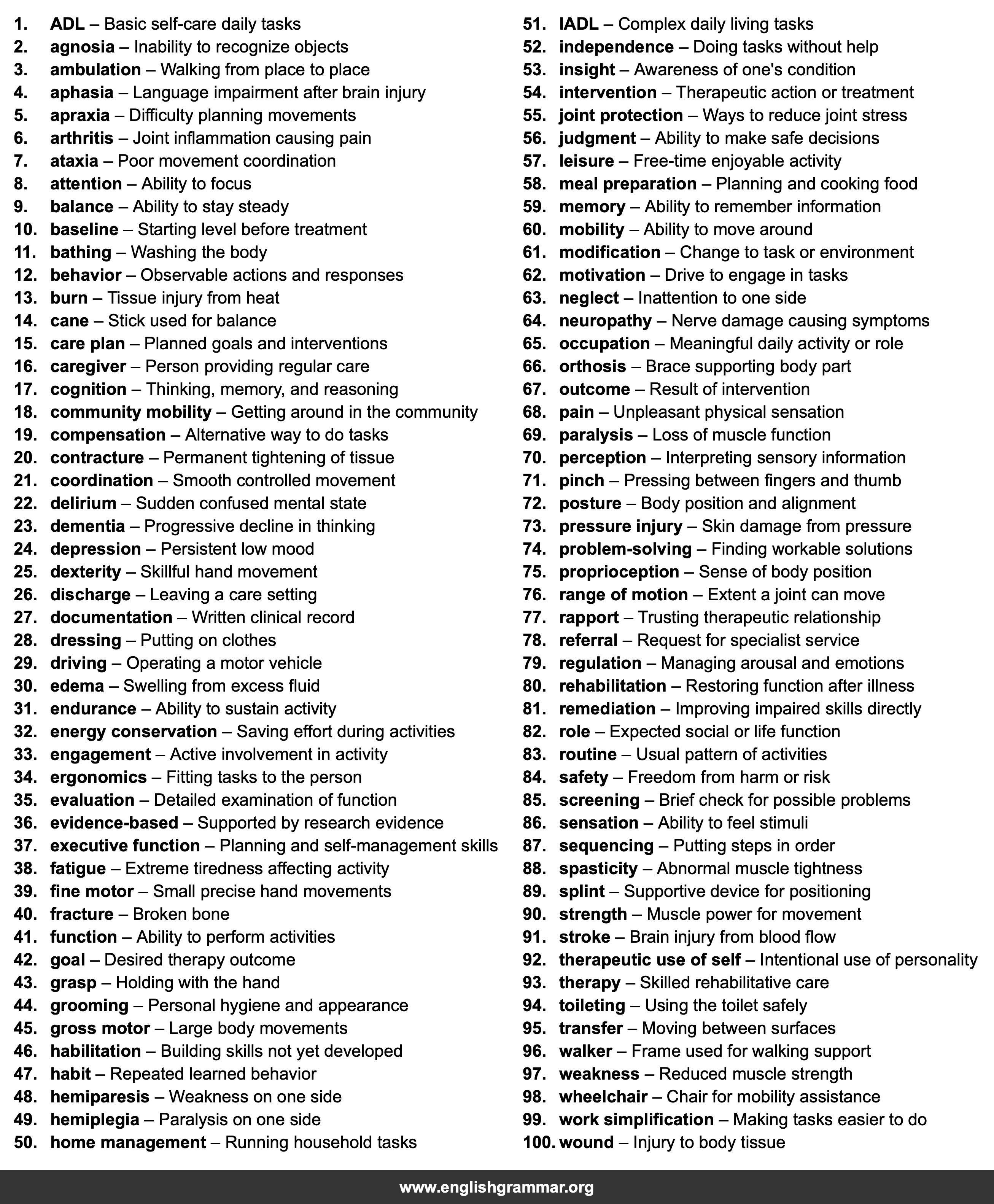
| No. | Item | Definition |
|---|---|---|
| 1. | ADL | Basic self-care daily tasks |
| 2. | agnosia | Inability to recognize objects |
| 3. | ambulation | Walking from place to place |
| 4. | aphasia | Language impairment after brain injury |
| 5. | apraxia | Difficulty planning movements |
| 6. | arthritis | Joint inflammation causing pain |
| 7. | ataxia | Poor movement coordination |
| 8. | attention | Ability to focus |
| 9. | balance | Ability to stay steady |
| 10. | baseline | Starting level before treatment |
| 11. | bathing | Washing the body |
| 12. | behavior | Observable actions and responses |
| 13. | burn | Tissue injury from heat |
| 14. | cane | Stick used for balance |
| 15. | care plan | Planned goals and interventions |
| 16. | caregiver | Person providing regular care |
| 17. | cognition | Thinking, memory, and reasoning |
| 18. | community mobility | Getting around in the community |
| 19. | compensation | Alternative way to do tasks |
| 20. | contracture | Permanent tightening of tissue |
| 21. | coordination | Smooth controlled movement |
| 22. | delirium | Sudden confused mental state |
| 23. | dementia | Progressive decline in thinking |
| 24. | depression | Persistent low mood |
| 25. | dexterity | Skillful hand movement |
| 26. | discharge | Leaving a care setting |
| 27. | documentation | Written clinical record |
| 28. | dressing | Putting on clothes |
| 29. | driving | Operating a motor vehicle |
| 30. | edema | Swelling from excess fluid |
| 31. | endurance | Ability to sustain activity |
| 32. | energy conservation | Saving effort during activities |
| 33. | engagement | Active involvement in activity |
| 34. | ergonomics | Fitting tasks to the person |
| 35. | evaluation | Detailed examination of function |
| 36. | evidence-based | Supported by research evidence |
| 37. | executive function | Planning and self-management skills |
| 38. | fatigue | Extreme tiredness affecting activity |
| 39. | fine motor | Small precise hand movements |
| 40. | fracture | Broken bone |
| 41. | function | Ability to perform activities |
| 42. | goal | Desired therapy outcome |
| 43. | grasp | Holding with the hand |
| 44. | grooming | Personal hygiene and appearance |
| 45. | gross motor | Large body movements |
| 46. | habilitation | Building skills not yet developed |
| 47. | habit | Repeated learned behavior |
| 48. | hemiparesis | Weakness on one side |
| 49. | hemiplegia | Paralysis on one side |
| 50. | home management | Running household tasks |
| 51. | IADL | Complex daily living tasks |
| 52. | independence | Doing tasks without help |
| 53. | insight | Awareness of one’s condition |
| 54. | intervention | Therapeutic action or treatment |
| 55. | joint protection | Ways to reduce joint stress |
| 56. | judgment | Ability to make safe decisions |
| 57. | leisure | Free-time enjoyable activity |
| 58. | meal preparation | Planning and cooking food |
| 59. | memory | Ability to remember information |
| 60. | mobility | Ability to move around |
| 61. | modification | Change to task or environment |
| 62. | motivation | Drive to engage in tasks |
| 63. | neglect | Inattention to one side |
| 64. | neuropathy | Nerve damage causing symptoms |
| 65. | occupation | Meaningful daily activity or role |
| 66. | orthosis | Brace supporting body part |
| 67. | outcome | Result of intervention |
| 68. | pain | Unpleasant physical sensation |
| 69. | paralysis | Loss of muscle function |
| 70. | perception | Interpreting sensory information |
| 71. | pinch | Pressing between fingers and thumb |
| 72. | posture | Body position and alignment |
| 73. | pressure injury | Skin damage from pressure |
| 74. | problem-solving | Finding workable solutions |
| 75. | proprioception | Sense of body position |
| 76. | range of motion | Extent a joint can move |
| 77. | rapport | Trusting therapeutic relationship |
| 78. | referral | Request for specialist service |
| 79. | regulation | Managing arousal and emotions |
| 80. | rehabilitation | Restoring function after illness |
| 81. | remediation | Improving impaired skills directly |
| 82. | role | Expected social or life function |
| 83. | routine | Usual pattern of activities |
| 84. | safety | Freedom from harm or risk |
| 85. | screening | Brief check for possible problems |
| 86. | sensation | Ability to feel stimuli |
| 87. | sequencing | Putting steps in order |
| 88. | spasticity | Abnormal muscle tightness |
| 89. | splint | Supportive device for positioning |
| 90. | strength | Muscle power for movement |
| 91. | stroke | Brain injury from blood flow |
| 92. | therapeutic use of self | Intentional use of personality |
| 93. | therapy | Skilled rehabilitative care |
| 94. | toileting | Using the toilet safely |
| 95. | transfer | Moving between surfaces |
| 96. | walker | Frame used for walking support |
| 97. | weakness | Reduced muscle strength |
| 98. | wheelchair | Chair for mobility assistance |
| 99. | work simplification | Making tasks easier to do |
| 100. | wound | Injury to body tissue |