
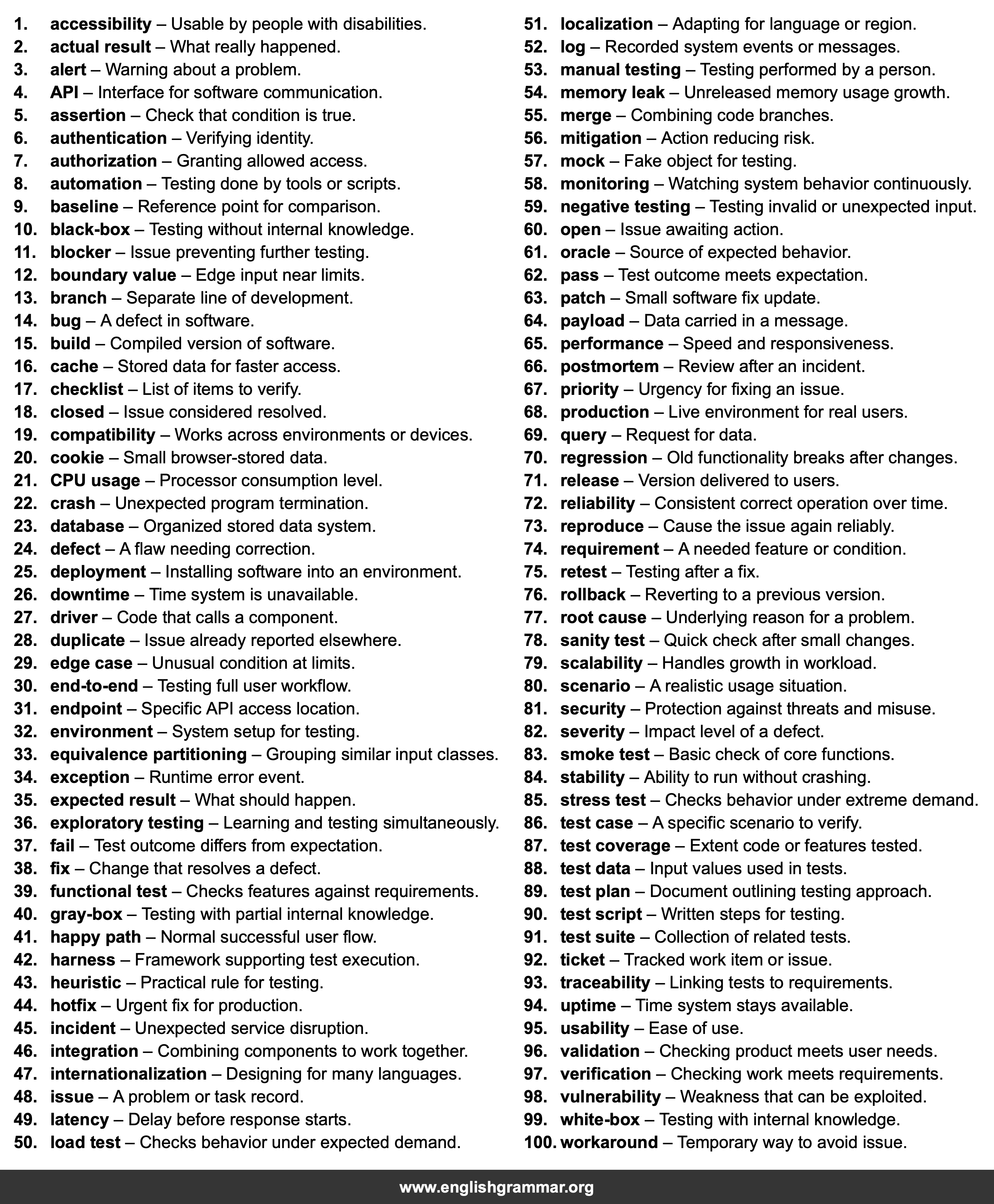
| No. | Item | Definition |
|---|---|---|
| 1. | accessibility | Usable by people with disabilities. |
| 2. | actual result | What really happened. |
| 3. | alert | Warning about a problem. |
| 4. | API | Interface for software communication. |
| 5. | assertion | Check that condition is true. |
| 6. | authentication | Verifying identity. |
| 7. | authorization | Granting allowed access. |
| 8. | automation | Testing done by tools or scripts. |
| 9. | baseline | Reference point for comparison. |
| 10. | black-box | Testing without internal knowledge. |
| 11. | blocker | Issue preventing further testing. |
| 12. | boundary value | Edge input near limits. |
| 13. | branch | Separate line of development. |
| 14. | bug | A defect in software. |
| 15. | build | Compiled version of software. |
| 16. | cache | Stored data for faster access. |
| 17. | checklist | List of items to verify. |
| 18. | closed | Issue considered resolved. |
| 19. | compatibility | Works across environments or devices. |
| 20. | cookie | Small browser-stored data. |
| 21. | CPU usage | Processor consumption level. |
| 22. | crash | Unexpected program termination. |
| 23. | database | Organized stored data system. |
| 24. | defect | A flaw needing correction. |
| 25. | deployment | Installing software into an environment. |
| 26. | downtime | Time system is unavailable. |
| 27. | driver | Code that calls a component. |
| 28. | duplicate | Issue already reported elsewhere. |
| 29. | edge case | Unusual condition at limits. |
| 30. | end-to-end | Testing full user workflow. |
| 31. | endpoint | Specific API access location. |
| 32. | environment | System setup for testing. |
| 33. | equivalence partitioning | Grouping similar input classes. |
| 34. | exception | Runtime error event. |
| 35. | expected result | What should happen. |
| 36. | exploratory testing | Learning and testing simultaneously. |
| 37. | fail | Test outcome differs from expectation. |
| 38. | fix | Change that resolves a defect. |
| 39. | functional test | Checks features against requirements. |
| 40. | gray-box | Testing with partial internal knowledge. |
| 41. | happy path | Normal successful user flow. |
| 42. | harness | Framework supporting test execution. |
| 43. | heuristic | Practical rule for testing. |
| 44. | hotfix | Urgent fix for production. |
| 45. | incident | Unexpected service disruption. |
| 46. | integration | Combining components to work together. |
| 47. | internationalization | Designing for many languages. |
| 48. | issue | A problem or task record. |
| 49. | latency | Delay before response starts. |
| 50. | load test | Checks behavior under expected demand. |
| 51. | localization | Adapting for language or region. |
| 52. | log | Recorded system events or messages. |
| 53. | manual testing | Testing performed by a person. |
| 54. | memory leak | Unreleased memory usage growth. |
| 55. | merge | Combining code branches. |
| 56. | mitigation | Action reducing risk. |
| 57. | mock | Fake object for testing. |
| 58. | monitoring | Watching system behavior continuously. |
| 59. | negative testing | Testing invalid or unexpected input. |
| 60. | open | Issue awaiting action. |
| 61. | oracle | Source of expected behavior. |
| 62. | pass | Test outcome meets expectation. |
| 63. | patch | Small software fix update. |
| 64. | payload | Data carried in a message. |
| 65. | performance | Speed and responsiveness. |
| 66. | postmortem | Review after an incident. |
| 67. | priority | Urgency for fixing an issue. |
| 68. | production | Live environment for real users. |
| 69. | query | Request for data. |
| 70. | regression | Old functionality breaks after changes. |
| 71. | release | Version delivered to users. |
| 72. | reliability | Consistent correct operation over time. |
| 73. | reproduce | Cause the issue again reliably. |
| 74. | requirement | A needed feature or condition. |
| 75. | retest | Testing after a fix. |
| 76. | rollback | Reverting to a previous version. |
| 77. | root cause | Underlying reason for a problem. |
| 78. | sanity test | Quick check after small changes. |
| 79. | scalability | Handles growth in workload. |
| 80. | scenario | A realistic usage situation. |
| 81. | security | Protection against threats and misuse. |
| 82. | severity | Impact level of a defect. |
| 83. | smoke test | Basic check of core functions. |
| 84. | stability | Ability to run without crashing. |
| 85. | stress test | Checks behavior under extreme demand. |
| 86. | test case | A specific scenario to verify. |
| 87. | test coverage | Extent code or features tested. |
| 88. | test data | Input values used in tests. |
| 89. | test plan | Document outlining testing approach. |
| 90. | test script | Written steps for testing. |
| 91. | test suite | Collection of related tests. |
| 92. | ticket | Tracked work item or issue. |
| 93. | traceability | Linking tests to requirements. |
| 94. | uptime | Time system stays available. |
| 95. | usability | Ease of use. |
| 96. | validation | Checking product meets user needs. |
| 97. | verification | Checking work meets requirements. |
| 98. | vulnerability | Weakness that can be exploited. |
| 99. | white-box | Testing with internal knowledge. |
| 100. | workaround | Temporary way to avoid issue. |