
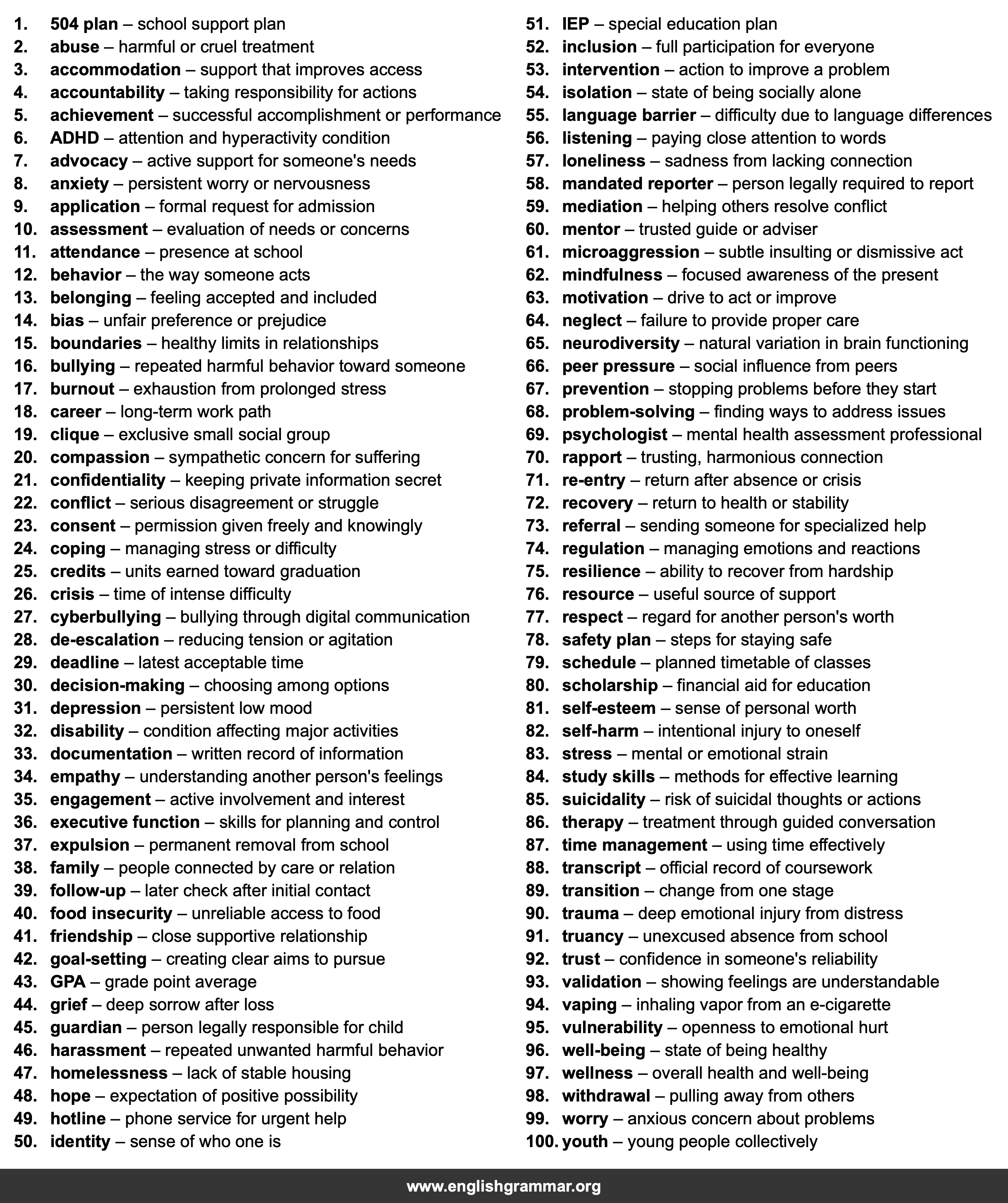
| No. | Item | Definition |
|---|---|---|
| 1. | 504 plan | school support plan |
| 2. | abuse | harmful or cruel treatment |
| 3. | accommodation | support that improves access |
| 4. | accountability | taking responsibility for actions |
| 5. | achievement | successful accomplishment or performance |
| 6. | ADHD | attention and hyperactivity condition |
| 7. | advocacy | active support for someone’s needs |
| 8. | anxiety | persistent worry or nervousness |
| 9. | application | formal request for admission |
| 10. | assessment | evaluation of needs or concerns |
| 11. | attendance | presence at school |
| 12. | behavior | the way someone acts |
| 13. | belonging | feeling accepted and included |
| 14. | bias | unfair preference or prejudice |
| 15. | boundaries | healthy limits in relationships |
| 16. | bullying | repeated harmful behavior toward someone |
| 17. | burnout | exhaustion from prolonged stress |
| 18. | career | long-term work path |
| 19. | clique | exclusive small social group |
| 20. | compassion | sympathetic concern for suffering |
| 21. | confidentiality | keeping private information secret |
| 22. | conflict | serious disagreement or struggle |
| 23. | consent | permission given freely and knowingly |
| 24. | coping | managing stress or difficulty |
| 25. | credits | units earned toward graduation |
| 26. | crisis | time of intense difficulty |
| 27. | cyberbullying | bullying through digital communication |
| 28. | de-escalation | reducing tension or agitation |
| 29. | deadline | latest acceptable time |
| 30. | decision-making | choosing among options |
| 31. | depression | persistent low mood |
| 32. | disability | condition affecting major activities |
| 33. | documentation | written record of information |
| 34. | empathy | understanding another person’s feelings |
| 35. | engagement | active involvement and interest |
| 36. | executive function | skills for planning and control |
| 37. | expulsion | permanent removal from school |
| 38. | family | people connected by care or relation |
| 39. | follow-up | later check after initial contact |
| 40. | food insecurity | unreliable access to food |
| 41. | friendship | close supportive relationship |
| 42. | goal-setting | creating clear aims to pursue |
| 43. | GPA | grade point average |
| 44. | grief | deep sorrow after loss |
| 45. | guardian | person legally responsible for child |
| 46. | harassment | repeated unwanted harmful behavior |
| 47. | homelessness | lack of stable housing |
| 48. | hope | expectation of positive possibility |
| 49. | hotline | phone service for urgent help |
| 50. | identity | sense of who one is |
| 51. | IEP | special education plan |
| 52. | inclusion | full participation for everyone |
| 53. | intervention | action to improve a problem |
| 54. | isolation | state of being socially alone |
| 55. | language barrier | difficulty due to language differences |
| 56. | listening | paying close attention to words |
| 57. | loneliness | sadness from lacking connection |
| 58. | mandated reporter | person legally required to report |
| 59. | mediation | helping others resolve conflict |
| 60. | mentor | trusted guide or adviser |
| 61. | microaggression | subtle insulting or dismissive act |
| 62. | mindfulness | focused awareness of the present |
| 63. | motivation | drive to act or improve |
| 64. | neglect | failure to provide proper care |
| 65. | neurodiversity | natural variation in brain functioning |
| 66. | peer pressure | social influence from peers |
| 67. | prevention | stopping problems before they start |
| 68. | problem-solving | finding ways to address issues |
| 69. | psychologist | mental health assessment professional |
| 70. | rapport | trusting, harmonious connection |
| 71. | re-entry | return after absence or crisis |
| 72. | recovery | return to health or stability |
| 73. | referral | sending someone for specialized help |
| 74. | regulation | managing emotions and reactions |
| 75. | resilience | ability to recover from hardship |
| 76. | resource | useful source of support |
| 77. | respect | regard for another person’s worth |
| 78. | safety plan | steps for staying safe |
| 79. | schedule | planned timetable of classes |
| 80. | scholarship | financial aid for education |
| 81. | self-esteem | sense of personal worth |
| 82. | self-harm | intentional injury to oneself |
| 83. | stress | mental or emotional strain |
| 84. | study skills | methods for effective learning |
| 85. | suicidality | risk of suicidal thoughts or actions |
| 86. | therapy | treatment through guided conversation |
| 87. | time management | using time effectively |
| 88. | transcript | official record of coursework |
| 89. | transition | change from one stage |
| 90. | trauma | deep emotional injury from distress |
| 91. | truancy | unexcused absence from school |
| 92. | trust | confidence in someone’s reliability |
| 93. | validation | showing feelings are understandable |
| 94. | vaping | inhaling vapor from an e-cigarette |
| 95. | vulnerability | openness to emotional hurt |
| 96. | well-being | state of being healthy |
| 97. | wellness | overall health and well-being |
| 98. | withdrawal | pulling away from others |
| 99. | worry | anxious concern about problems |
| 100. | youth | young people collectively |