
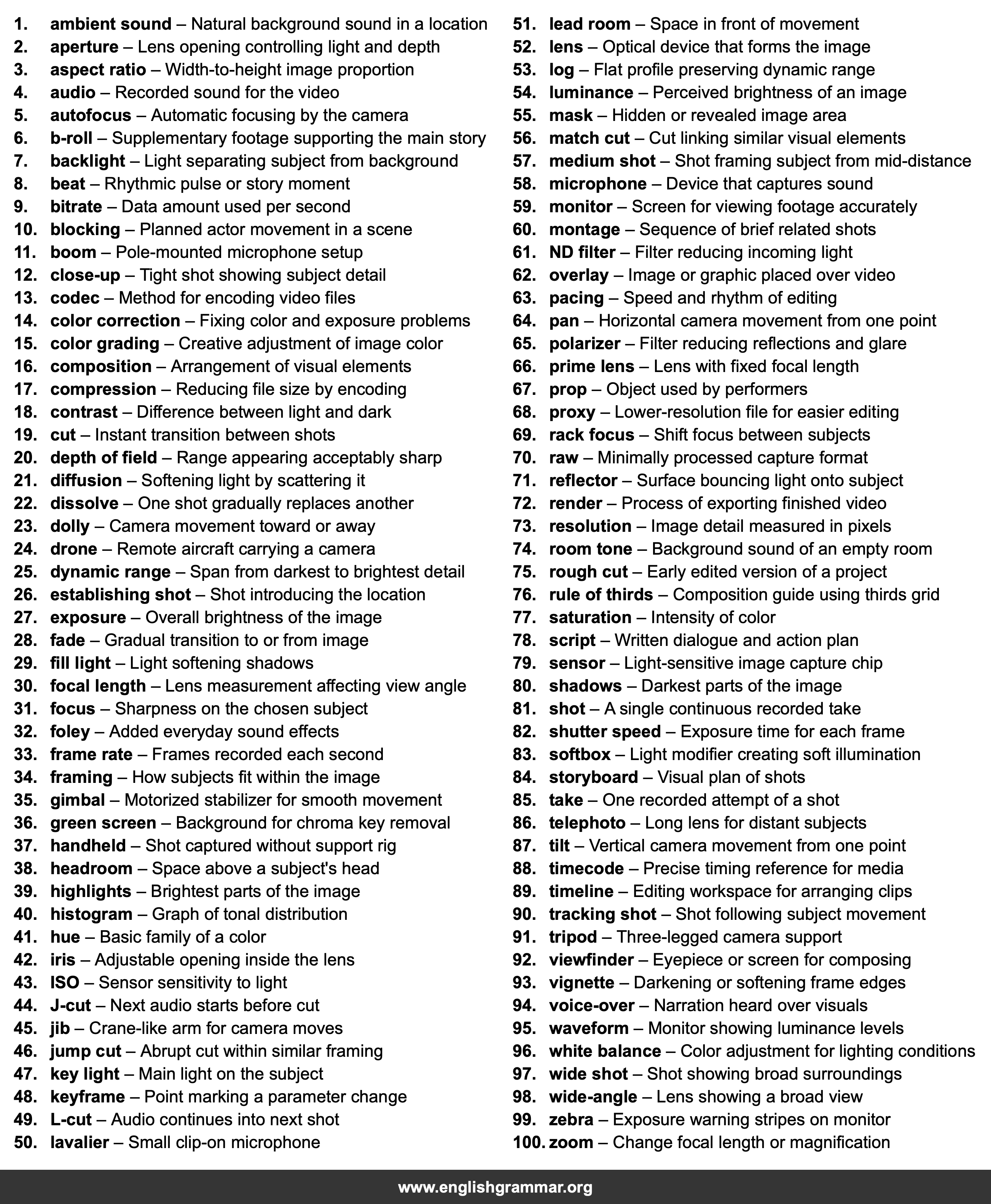
| No. | Item | Definition |
|---|---|---|
| 1. | ambient sound | Natural background sound in a location |
| 2. | aperture | Lens opening controlling light and depth |
| 3. | aspect ratio | Width-to-height image proportion |
| 4. | audio | Recorded sound for the video |
| 5. | autofocus | Automatic focusing by the camera |
| 6. | b-roll | Supplementary footage supporting the main story |
| 7. | backlight | Light separating subject from background |
| 8. | beat | Rhythmic pulse or story moment |
| 9. | bitrate | Data amount used per second |
| 10. | blocking | Planned actor movement in a scene |
| 11. | boom | Pole-mounted microphone setup |
| 12. | close-up | Tight shot showing subject detail |
| 13. | codec | Method for encoding video files |
| 14. | color correction | Fixing color and exposure problems |
| 15. | color grading | Creative adjustment of image color |
| 16. | composition | Arrangement of visual elements |
| 17. | compression | Reducing file size by encoding |
| 18. | contrast | Difference between light and dark |
| 19. | cut | Instant transition between shots |
| 20. | depth of field | Range appearing acceptably sharp |
| 21. | diffusion | Softening light by scattering it |
| 22. | dissolve | One shot gradually replaces another |
| 23. | dolly | Camera movement toward or away |
| 24. | drone | Remote aircraft carrying a camera |
| 25. | dynamic range | Span from darkest to brightest detail |
| 26. | establishing shot | Shot introducing the location |
| 27. | exposure | Overall brightness of the image |
| 28. | fade | Gradual transition to or from image |
| 29. | fill light | Light softening shadows |
| 30. | focal length | Lens measurement affecting view angle |
| 31. | focus | Sharpness on the chosen subject |
| 32. | foley | Added everyday sound effects |
| 33. | frame rate | Frames recorded each second |
| 34. | framing | How subjects fit within the image |
| 35. | gimbal | Motorized stabilizer for smooth movement |
| 36. | green screen | Background for chroma key removal |
| 37. | handheld | Shot captured without support rig |
| 38. | headroom | Space above a subject’s head |
| 39. | highlights | Brightest parts of the image |
| 40. | histogram | Graph of tonal distribution |
| 41. | hue | Basic family of a color |
| 42. | iris | Adjustable opening inside the lens |
| 43. | ISO | Sensor sensitivity to light |
| 44. | J-cut | Next audio starts before cut |
| 45. | jib | Crane-like arm for camera moves |
| 46. | jump cut | Abrupt cut within similar framing |
| 47. | key light | Main light on the subject |
| 48. | keyframe | Point marking a parameter change |
| 49. | L-cut | Audio continues into next shot |
| 50. | lavalier | Small clip-on microphone |
| 51. | lead room | Space in front of movement |
| 52. | lens | Optical device that forms the image |
| 53. | log | Flat profile preserving dynamic range |
| 54. | luminance | Perceived brightness of an image |
| 55. | mask | Hidden or revealed image area |
| 56. | match cut | Cut linking similar visual elements |
| 57. | medium shot | Shot framing subject from mid-distance |
| 58. | microphone | Device that captures sound |
| 59. | monitor | Screen for viewing footage accurately |
| 60. | montage | Sequence of brief related shots |
| 61. | ND filter | Filter reducing incoming light |
| 62. | overlay | Image or graphic placed over video |
| 63. | pacing | Speed and rhythm of editing |
| 64. | pan | Horizontal camera movement from one point |
| 65. | polarizer | Filter reducing reflections and glare |
| 66. | prime lens | Lens with fixed focal length |
| 67. | prop | Object used by performers |
| 68. | proxy | Lower-resolution file for easier editing |
| 69. | rack focus | Shift focus between subjects |
| 70. | raw | Minimally processed capture format |
| 71. | reflector | Surface bouncing light onto subject |
| 72. | render | Process of exporting finished video |
| 73. | resolution | Image detail measured in pixels |
| 74. | room tone | Background sound of an empty room |
| 75. | rough cut | Early edited version of a project |
| 76. | rule of thirds | Composition guide using thirds grid |
| 77. | saturation | Intensity of color |
| 78. | script | Written dialogue and action plan |
| 79. | sensor | Light-sensitive image capture chip |
| 80. | shadows | Darkest parts of the image |
| 81. | shot | A single continuous recorded take |
| 82. | shutter speed | Exposure time for each frame |
| 83. | softbox | Light modifier creating soft illumination |
| 84. | storyboard | Visual plan of shots |
| 85. | take | One recorded attempt of a shot |
| 86. | telephoto | Long lens for distant subjects |
| 87. | tilt | Vertical camera movement from one point |
| 88. | timecode | Precise timing reference for media |
| 89. | timeline | Editing workspace for arranging clips |
| 90. | tracking shot | Shot following subject movement |
| 91. | tripod | Three-legged camera support |
| 92. | viewfinder | Eyepiece or screen for composing |
| 93. | vignette | Darkening or softening frame edges |
| 94. | voice-over | Narration heard over visuals |
| 95. | waveform | Monitor showing luminance levels |
| 96. | white balance | Color adjustment for lighting conditions |
| 97. | wide shot | Shot showing broad surroundings |
| 98. | wide-angle | Lens showing a broad view |
| 99. | zebra | Exposure warning stripes on monitor |
| 100. | zoom | Change focal length or magnification |