
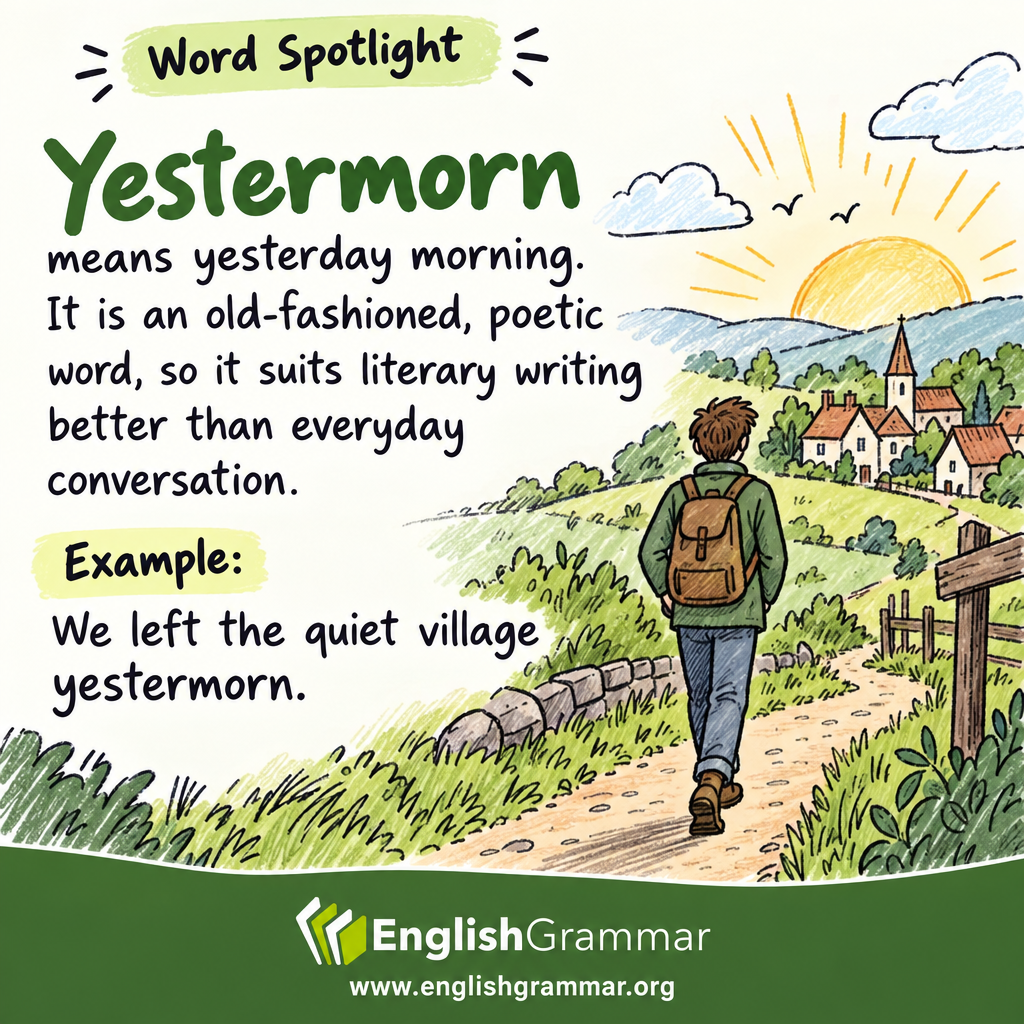
Yestermorn means yesterday morning: the morning of the day before today. It offers a compact way to express that idea. In modern English, however, it sounds old-fashioned and poetic rather than neutral.
You may encounter yestermorn in a poem, song, historical story, or other literary writing. A writer might choose it to create an atmosphere that feels timeless, traditional, or connected with an earlier age. In ordinary conversation, messages, and practical writing, yesterday morning is usually clearer and more natural.
Like yesterday morning, yestermorn can act as a time expression. It often appears without a preposition when it tells us when something happened: “The travelers crossed the river yestermorn.”
- Literary: The travelers crossed the river yestermorn.
- Everyday: The travelers crossed the river yesterday morning.
These sentences have the same basic meaning, but they create different impressions. The first sounds as though it belongs in a tale or poem. The second would fit naturally into everyday speech or a straightforward report.
Because many readers will recognize the parts of the word but may not use it themselves, choose yestermorn deliberately. It can add color to writing when the surrounding language has a similarly poetic style. In a casual exchange, it may sound playful or unusually formal. If your main goal is simple communication, use yesterday morning.