• Skip to primary navigation
  • Skip to main content
  • Skip to primary sidebar
Home of English Grammar
  • Home
  • Exercises
  • Matches
  • Posts
  • Rules
  • Social Media Archive
  • Tools
    • Grammar Checker
    • Very Replacer
    • Word Counter
  • Vocabulary
  • Writing Guides
  • Upgrade to Pro

EnglishGrammar Team

100 Words to Use Instead of “Lift”

April 9, 2026

100 Words to Use Instead of

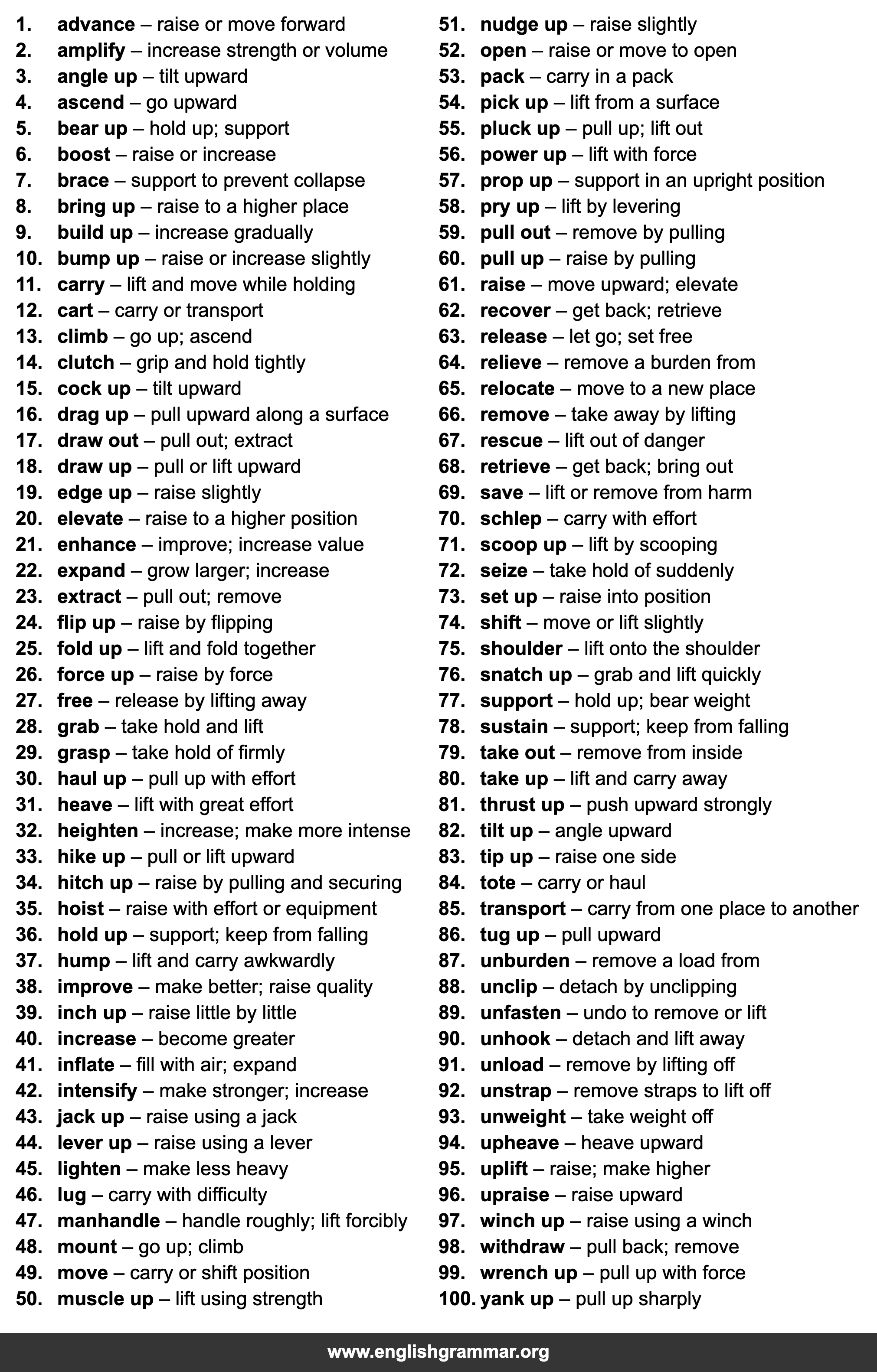
No. Item Definition
1. advance raise or move forward
2. amplify increase strength or volume
3. angle up tilt upward
4. ascend go upward
5. bear up hold up; support
6. boost raise or increase
7. brace support to prevent collapse
8. bring up raise to a higher place
9. build up increase gradually
10. bump up raise or increase slightly
11. carry lift and move while holding
12. cart carry or transport
13. climb go up; ascend
14. clutch grip and hold tightly
15. cock up tilt upward
16. drag up pull upward along a surface
17. draw out pull out; extract
18. draw up pull or lift upward
19. edge up raise slightly
20. elevate raise to a higher position
21. enhance improve; increase value
22. expand grow larger; increase
23. extract pull out; remove
24. flip up raise by flipping
25. fold up lift and fold together
26. force up raise by force
27. free release by lifting away
28. grab take hold and lift
29. grasp take hold of firmly
30. haul up pull up with effort
31. heave lift with great effort
32. heighten increase; make more intense
33. hike up pull or lift upward
34. hitch up raise by pulling and securing
35. hoist raise with effort or equipment
36. hold up support; keep from falling
37. hump lift and carry awkwardly
38. improve make better; raise quality
39. inch up raise little by little
40. increase become greater
41. inflate fill with air; expand
42. intensify make stronger; increase
43. jack up raise using a jack
44. lever up raise using a lever
45. lighten make less heavy
46. lug carry with difficulty
47. manhandle handle roughly; lift forcibly
48. mount go up; climb
49. move carry or shift position
50. muscle up lift using strength
51. nudge up raise slightly
52. open raise or move to open
53. pack carry in a pack
54. pick up lift from a surface
55. pluck up pull up; lift out
56. power up lift with force
57. prop up support in an upright position
58. pry up lift by levering
59. pull out remove by pulling
60. pull up raise by pulling
61. raise move upward; elevate
62. recover get back; retrieve
63. release let go; set free
64. relieve remove a burden from
65. relocate move to a new place
66. remove take away by lifting
67. rescue lift out of danger
68. retrieve get back; bring out
69. save lift or remove from harm
70. schlep carry with effort
71. scoop up lift by scooping
72. seize take hold of suddenly
73. set up raise into position
74. shift move or lift slightly
75. shoulder lift onto the shoulder
76. snatch up grab and lift quickly
77. support hold up; bear weight
78. sustain support; keep from falling
79. take out remove from inside
80. take up lift and carry away
81. thrust up push upward strongly
82. tilt up angle upward
83. tip up raise one side
84. tote carry or haul
85. transport carry from one place to another
86. tug up pull upward
87. unburden remove a load from
88. unclip detach by unclipping
89. unfasten undo to remove or lift
90. unhook detach and lift away
91. unload remove by lifting off
92. unstrap remove straps to lift off
93. unweight take weight off
94. upheave heave upward
95. uplift raise; make higher
96. upraise raise upward
97. winch up raise using a winch
98. withdraw pull back; remove
99. wrench up pull up with force
100. yank up pull up sharply

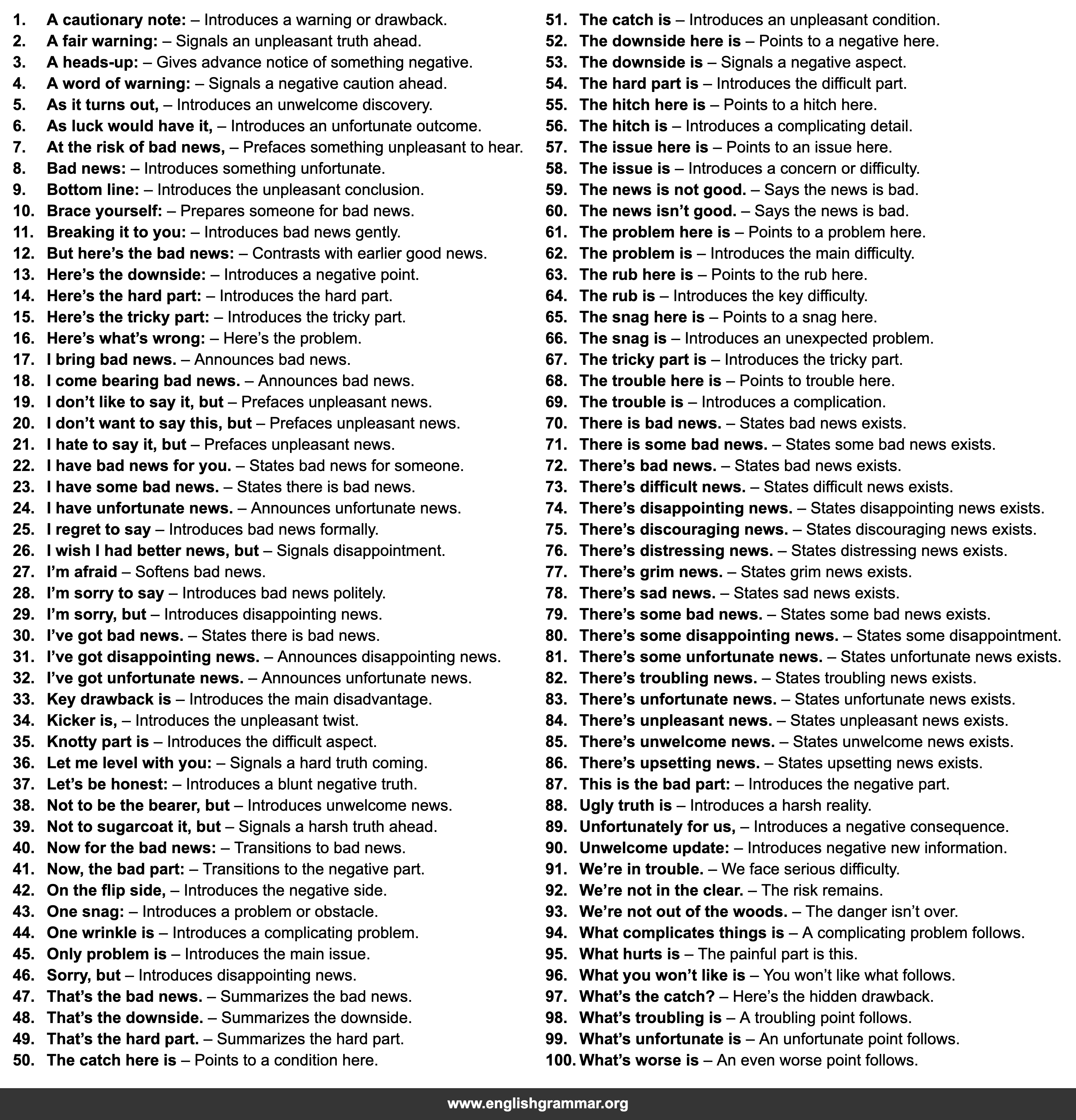
100 Ways to Say “The bad news is”

April 9, 2026

100 Ways to Say

No. Item Definition
1. A cautionary note: Introduces a warning or drawback.
2. A fair warning: Signals an unpleasant truth ahead.
3. A heads-up: Gives advance notice of something negative.
4. A word of warning: Signals a negative caution ahead.
5. As it turns out, Introduces an unwelcome discovery.
6. As luck would have it, Introduces an unfortunate outcome.
7. At the risk of bad news, Prefaces something unpleasant to hear.
8. Bad news: Introduces something unfortunate.
9. Bottom line: Introduces the unpleasant conclusion.
10. Brace yourself: Prepares someone for bad news.
11. Breaking it to you: Introduces bad news gently.
12. But here’s the bad news: Contrasts with earlier good news.
13. Here’s the downside: Introduces a negative point.
14. Here’s the hard part: Introduces the hard part.
15. Here’s the tricky part: Introduces the tricky part.
16. Here’s what’s wrong: Here’s the problem.
17. I bring bad news. Announces bad news.
18. I come bearing bad news. Announces bad news.
19. I don’t like to say it, but Prefaces unpleasant news.
20. I don’t want to say this, but Prefaces unpleasant news.
21. I hate to say it, but Prefaces unpleasant news.
22. I have bad news for you. States bad news for someone.
23. I have some bad news. States there is bad news.
24. I have unfortunate news. Announces unfortunate news.
25. I regret to say Introduces bad news formally.
26. I wish I had better news, but Signals disappointment.
27. I’m afraid Softens bad news.
28. I’m sorry to say Introduces bad news politely.
29. I’m sorry, but Introduces disappointing news.
30. I’ve got bad news. States there is bad news.
31. I’ve got disappointing news. Announces disappointing news.
32. I’ve got unfortunate news. Announces unfortunate news.
33. Key drawback is Introduces the main disadvantage.
34. Kicker is, Introduces the unpleasant twist.
35. Knotty part is Introduces the difficult aspect.
36. Let me level with you: Signals a hard truth coming.
37. Let’s be honest: Introduces a blunt negative truth.
38. Not to be the bearer, but Introduces unwelcome news.
39. Not to sugarcoat it, but Signals a harsh truth ahead.
40. Now for the bad news: Transitions to bad news.
41. Now, the bad part: Transitions to the negative part.
42. On the flip side, Introduces the negative side.
43. One snag: Introduces a problem or obstacle.
44. One wrinkle is Introduces a complicating problem.
45. Only problem is Introduces the main issue.
46. Sorry, but Introduces disappointing news.
47. That’s the bad news. Summarizes the bad news.
48. That’s the downside. Summarizes the downside.
49. That’s the hard part. Summarizes the hard part.
50. The catch here is Points to a condition here.
51. The catch is Introduces an unpleasant condition.
52. The downside here is Points to a negative here.
53. The downside is Signals a negative aspect.
54. The hard part is Introduces the difficult part.
55. The hitch here is Points to a hitch here.
56. The hitch is Introduces a complicating detail.
57. The issue here is Points to an issue here.
58. The issue is Introduces a concern or difficulty.
59. The news is not good. Says the news is bad.
60. The news isn’t good. Says the news is bad.
61. The problem here is Points to a problem here.
62. The problem is Introduces the main difficulty.
63. The rub here is Points to the rub here.
64. The rub is Introduces the key difficulty.
65. The snag here is Points to a snag here.
66. The snag is Introduces an unexpected problem.
67. The tricky part is Introduces the tricky part.
68. The trouble here is Points to trouble here.
69. The trouble is Introduces a complication.
70. There is bad news. States bad news exists.
71. There is some bad news. States some bad news exists.
72. There’s bad news. States bad news exists.
73. There’s difficult news. States difficult news exists.
74. There’s disappointing news. States disappointing news exists.
75. There’s discouraging news. States discouraging news exists.
76. There’s distressing news. States distressing news exists.
77. There’s grim news. States grim news exists.
78. There’s sad news. States sad news exists.
79. There’s some bad news. States some bad news exists.
80. There’s some disappointing news. States some disappointment.
81. There’s some unfortunate news. States unfortunate news exists.
82. There’s troubling news. States troubling news exists.
83. There’s unfortunate news. States unfortunate news exists.
84. There’s unpleasant news. States unpleasant news exists.
85. There’s unwelcome news. States unwelcome news exists.
86. There’s upsetting news. States upsetting news exists.
87. This is the bad part: Introduces the negative part.
88. Ugly truth is Introduces a harsh reality.
89. Unfortunately for us, Introduces a negative consequence.
90. Unwelcome update: Introduces negative new information.
91. We’re in trouble. We face serious difficulty.
92. We’re not in the clear. The risk remains.
93. We’re not out of the woods. The danger isn’t over.
94. What complicates things is A complicating problem follows.
95. What hurts is The painful part is this.
96. What you won’t like is You won’t like what follows.
97. What’s the catch? Here’s the hidden drawback.
98. What’s troubling is A troubling point follows.
99. What’s unfortunate is An unfortunate point follows.
100. What’s worse is An even worse point follows.

Ain’t is older than many people think

April 9, 2026 pdf

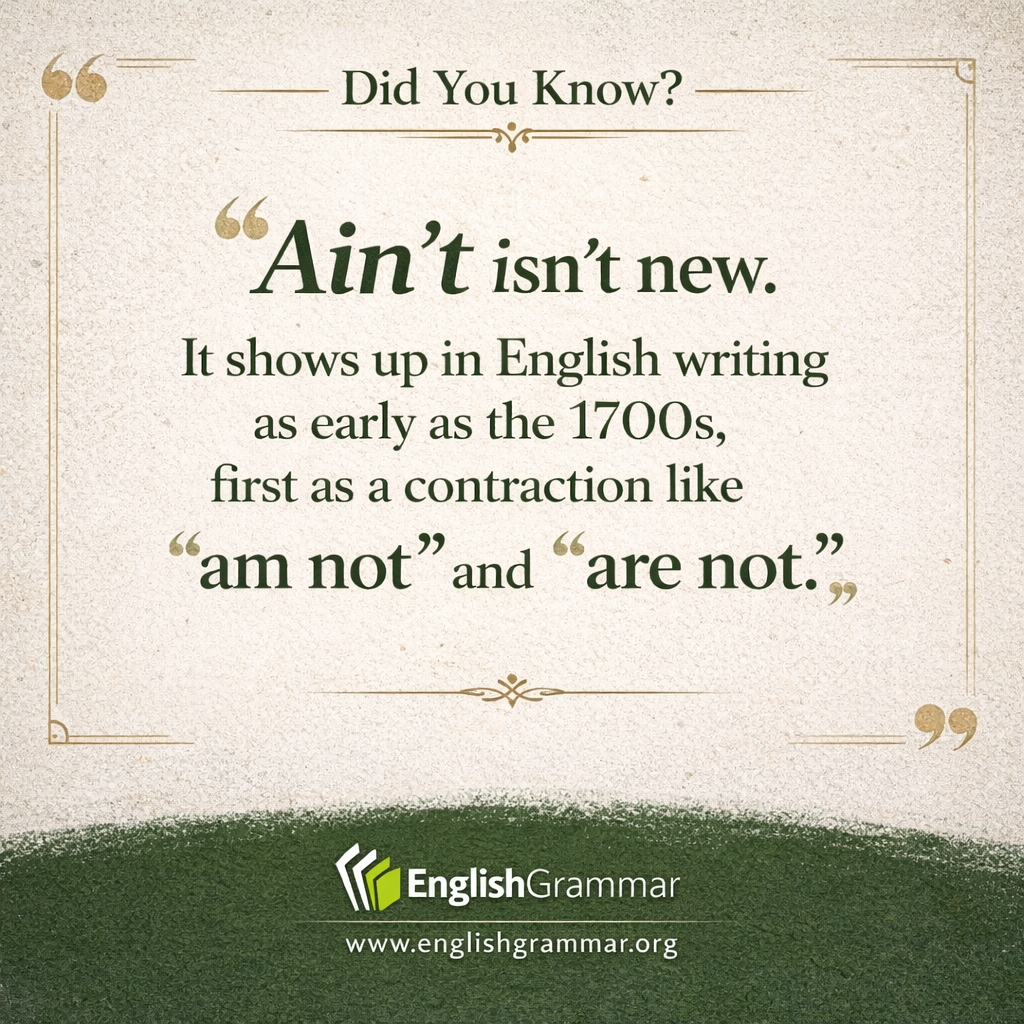
"Ain't" is older than many people think.

Ain’t feels modern to many readers, but it has a long paper trail. In English texts, it appears by the 1700s, and it likely grew from everyday speech where people regularly shortened common verb phrases.

Early on, ain’t could stand in for several negatives, especially forms related to be and have. It is often explained as developing from pronunciations and spellings connected to phrases like am not and are not, and it later spread to other patterns in speech.

What changed was not the word’s age, but its social meaning. Over time, style guides and school norms treated ain’t as nonstandard, so it became a marker of informal, regional, or working class speech in many settings. That is why it is common in dialogue and lyrics, but avoided in formal writing.

Examples and contrasts:

  • Informal: I ain’t ready yet.
  • More formal: I’m not ready yet.
  • Informal: They ain’t coming.
  • More formal: They aren’t coming.

If you want a safe rule, use ain’t intentionally for voice, character, or casual tone, and choose isn’t, aren’t, or haven’t in formal contexts.

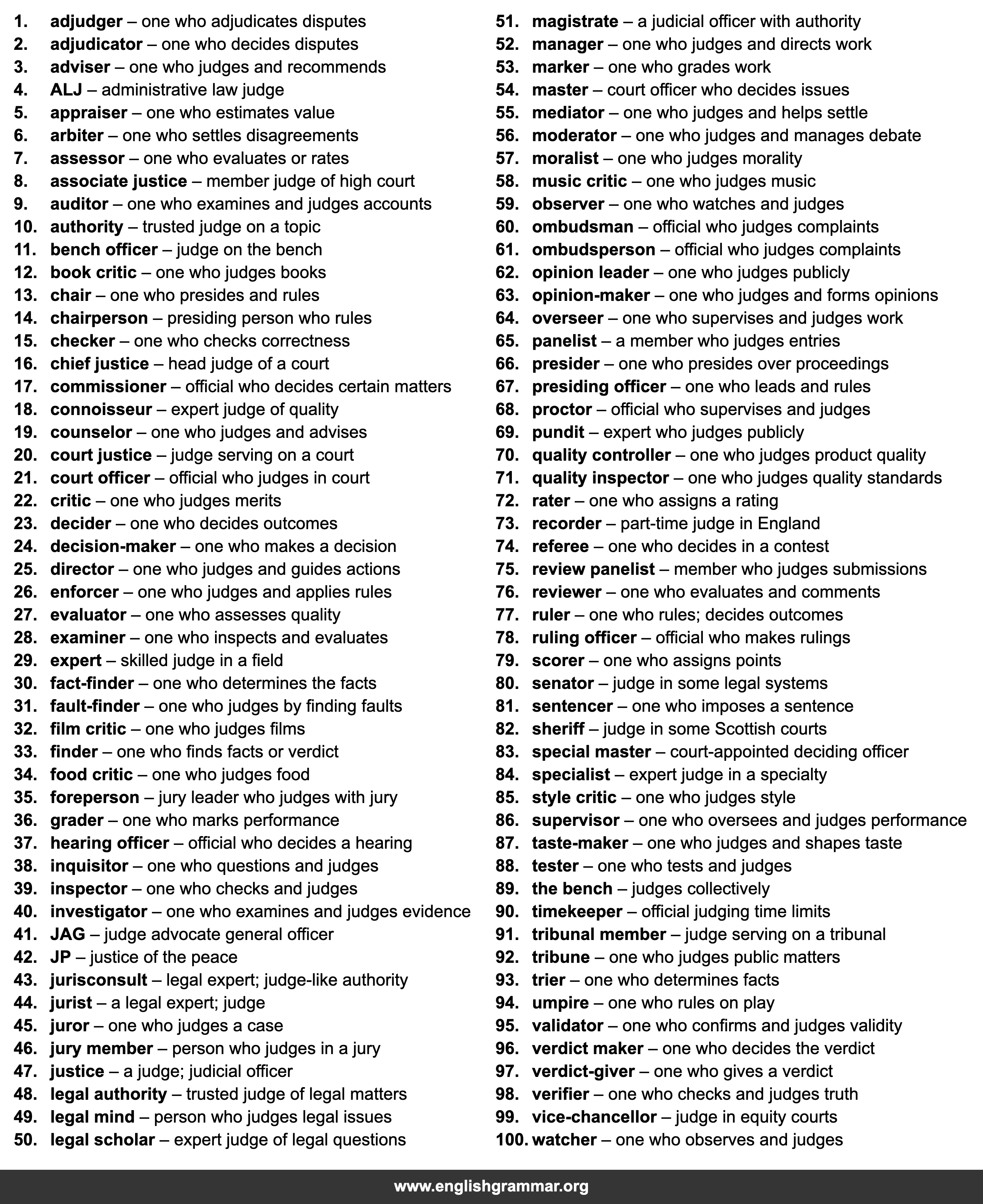
100 Best Synonyms for “Judge”

April 9, 2026

100 Best Synonyms for

No. Item Definition
1. adjudger one who adjudicates disputes
2. adjudicator one who decides disputes
3. adviser one who judges and recommends
4. ALJ administrative law judge
5. appraiser one who estimates value
6. arbiter one who settles disagreements
7. assessor one who evaluates or rates
8. associate justice member judge of high court
9. auditor one who examines and judges accounts
10. authority trusted judge on a topic
11. bench officer judge on the bench
12. book critic one who judges books
13. chair one who presides and rules
14. chairperson presiding person who rules
15. checker one who checks correctness
16. chief justice head judge of a court
17. commissioner official who decides certain matters
18. connoisseur expert judge of quality
19. counselor one who judges and advises
20. court justice judge serving on a court
21. court officer official who judges in court
22. critic one who judges merits
23. decider one who decides outcomes
24. decision-maker one who makes a decision
25. director one who judges and guides actions
26. enforcer one who judges and applies rules
27. evaluator one who assesses quality
28. examiner one who inspects and evaluates
29. expert skilled judge in a field
30. fact-finder one who determines the facts
31. fault-finder one who judges by finding faults
32. film critic one who judges films
33. finder one who finds facts or verdict
34. food critic one who judges food
35. foreperson jury leader who judges with jury
36. grader one who marks performance
37. hearing officer official who decides a hearing
38. inquisitor one who questions and judges
39. inspector one who checks and judges
40. investigator one who examines and judges evidence
41. JAG judge advocate general officer
42. JP justice of the peace
43. jurisconsult legal expert; judge-like authority
44. jurist a legal expert; judge
45. juror one who judges a case
46. jury member person who judges in a jury
47. justice a judge; judicial officer
48. legal authority trusted judge of legal matters
49. legal mind person who judges legal issues
50. legal scholar expert judge of legal questions
51. magistrate a judicial officer with authority
52. manager one who judges and directs work
53. marker one who grades work
54. master court officer who decides issues
55. mediator one who judges and helps settle
56. moderator one who judges and manages debate
57. moralist one who judges morality
58. music critic one who judges music
59. observer one who watches and judges
60. ombudsman official who judges complaints
61. ombudsperson official who judges complaints
62. opinion leader one who judges publicly
63. opinion-maker one who judges and forms opinions
64. overseer one who supervises and judges work
65. panelist a member who judges entries
66. presider one who presides over proceedings
67. presiding officer one who leads and rules
68. proctor official who supervises and judges
69. pundit expert who judges publicly
70. quality controller one who judges product quality
71. quality inspector one who judges quality standards
72. rater one who assigns a rating
73. recorder part-time judge in England
74. referee one who decides in a contest
75. review panelist member who judges submissions
76. reviewer one who evaluates and comments
77. ruler one who rules; decides outcomes
78. ruling officer official who makes rulings
79. scorer one who assigns points
80. senator judge in some legal systems
81. sentencer one who imposes a sentence
82. sheriff judge in some Scottish courts
83. special master court-appointed deciding officer
84. specialist expert judge in a specialty
85. style critic one who judges style
86. supervisor one who oversees and judges performance
87. taste-maker one who judges and shapes taste
88. tester one who tests and judges
89. the bench judges collectively
90. timekeeper official judging time limits
91. tribunal member judge serving on a tribunal
92. tribune one who judges public matters
93. trier one who determines facts
94. umpire one who rules on play
95. validator one who confirms and judges validity
96. verdict maker one who decides the verdict
97. verdict-giver one who gives a verdict
98. verifier one who checks and judges truth
99. vice-chancellor judge in equity courts
100. watcher one who observes and judges

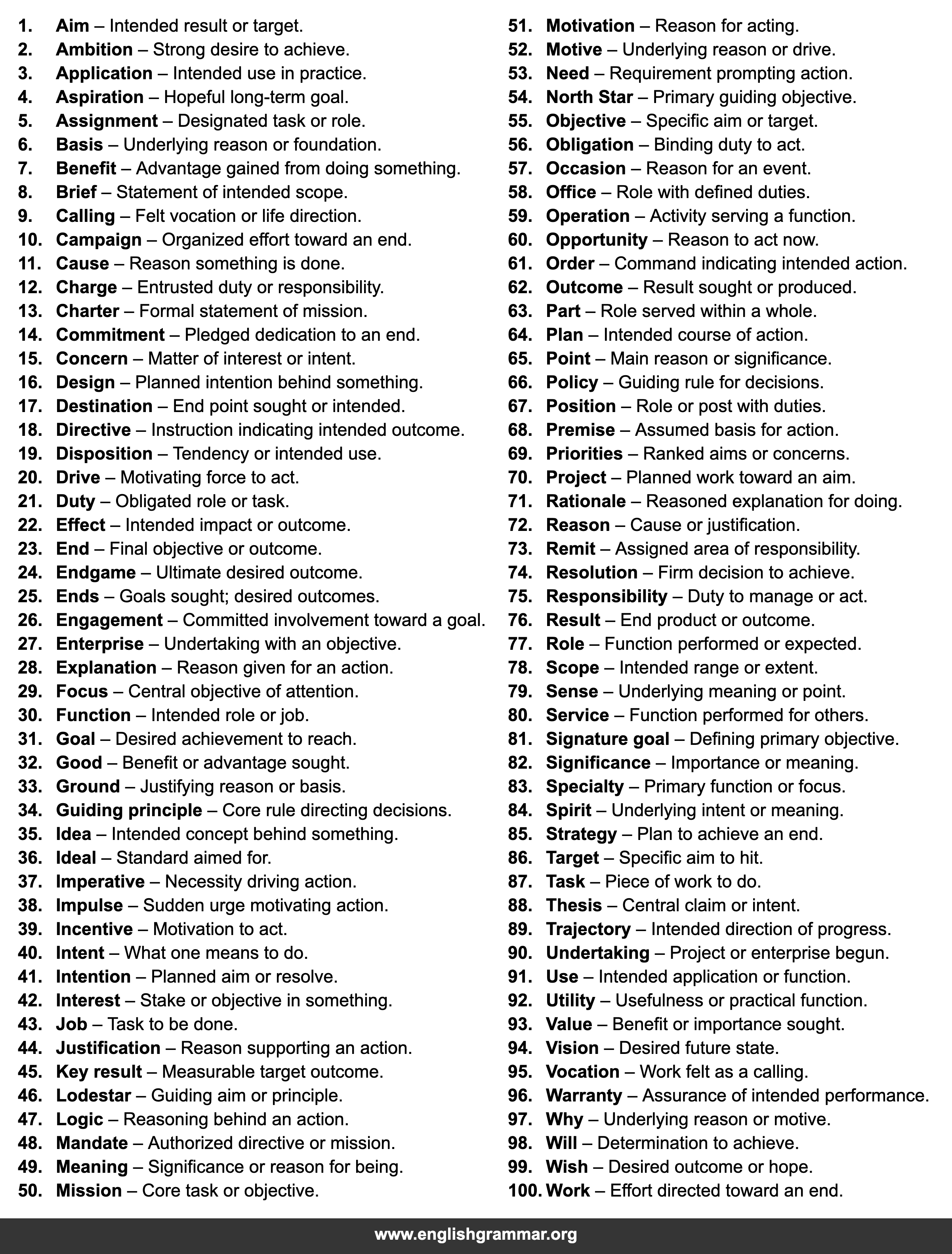
100 Words to Use Instead of “Purpose”

April 9, 2026

100 Words to Use Instead of

No. Term Definition
1. Aim Intended result or target.
2. Ambition Strong desire to achieve.
3. Application Intended use in practice.
4. Aspiration Hopeful long-term goal.
5. Assignment Designated task or role.
6. Basis Underlying reason or foundation.
7. Benefit Advantage gained from doing something.
8. Brief Statement of intended scope.
9. Calling Felt vocation or life direction.
10. Campaign Organized effort toward an end.
11. Cause Reason something is done.
12. Charge Entrusted duty or responsibility.
13. Charter Formal statement of mission.
14. Commitment Pledged dedication to an end.
15. Concern Matter of interest or intent.
16. Design Planned intention behind something.
17. Destination End point sought or intended.
18. Directive Instruction indicating intended outcome.
19. Disposition Tendency or intended use.
20. Drive Motivating force to act.
21. Duty Obligated role or task.
22. Effect Intended impact or outcome.
23. End Final objective or outcome.
24. Endgame Ultimate desired outcome.
25. Ends Goals sought; desired outcomes.
26. Engagement Committed involvement toward a goal.
27. Enterprise Undertaking with an objective.
28. Explanation Reason given for an action.
29. Focus Central objective of attention.
30. Function Intended role or job.
31. Goal Desired achievement to reach.
32. Good Benefit or advantage sought.
33. Ground Justifying reason or basis.
34. Guiding principle Core rule directing decisions.
35. Idea Intended concept behind something.
36. Ideal Standard aimed for.
37. Imperative Necessity driving action.
38. Impulse Sudden urge motivating action.
39. Incentive Motivation to act.
40. Intent What one means to do.
41. Intention Planned aim or resolve.
42. Interest Stake or objective in something.
43. Job Task to be done.
44. Justification Reason supporting an action.
45. Key result Measurable target outcome.
46. Lodestar Guiding aim or principle.
47. Logic Reasoning behind an action.
48. Mandate Authorized directive or mission.
49. Meaning Significance or reason for being.
50. Mission Core task or objective.
51. Motivation Reason for acting.
52. Motive Underlying reason or drive.
53. Need Requirement prompting action.
54. North Star Primary guiding objective.
55. Objective Specific aim or target.
56. Obligation Binding duty to act.
57. Occasion Reason for an event.
58. Office Role with defined duties.
59. Operation Activity serving a function.
60. Opportunity Reason to act now.
61. Order Command indicating intended action.
62. Outcome Result sought or produced.
63. Part Role served within a whole.
64. Plan Intended course of action.
65. Point Main reason or significance.
66. Policy Guiding rule for decisions.
67. Position Role or post with duties.
68. Premise Assumed basis for action.
69. Priorities Ranked aims or concerns.
70. Project Planned work toward an aim.
71. Rationale Reasoned explanation for doing.
72. Reason Cause or justification.
73. Remit Assigned area of responsibility.
74. Resolution Firm decision to achieve.
75. Responsibility Duty to manage or act.
76. Result End product or outcome.
77. Role Function performed or expected.
78. Scope Intended range or extent.
79. Sense Underlying meaning or point.
80. Service Function performed for others.
81. Signature goal Defining primary objective.
82. Significance Importance or meaning.
83. Specialty Primary function or focus.
84. Spirit Underlying intent or meaning.
85. Strategy Plan to achieve an end.
86. Target Specific aim to hit.
87. Task Piece of work to do.
88. Thesis Central claim or intent.
89. Trajectory Intended direction of progress.
90. Undertaking Project or enterprise begun.
91. Use Intended application or function.
92. Utility Usefulness or practical function.
93. Value Benefit or importance sought.
94. Vision Desired future state.
95. Vocation Work felt as a calling.
96. Warranty Assurance of intended performance.
97. Why Underlying reason or motive.
98. Will Determination to achieve.
99. Wish Desired outcome or hope.
100. Work Effort directed toward an end.
  • « Go to Previous Page
  • Page 1
  • Interim pages omitted …
  • Page 1038
  • Page 1039
  • Page 1040
  • Page 1041
  • Page 1042
  • Interim pages omitted …
  • Page 2325
  • Go to Next Page »

Primary Sidebar

2,485,429 
761,532 
Improve Your English
  • Download 2026 Grammar Guide (PDF)
  • Free Weekly Exercises & Vocabulary
  • Join over 3 Million English Learners
We respect your privacy. Unsubscribe anytime.
Grammar Checker - Try Now

Latest Posts

  • 100 Best Synonyms for “Stranded” October 12, 2026
  • The surprisingly old roots of “newfangled” October 12, 2026
  • 100 Best Synonyms for “Answer” October 12, 2026
  • 100 Best Synonyms for “Prove” October 12, 2026
  • 100 Best Synonyms for “Repressed” October 12, 2026
  • 100 Best Synonyms for “Ambiguity” October 12, 2026
  • 100 Best Synonyms for “Paradigmatic” October 12, 2026
Home of English Grammar

Free English grammar exercises, rules and vocabulary lists, with new exercises every week. Join the leading English grammar site with over 3 million followers.

Upgrade to Pro

Learn

  • Exercises
  • Matches
  • Grammar rules
  • Vocabulary lists
  • Writing guides
  • Online tools

More

  • Top social media posts
  • Various posts
  • Free grammar guide (PDF)
  • Contact

Pro

  • What is Pro?
  • Pro account
  • Pro exercises

Copyright © 2026 EnglishGrammar.org

  • Disclaimer
  • Privacy policy
  • Refund policy
  • Terms
  • Sitemap
Improve Your English
  • Download 2026 Grammar Guide (PDF)
  • Free Weekly Exercises & Vocabulary
  • Join over 3 Million English Learners
We respect your privacy. Unsubscribe anytime.