| No. | Term | Definition |
|---|---|---|
| 1. | Affirmation | Positive statement reinforcing belief. |
| 2. | Altruism | Selfless concern for others’ well-being. |
| 3. | Ambition | Strong desire to achieve goals. |
| 4. | Anticipate | Expect or predict future events. |
| 5. | Appreciate | Recognize the value of something. |
| 6. | Aspire | Aim for a higher goal. |
| 7. | Balance | Even distribution for stability. |
| 8. | Belief | Confidence in the truth. |
| 9. | Bliss | Perfect happiness and joy. |
| 10. | Boldness | Willingness to take risks. |
| 11. | Bravery | Courage in facing challenges. |
| 12. | Calmness | Peaceful and composed state. |
| 13. | Captivate | Attract and hold attention. |
| 14. | Charisma | Compelling attractiveness or charm. |
| 15. | Clarity | Clearness in thought or expression. |
| 16. | Commitment | Dedication to a cause. |
| 17. | Compassion | Sympathy and concern for others. |
| 18. | Confidence | Self-assurance in abilities. |
| 19. | Connection | Bond with others. |
| 20. | Consciousness | Awareness of thoughts and surroundings. |
| 21. | Consistency | Steady and uniform behavior. |
| 22. | Contentment | Satisfaction with what one has. |
| 23. | Courage | Ability to confront fear. |
| 24. | Creativity | Ability to generate original ideas. |
| 25. | Curiosity | Desire to learn or know more. |
| 26. | Dedication | Devotion to a task or purpose. |
| 27. | Delight | Great pleasure or joy. |
| 28. | Determination | Firmness in achieving goals. |
| 29. | Diligence | Careful and persistent work. |
| 30. | Discipline | Self-control in behavior. |
| 31. | Discovery | Finding something new. |
| 32. | Elation | Great happiness and exhilaration. |
| 33. | Empathy | Understanding others’ emotions. |
| 34. | Empower | Give power or authority. |
| 35. | Encouragement | Support to boost confidence. |
| 36. | Endurance | Ability to withstand hardship. |
| 37. | Enthusiasm | Intense interest or excitement. |
| 38. | Equilibrium | State of balance. |
| 39. | Excellence | High quality or superiority. |
| 40. | Expectation | Belief about future outcomes. |
| 41. | Faith | Complete trust or confidence. |
| 42. | Flexibility | Adaptability to change. |
| 43. | Focus | Concentrated attention. |
| 44. | Fortitude | Strength in adversity. |
| 45. | Fulfillment | Satisfaction from achievement. |
| 46. | Generosity | Willingness to give. |
| 47. | Gratitude | Thankfulness for benefits received. |
| 48. | Harmony | Agreement and peace. |
| 49. | Hope | Expectation of positive outcomes. |
| 50. | Humility | Modest view of one’s importance. |
| 51. | Inspiration | Stimulus to creative action. |
| 52. | Integrity | Adherence to moral principles. |
| 53. | Intuition | Understanding without conscious reasoning. |
| 54. | Joy | Intense happiness. |
| 55. | Kindness | Being friendly and generous. |
| 56. | Knowledge | Awareness and understanding. |
| 57. | Legacy | Lasting impact or inheritance. |
| 58. | Liberty | Freedom from restrictions. |
| 59. | Love | Deep affection and care. |
| 60. | Mindfulness | Present-focused awareness. |
| 61. | Motivation | Reason for acting. |
| 62. | Optimism | Hopefulness about the future. |
| 63. | Passion | Intense enthusiasm. |
| 64. | Patience | Ability to wait calmly. |
| 65. | Perseverance | Persistent effort. |
| 66. | Perspective | Viewpoint or outlook. |
| 67. | Positivity | Focus on positive aspects. |
| 68. | Potential | Possibility for growth. |
| 69. | Power | Ability to influence. |
| 70. | Presence | Being fully attentive. |
| 71. | Pragmatic | Practical approach. |
| 72. | Progress | Forward movement. |
| 73. | Prosperity | State of thriving. |
| 74. | Purpose | Meaningful goal. |
| 75. | Radiate | Emit positive energy. |
| 76. | Reliability | Dependability. |
| 77. | Resilience | Ability to recover. |
| 78. | Resourcefulness | Ability to find solutions. |
| 79. | Respect | Regard for others. |
| 80. | Responsibility | Duty to act. |
| 81. | Serenity | Calm and peacefulness. |
| 82. | Sincerity | Genuine honesty. |
| 83. | Sociability | Enjoyment of social interactions. |
| 84. | Solidarity | Unity with others. |
| 85. | Spirituality | Connection to something greater. |
| 86. | Strength | Physical or mental power. |
| 87. | Success | Achievement of goals. |
| 88. | Support | Assistance and encouragement. |
| 89. | Sympathy | Sharing others’ feelings. |
| 90. | Tenacity | Persistent determination. |
| 91. | Tranquility | Peaceful calmness. |
| 92. | Trust | Reliance on others. |
| 93. | Understanding | Comprehension of others. |
| 94. | Uplift | Raise spirits or morale. |
| 95. | Valor | Great courage. |
| 96. | Vibrancy | Full of energy. |
| 97. | Vision | Clear idea of future. |
| 98. | Vitality | Lively energy. |
| 99. | Wellness | State of good health. |
| 100. | Wisdom | Deep understanding and judgment. |
Vocabulary
100 Words Every Native English Speaker Should Know
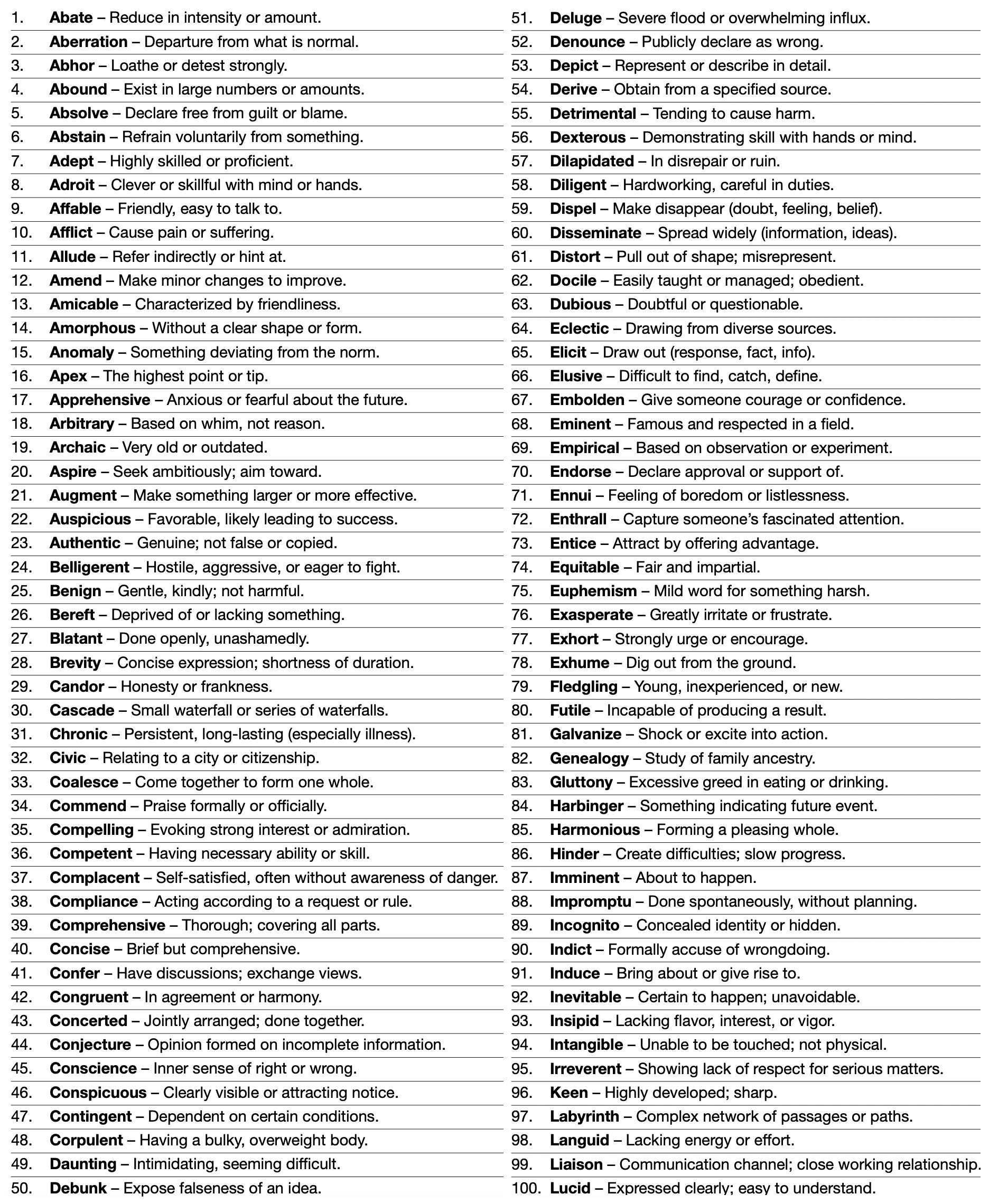
| No. | Term | Definition |
|---|---|---|
| 1. | Abate | To reduce in intensity or amount. |
| 2. | Aberration | Departure from what is normal. |
| 3. | Abhor | To loathe or detest strongly. |
| 4. | Abound | To exist in large numbers or amounts. |
| 5. | Absolve | To declare free from guilt or blame. |
| 6. | Abstain | To refrain voluntarily from something. |
| 7. | Adept | Highly skilled or proficient. |
| 8. | Adroit | Clever or skillful with mind or hands. |
| 9. | Affable | Friendly, easy to talk to. |
| 10. | Afflict | To cause pain or suffering. |
| 11. | Allude | To refer indirectly or hint at. |
| 12. | Amend | To make minor changes to improve. |
| 13. | Amicable | Characterized by friendliness. |
| 14. | Amorphous | Without a clear shape or form. |
| 15. | Anomaly | Something deviating from the norm. |
| 16. | Apex | The highest point or tip. |
| 17. | Apprehensive | Anxious or fearful about the future. |
| 18. | Arbitrary | Based on whim, not reason. |
| 19. | Archaic | Very old or outdated. |
| 20. | Aspire | To seek ambitiously; aim toward. |
| 21. | Augment | To make something larger or more effective. |
| 22. | Auspicious | Favorable, likely leading to success. |
| 23. | Authentic | Genuine; not false or copied. |
| 24. | Belligerent | Hostile, aggressive, or eager to fight. |
| 25. | Benign | Gentle, kindly; not harmful. |
| 26. | Bereft | Deprived of or lacking something. |
| 27. | Blatant | Done openly, unashamedly. |
| 28. | Brevity | Concise expression; shortness of duration. |
| 29. | Candor | Honesty or frankness. |
| 30. | Cascade | A small waterfall or series of waterfalls. |
| 31. | Chronic | Persistent, long-lasting (especially illness). |
| 32. | Civic | Relating to a city or citizenship. |
| 33. | Coalesce | To come together to form one whole. |
| 34. | Commend | To praise formally or officially. |
| 35. | Compelling | Evoking strong interest or admiration. |
| 36. | Competent | Having necessary ability or skill. |
| 37. | Complacent | Self-satisfied, often without awareness of danger. |
| 38. | Compliance | Acting according to a request or rule. |
| 39. | Comprehensive | Thorough; covering all parts. |
| 40. | Concise | Brief but comprehensive. |
| 41. | Confer | To have discussions; exchange views. |
| 42. | Congruent | In agreement or harmony. |
| 43. | Concerted | Jointly arranged; done together. |
| 44. | Conjecture | Opinion formed on incomplete information. |
| 45. | Conscience | Inner sense of right or wrong. |
| 46. | Conspicuous | Clearly visible or attracting notice. |
| 47. | Contingent | Dependent on certain conditions. |
| 48. | Corpulent | Having a bulky, overweight body. |
| 49. | Daunting | Intimidating, seeming difficult. |
| 50. | Debunk | To expose falseness of an idea. |
| 51. | Deluge | Severe flood or overwhelming influx. |
| 52. | Denounce | To publicly declare as wrong. |
| 53. | Depict | To represent or describe in detail. |
| 54. | Derive | To obtain from a specified source. |
| 55. | Detrimental | Tending to cause harm. |
| 56. | Dexterous | Demonstrating skill with hands or mind. |
| 57. | Dilapidated | In disrepair or ruin. |
| 58. | Diligent | Hardworking, careful in duties. |
| 59. | Dispel | To make disappear (doubt, feeling, belief). |
| 60. | Disseminate | To spread widely (information, ideas). |
| 61. | Distort | To pull out of shape; misrepresent. |
| 62. | Docile | Easily taught or managed; obedient. |
| 63. | Dubious | Doubtful or questionable. |
| 64. | Eclectic | Drawing from diverse sources. |
| 65. | Elicit | To draw out (response, fact, info). |
| 66. | Elusive | Difficult to find, catch, define. |
| 67. | Embolden | To give someone courage or confidence. |
| 68. | Eminent | Famous and respected in a field. |
| 69. | Empirical | Based on observation or experiment. |
| 70. | Endorse | To declare approval or support of. |
| 71. | Ennui | Feeling of boredom or listlessness. |
| 72. | Enthrall | To capture someone’s fascinated attention. |
| 73. | Entice | To attract by offering advantage. |
| 74. | Equitable | Fair and impartial. |
| 75. | Euphemism | Mild word for something harsh. |
| 76. | Exasperate | Greatly irritate or frustrate. |
| 77. | Exhort | To strongly urge or encourage. |
| 78. | Exhume | To dig out from the ground. |
| 79. | Fledgling | Young, inexperienced, or new. |
| 80. | Futile | Incapable of producing a result; pointless. |
| 81. | Galvanize | To shock or excite into action. |
| 82. | Genealogy | Study of family ancestry. |
| 83. | Gluttony | Excessive greed in eating or drinking. |
| 84. | Harbinger | Something indicating a future event. |
| 85. | Harmonious | Forming a pleasing whole. |
| 86. | Hinder | To create difficulties; slow progress. |
| 87. | Imminent | About to happen. |
| 88. | Impromptu | Done spontaneously, without planning. |
| 89. | Incognito | Concealed identity or hidden. |
| 90. | Indict | To formally accuse of wrongdoing. |
| 91. | Induce | To bring about or give rise to. |
| 92. | Inevitabile | Certain to happen; unavoidable. |
| 93. | Insipid | Lacking flavor, interest, or vigor. |
| 94. | Intangible | Unable to be touched; not physical. |
| 95. | Irreverent | Showing lack of respect for serious matters. |
| 96. | Keen | Highly developed; sharp. |
| 97. | Labyrinth | Complex network of passages or paths. |
| 98. | Languid | Lacking energy or effort. |
| 99. | Liaison | Communication channel; close working relationship. |
| 100. | Lucid | Expressed clearly; easy to understand. |
100 Words Every New High School Student Should Know
| No. | Term | Definition |
|---|---|---|
| 1. | Adapt | To adjust or change to fit new conditions. |
| 2. | Analyze | To examine something in detail to understand it better. |
| 3. | Anticipate | To expect or predict. |
| 4. | Articulate | Able to express ideas clearly and effectively. |
| 5. | Aspire | To strive for or aim at something. |
| 6. | Assess | To evaluate or estimate the value or quality of something. |
| 7. | Authentic | Genuine or real. |
| 8. | Bias | A preference or prejudice for or against something. |
| 9. | Candid | Truthful and straightforward. |
| 10. | Collaborate | To work together to achieve a common goal. |
| 11. | Commitment | A promise or dedication to something. |
| 12. | Compassion | Sympathy and concern for others. |
| 13. | Comprehend | To understand. |
| 14. | Conclude | To decide or bring to an end. |
| 15. | Conflict | A serious disagreement or argument. |
| 16. | Consequence | A result or effect of an action. |
| 17. | Contrast | To compare in a way that highlights differences. |
| 18. | Credible | Believable or trustworthy. |
| 19. | Critique | To evaluate or analyze critically. |
| 20. | Curiosity | A desire to learn or know more. |
| 21. | Debate | A formal discussion on a particular topic. |
| 22. | Defend | To support or justify an idea, argument, or person. |
| 23. | Demonstrate | To show clearly by example. |
| 24. | Diligent | Showing care and effort in work or duties. |
| 25. | Distinguish | To recognize or point out differences. |
| 26. | Diverse | Showing a great deal of variety. |
| 27. | Effective | Successful in producing the desired result. |
| 28. | Empathy | Understanding and sharing someone else’s feelings. |
| 29. | Evaluate | To judge the importance of something. |
| 30. | Evidence | Facts that support a belief or idea. |
| 31. | Evolve | To develop gradually over time. |
| 32. | Explain | To make clear or understandable. |
| 33. | Explore | To investigate or study in detail. |
| 34. | Express | To convey thoughts or feelings. |
| 35. | Fair | Treating everyone equally and justly. |
| 36. | Focus | To concentrate attention or effort. |
| 37. | Foreshadow | To indicate or hint at future events. |
| 38. | Goal | A desired result or achievement. |
| 39. | Gratitude | Thankfulness. |
| 40. | Honest | Truthful and sincere. |
| 41. | Hypothesis | An educated guess or proposed explanation. |
| 42. | Identify | To recognize or name something. |
| 43. | Impact | The effect or influence of one thing on another. |
| 44. | Infer | To deduce information from evidence and reasoning. |
| 45. | Initiate | To begin or start. |
| 46. | Innovate | To create new ideas or methods. |
| 47. | Integrity | Adherence to moral and ethical principles. |
| 48. | Interpret | To explain the meaning of something. |
| 49. | Investigate | To carry out research or study. |
| 50. | Justice | Fairness or moral rightness. |
| 51. | Logical | Clear and reasonable thinking. |
| 52. | Motivate | To inspire or encourage action. |
| 53. | Navigate | To find a way or direction. |
| 54. | Neutral | Not supporting either side in a conflict. |
| 55. | Observe | To watch carefully. |
| 56. | Organize | To arrange in an orderly way. |
| 57. | Participate | To take part in an activity. |
| 58. | Perceive | To become aware of through the senses. |
| 59. | Persist | To continue firmly despite difficulties. |
| 60. | Persuade | To convince someone to do or believe something. |
| 61. | Plagiarism | Using another’s work without giving credit. |
| 62. | Plan | A detailed proposal for achieving something. |
| 63. | Ponder | To think about something deeply. |
| 64. | Potential | Possible, as opposed to actual. |
| 65. | Predict | To declare what will happen in the future. |
| 66. | Prioritize | To arrange in order of importance. |
| 67. | Proactive | Taking action before a problem occurs. |
| 68. | Problem | A situation that needs to be dealt with. |
| 69. | Progress | Forward or onward movement. |
| 70. | Propose | To put forward an idea or plan. |
| 71. | Question | To ask or inquire. |
| 72. | Reason | A cause or explanation. |
| 73. | Reflect | To think deeply or carefully. |
| 74. | Relevant | Closely connected to the matter at hand. |
| 75. | Reliable | Dependable. |
| 76. | Research | A detailed study to discover new information. |
| 77. | Respect | A feeling of admiration or consideration. |
| 78. | Resolve | To solve a problem or conflict. |
| 79. | Responsibility | The state of being accountable. |
| 80. | Revise | To review and improve. |
| 81. | Secure | Safe or protected. |
| 82. | Significant | Important or meaningful. |
| 83. | Solution | The answer to a problem. |
| 84. | Strategy | A plan of action. |
| 85. | Strength | The quality of being strong. |
| 86. | Structure | The arrangement of parts. |
| 87. | Success | Achieving a goal. |
| 88. | Summarize | To briefly state the main points. |
| 89. | Support | To hold up or provide assistance. |
| 90. | Synthesize | To combine parts into a whole. |
| 91. | Teamwork | Working effectively with others. |
| 92. | Thesis | A statement or idea to be proven. |
| 93. | Tolerance | Acceptance of differences. |
| 94. | Transition | A change from one state to another. |
| 95. | Trust | Firm belief in someone’s reliability. |
| 96. | Unique | One of a kind. |
| 97. | Value | The importance or worth of something. |
| 98. | Verify | To confirm the truth of something. |
| 99. | Vision | The ability to think about the future. |
| 100. | Wisdom | The ability to make sound decisions. |
100 Words Every College Student Should Know
| No. | Term | Definition |
|---|---|---|
| 1. | Abate | To reduce in intensity. |
| 2. | Abstract | Existing as a concept rather than a concrete object. |
| 3. | Accessible | Easily reached or understood. |
| 4. | Accommodate | To provide space or meet needs. |
| 5. | Accumulate | To gather or collect over time. |
| 6. | Affinity | A natural liking or attraction. |
| 7. | Ambiguous | Open to more than one interpretation. |
| 8. | Anomaly | Something unusual or out of place. |
| 9. | Arbitrary | Based on random choice or personal whim. |
| 10. | Archae | Old-fashioned or outdated. |
| 11. | Articulation | Clear and effective expression of ideas. |
| 12. | Assimilation | Process of taking in and integrating. |
| 13. | Augment | To increase or make larger. |
| 14. | Brevity | Concise and exact use of words. |
| 15. | Camaraderie | Mutual trust and friendship among a group. |
| 16. | Capricious | Prone to sudden mood or behavior changes. |
| 17. | Catalyst | Something that sparks or speeds up change. |
| 18. | Chronology | Arrangement of events in time order. |
| 19. | Clarity | To make something easier to understand. |
| 20. | Coherent | Logically connected and consistent. |
| 21. | Cohesion | Unity or sticking together. |
| 22. | Coincide | To occur at the same time or agree. |
| 23. | Collaborate | To work together toward a common goal. |
| 24. | Colloquial | Informal or conversational in tone. |
| 25. | Commencement | A beginning or start; graduation ceremony. |
| 26. | Compile | To gather information from various sources. |
| 27. | Compliance | Adherence to rules or standards. |
| 28. | Comprehensive | Covering all or nearly all aspects. |
| 29. | Conceptualize | To form a concept or idea. |
| 30. | Condescending | Showing a patronizing or superior attitude. |
| 31. | Conform | To comply with standards or norms. |
| 32. | Consensus | General agreement among a group. |
| 33. | Contextualize | To place in an appropriate setting or context. |
| 34. | Continuum | A continuous sequence or range. |
| 35. | Contingency | A possible but uncertain event. |
| 36. | Convergence | Coming together from different directions. |
| 37. | Convoluted | Extremely complex or difficult to follow. |
| 38. | Correlate | To show a relationship or connection. |
| 39. | Critique | To analyze and evaluate critically. |
| 40. | Decipher | To interpret or make sense of something complex. |
| 41. | Deficit | A shortage or lack of something. |
| 42. | Delineate | To describe or outline precisely. |
| 43. | Derivative | Unoriginal; derived from another source. |
| 44. | Discourse | Written or spoken communication. |
| 45. | Discrepancy | A difference or inconsistency. |
| 46. | Disparage | To belittle or speak down about. |
| 47. | Disseminate | To spread widely (e.g., information). |
| 48. | Distort | To twist out of a natural or normal shape or meaning. |
| 49. | Elaborate | To provide more detail or expand. |
| 50. | Elusive | Difficult to find, catch, or achieve. |
| 51. | Empathy | The ability to understand and share another’s feelings. |
| 52. | Encompass | To include or contain within. |
| 53. | Equivocal | Open to multiple interpretations; ambiguous. |
| 54. | Ethos | Characteristic spirit or ideals of a community or culture. |
| 55. | Evaluate | To assess or judge the value or quality of something. |
| 56. | Expository | Intended to explain or describe. |
| 57. | Feasible | Possible and practical to do. |
| 58. | Fidelity | Faithfulness or accuracy. |
| 59. | Flux | Continuous change or movement. |
| 60. | Formative | Influential in developing or shaping. |
| 61. | Frenetic | Fast, energetic, and often uncontrolled. |
| 62. | Futile | Having no useful result; pointless. |
| 63. | Holistic | Considering the whole rather than individual parts. |
| 64. | Ideation | The process of forming ideas or concepts. |
| 65. | Impetus | A driving force or motivation. |
| 66. | Implicit | Implied rather than explicitly stated. |
| 67. | Incentive | Something that encourages action or effort. |
| 68. | Incremental | Describing small, step-by-step increases. |
| 69. | Infer | To derive a conclusion from evidence. |
| 70. | Inherent | Existing in something as a permanent attribute. |
| 71. | Innovate | To introduce new ideas or methods. |
| 72. | Integrity | Adherence to moral and ethical principles. |
| 73. | Interdisciplinary | Involving two or more academic fields. |
| 74. | Jargon | Specialized or technical language. |
| 75. | Kinetic | Relating to motion or movement. |
| 76. | Legitimate | Lawful or valid; also genuine. |
| 77. | Lexicon | A specialized vocabulary or dictionary. |
| 78. | Methodology | A system of methods or principles. |
| 79. | Nuance | A subtle distinction or variation. |
| 80. | Objective | Unbiased; based on facts rather than feelings. |
| 81. | Obligation | A duty or commitment. |
| 82. | Obscure | Unclear, partially hidden, or little known. |
| 83. | Optimal | Most favorable or desirable. |
| 84. | Parameter | A measurable factor defining a system. |
| 85. | Paradigm | A typical pattern or model. |
| 86. | Periphery | The outer limits or edge of an area or object. |
| 87. | Plausible | Appearing truthful or reasonable. |
| 88. | Pragmatic | Practical, concerned with usefulness. |
| 89. | Precedent | An earlier event that may serve as an example. |
| 90. | Preface | An introductory statement. |
| 91. | Premise | A previous statement from which a conclusion is drawn. |
| 92. | Provoke | To stimulate or incite action or emotion. |
| 93. | Quantitative | Relating to or measured by quantity. |
| 94. | Qualitative | Relating to or measured by quality. |
| 95. | Rationale | Reasoning or justification for something. |
| 96. | Rectify | To correct or make right. |
| 97. | Redundancy | Repetition that is no longer necessary. |
| 98. | Refute | To prove wrong or disprove. |
| 99. | Rhetorical | Related to effective speaking or writing techniques. |
| 100. | Salient | Most noticeable or important. |
100 Words Every Adult Should Know
| No. | Term | Definition |
|---|---|---|
| 1. | Acquiesce | To agree silently or reluctantly. |
| 2. | Acronym | Abbreviation formed from initials. |
| 3. | Ambiguity | Multiple possible meanings or uncertainty. |
| 4. | Analogy | Comparison highlighting similarities. |
| 5. | Anachronism | Something misplaced in time. |
| 6. | Andragogy | Methods/principles of adult learning. |
| 7. | Antithesis | Direct opposite or contrast. |
| 8. | Antonym | Word with opposite meaning. |
| 9. | Articulate | To express clearly and effectively. |
| 10. | Assonance | Repeated vowel sounds in words. |
| 11. | Benchmarking | To measure performance against a standard. |
| 12. | Brainstorming | To generate ideas in a free-flowing way. |
| 13. | Circumspect | Cautious, considering all circumstances. |
| 14. | Clandestine | Secret or covert. |
| 15. | Cognition | Mental processes of understanding. |
| 16. | Collaborate | To work jointly on a project. |
| 17. | Colloquial | Informal, everyday language. |
| 18. | Connotation | Implied or emotional meaning. |
| 19. | Contrived | Artificially formed or forced. |
| 20. | Conundrum | Difficult puzzle or problem. |
| 21. | Correlation | Relationship between two variables. |
| 22. | Criterion | Standard or principle for judgment. |
| 23. | Cumulative | Increasing or growing in quantity. |
| 24. | Curriculum | Structured course of study. |
| 25. | Deference | Respectful submission or regard. |
| 26. | Developmental | Relating to growth or progress. |
| 27. | Dialect | Regional variation of language. |
| 28. | Diction | Word choice and phrasing. |
| 29. | Didactic | Intended to teach or instruct. |
| 30. | Dissertation | Lengthy, formal research paper. |
| 31. | Divergent | Differing or moving apart. |
| 32. | Egregious | Extremely bad or shocking. |
| 33. | Eloquence | Fluent, persuasive speaking/writing. |
| 34. | Emergent | Newly appearing or developing. |
| 35. | Empathy | To understand another’s feelings. |
| 36. | Enigma | Mysterious or puzzling situation. |
| 37. | Epitome | Perfect example of something. |
| 38. | Epiphany | Sudden insight or realization. |
| 39. | Epitaph | Inscription on a tombstone. |
| 40. | Erudite | Having great knowledge, scholarly. |
| 41. | Existential | Relating to existence/meaning of life. |
| 42. | Exponential | Rapidly increasing or expanding. |
| 43. | Formative | Shaping or influencing development. |
| 44. | Holistic | Emphasizing the whole, not parts. |
| 45. | Homonym | Word identical in form, different meaning. |
| 46. | Hubris | Excessive pride or self-confidence. |
| 47. | Hyperbole | Deliberate exaggeration for effect. |
| 48. | Incongruous | Out of place or inconsistent. |
| 49. | Infamy | Extreme dishonor or notoriety. |
| 50. | Initiation | Act of beginning or introduction. |
| 51. | Innate | Inborn or natural characteristic. |
| 52. | Intellectual | Relating to mental or academic pursuits. |
| 53. | Interactive | Involving two-way communication/engagement. |
| 54. | Irony | Outcome opposite of what’s expected. |
| 55. | Jargon | Specialized language of a group. |
| 56. | Juxtaposition | To place contrasting elements side by side. |
| 57. | Malapropism | Misuse of similar-sounding words. |
| 58. | Magnanimous | Generous or noble in spirit. |
| 59. | Mentor | Experienced guide or adviser. |
| 60. | Metaphor | Indirect comparison without “like” or “as.” |
| 61. | Meticulous | Extremely careful, detail-oriented. |
| 62. | Mnemonic | Memory aid or device. |
| 63. | Monologue | Extended speech by one person. |
| 64. | Motif | Recurring theme or element. |
| 65. | Myriad | Countless or a great number. |
| 66. | Nemesis | Formidable rival or persistent challenge. |
| 67. | Nominal | Existing in name only. |
| 68. | Norms | Standard or typical behaviors. |
| 69. | Obfuscate | To make unclear or confusing. |
| 70. | Obtuse | Slow to understand or insensitive. |
| 71. | Onomatopoeia | Word mimicking a sound. |
| 72. | Ostentatious | Showy or pretentious display. |
| 73. | Oxymoron | Contradictory terms (e.g. “jumbo shrimp”). |
| 74. | Paradox | Seemingly contradictory but possibly true. |
| 75. | Paraphrase | To restate text in different words. |
| 76. | Pedantic | Overly concerned with minor details. |
| 77. | Pedagogy | Method and practice of teaching. |
| 78. | Perusal | Careful reading or examination. |
| 79. | Phonemes | Smallest units of sound in language. |
| 80. | Phonological | Relating to sound systems in language. |
| 81. | Plagiarism | To present another’s work as one’s own. |
| 82. | Plethora | Overabundance or excessive amount. |
| 83. | Posthumously | Occurring or published after death. |
| 84. | Preposition | Relational word (e.g. “in,” “on,” “by”). |
| 85. | Pretentious | To make an exaggerated show of importance. |
| 86. | Pseudonym | Fictitious name, often for authors. |
| 87. | References | Sources cited or consulted. |
| 88. | Reflection | Serious thought or consideration. |
| 89. | Rubric | A set of criteria or a guide for assessment. |
| 90. | Sardonic | Grimly mocking or cynical. |
| 91. | Satire | Use of humor to criticize. |
| 92. | Simile | Comparison using “like” or “as.” |
| 93. | Soliloquy | Speech by a character alone on stage. |
| 94. | Superfluous | Unnecessary or excessive. |
| 95. | Syntax | Arrangement of words/phrases in sentences. |
| 96. | Thesis | Main idea or central argument. |
| 97. | Validity | Soundness or legitimacy of something. |
| 98. | Vernacular | Everyday language used by ordinary people. |
| 99. | Virtual | Existing digitally or conceptually. |
| 100. | Vocational | Relating to skilled trades or careers. |