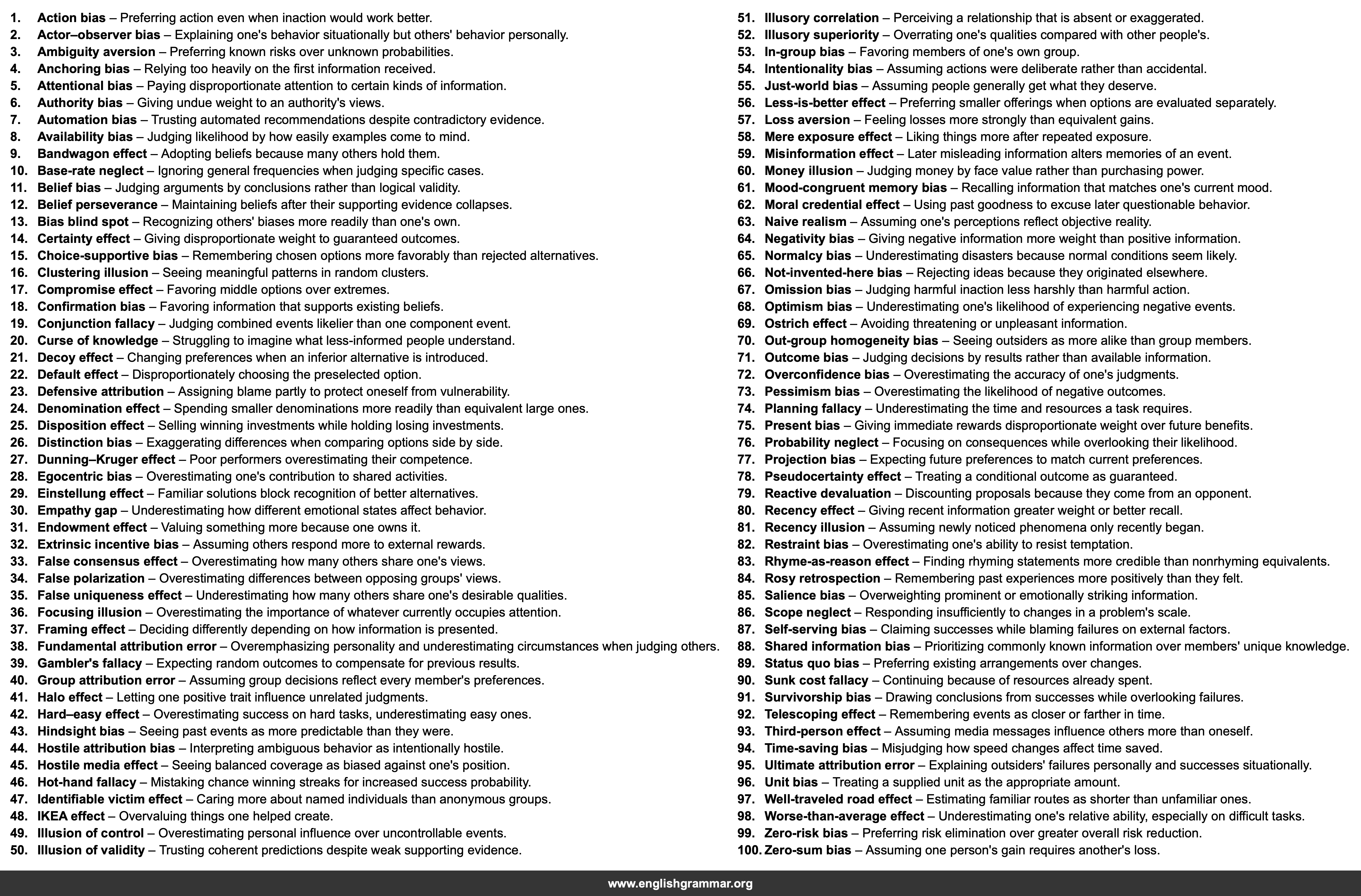
| No. | Item | Definition |
|---|---|---|
| 1. | Action bias | Preferring action even when inaction would work better. |
| 2. | Actor–observer bias | Explaining one’s behavior situationally but others’ behavior personally. |
| 3. | Ambiguity aversion | Preferring known risks over unknown probabilities. |
| 4. | Anchoring bias | Relying too heavily on the first information received. |
| 5. | Attentional bias | Paying disproportionate attention to certain kinds of information. |
| 6. | Authority bias | Giving undue weight to an authority’s views. |
| 7. | Automation bias | Trusting automated recommendations despite contradictory evidence. |
| 8. | Availability bias | Judging likelihood by how easily examples come to mind. |
| 9. | Bandwagon effect | Adopting beliefs because many others hold them. |
| 10. | Base-rate neglect | Ignoring general frequencies when judging specific cases. |
| 11. | Belief bias | Judging arguments by conclusions rather than logical validity. |
| 12. | Belief perseverance | Maintaining beliefs after their supporting evidence collapses. |
| 13. | Bias blind spot | Recognizing others’ biases more readily than one’s own. |
| 14. | Certainty effect | Giving disproportionate weight to guaranteed outcomes. |
| 15. | Choice-supportive bias | Remembering chosen options more favorably than rejected alternatives. |
| 16. | Clustering illusion | Seeing meaningful patterns in random clusters. |
| 17. | Compromise effect | Favoring middle options over extremes. |
| 18. | Confirmation bias | Favoring information that supports existing beliefs. |
| 19. | Conjunction fallacy | Judging combined events likelier than one component event. |
| 20. | Curse of knowledge | Struggling to imagine what less-informed people understand. |
| 21. | Decoy effect | Changing preferences when an inferior alternative is introduced. |
| 22. | Default effect | Disproportionately choosing the preselected option. |
| 23. | Defensive attribution | Assigning blame partly to protect oneself from vulnerability. |
| 24. | Denomination effect | Spending smaller denominations more readily than equivalent large ones. |
| 25. | Disposition effect | Selling winning investments while holding losing investments. |
| 26. | Distinction bias | Exaggerating differences when comparing options side by side. |
| 27. | Dunning–Kruger effect | Poor performers overestimating their competence. |
| 28. | Egocentric bias | Overestimating one’s contribution to shared activities. |
| 29. | Einstellung effect | Familiar solutions block recognition of better alternatives. |
| 30. | Empathy gap | Underestimating how different emotional states affect behavior. |
| 31. | Endowment effect | Valuing something more because one owns it. |
| 32. | Extrinsic incentive bias | Assuming others respond more to external rewards. |
| 33. | False consensus effect | Overestimating how many others share one’s views. |
| 34. | False polarization | Overestimating differences between opposing groups’ views. |
| 35. | False uniqueness effect | Underestimating how many others share one’s desirable qualities. |
| 36. | Focusing illusion | Overestimating the importance of whatever currently occupies attention. |
| 37. | Framing effect | Deciding differently depending on how information is presented. |
| 38. | Fundamental attribution error | Overemphasizing personality and underestimating circumstances when judging others. |
| 39. | Gambler’s fallacy | Expecting random outcomes to compensate for previous results. |
| 40. | Group attribution error | Assuming group decisions reflect every member’s preferences. |
| 41. | Halo effect | Letting one positive trait influence unrelated judgments. |
| 42. | Hard–easy effect | Overestimating success on hard tasks, underestimating easy ones. |
| 43. | Hindsight bias | Seeing past events as more predictable than they were. |
| 44. | Hostile attribution bias | Interpreting ambiguous behavior as intentionally hostile. |
| 45. | Hostile media effect | Seeing balanced coverage as biased against one’s position. |
| 46. | Hot-hand fallacy | Mistaking chance winning streaks for increased success probability. |
| 47. | Identifiable victim effect | Caring more about named individuals than anonymous groups. |
| 48. | IKEA effect | Overvaluing things one helped create. |
| 49. | Illusion of control | Overestimating personal influence over uncontrollable events. |
| 50. | Illusion of validity | Trusting coherent predictions despite weak supporting evidence. |
| 51. | Illusory correlation | Perceiving a relationship that is absent or exaggerated. |
| 52. | Illusory superiority | Overrating one’s qualities compared with other people’s. |
| 53. | In-group bias | Favoring members of one’s own group. |
| 54. | Intentionality bias | Assuming actions were deliberate rather than accidental. |
| 55. | Just-world bias | Assuming people generally get what they deserve. |
| 56. | Less-is-better effect | Preferring smaller offerings when options are evaluated separately. |
| 57. | Loss aversion | Feeling losses more strongly than equivalent gains. |
| 58. | Mere exposure effect | Liking things more after repeated exposure. |
| 59. | Misinformation effect | Later misleading information alters memories of an event. |
| 60. | Money illusion | Judging money by face value rather than purchasing power. |
| 61. | Mood-congruent memory bias | Recalling information that matches one’s current mood. |
| 62. | Moral credential effect | Using past goodness to excuse later questionable behavior. |
| 63. | Naive realism | Assuming one’s perceptions reflect objective reality. |
| 64. | Negativity bias | Giving negative information more weight than positive information. |
| 65. | Normalcy bias | Underestimating disasters because normal conditions seem likely. |
| 66. | Not-invented-here bias | Rejecting ideas because they originated elsewhere. |
| 67. | Omission bias | Judging harmful inaction less harshly than harmful action. |
| 68. | Optimism bias | Underestimating one’s likelihood of experiencing negative events. |
| 69. | Ostrich effect | Avoiding threatening or unpleasant information. |
| 70. | Out-group homogeneity bias | Seeing outsiders as more alike than group members. |
| 71. | Outcome bias | Judging decisions by results rather than available information. |
| 72. | Overconfidence bias | Overestimating the accuracy of one’s judgments. |
| 73. | Pessimism bias | Overestimating the likelihood of negative outcomes. |
| 74. | Planning fallacy | Underestimating the time and resources a task requires. |
| 75. | Present bias | Giving immediate rewards disproportionate weight over future benefits. |
| 76. | Probability neglect | Focusing on consequences while overlooking their likelihood. |
| 77. | Projection bias | Expecting future preferences to match current preferences. |
| 78. | Pseudocertainty effect | Treating a conditional outcome as guaranteed. |
| 79. | Reactive devaluation | Discounting proposals because they come from an opponent. |
| 80. | Recency effect | Giving recent information greater weight or better recall. |
| 81. | Recency illusion | Assuming newly noticed phenomena only recently began. |
| 82. | Restraint bias | Overestimating one’s ability to resist temptation. |
| 83. | Rhyme-as-reason effect | Finding rhyming statements more credible than nonrhyming equivalents. |
| 84. | Rosy retrospection | Remembering past experiences more positively than they felt. |
| 85. | Salience bias | Overweighting prominent or emotionally striking information. |
| 86. | Scope neglect | Responding insufficiently to changes in a problem’s scale. |
| 87. | Self-serving bias | Claiming successes while blaming failures on external factors. |
| 88. | Shared information bias | Prioritizing commonly known information over members’ unique knowledge. |
| 89. | Status quo bias | Preferring existing arrangements over changes. |
| 90. | Sunk cost fallacy | Continuing because of resources already spent. |
| 91. | Survivorship bias | Drawing conclusions from successes while overlooking failures. |
| 92. | Telescoping effect | Remembering events as closer or farther in time. |
| 93. | Third-person effect | Assuming media messages influence others more than oneself. |
| 94. | Time-saving bias | Misjudging how speed changes affect time saved. |
| 95. | Ultimate attribution error | Explaining outsiders’ failures personally and successes situationally. |
| 96. | Unit bias | Treating a supplied unit as the appropriate amount. |
| 97. | Well-traveled road effect | Estimating familiar routes as shorter than unfamiliar ones. |
| 98. | Worse-than-average effect | Underestimating one’s relative ability, especially on difficult tasks. |
| 99. | Zero-risk bias | Preferring risk elimination over greater overall risk reduction. |
| 100. | Zero-sum bias | Assuming one person’s gain requires another’s loss. |
