
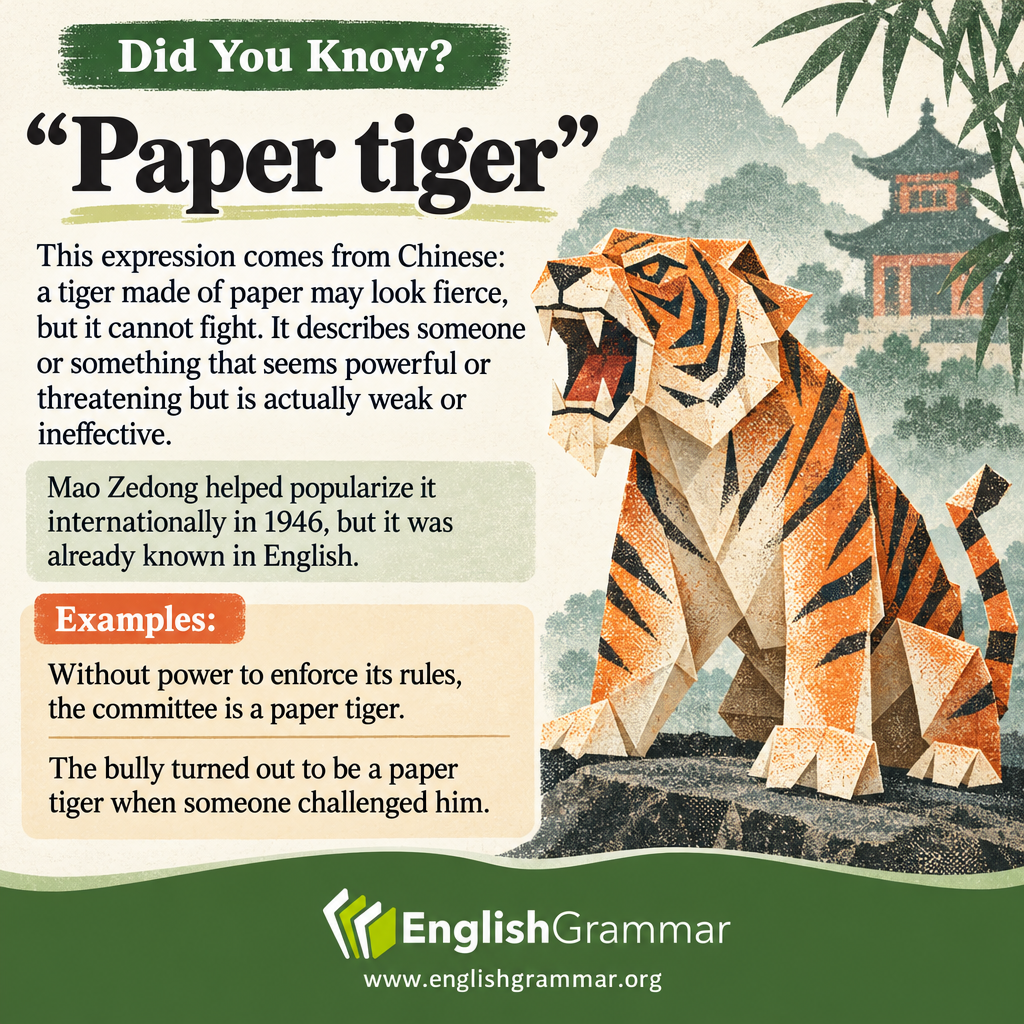
A “paper tiger” is a person, group, or thing that seems powerful or threatening but is actually weak or ineffective. The expression points to a gap between appearance and real power.
It comes from the Chinese expression zhǐ lǎohǔ, literally meaning “paper tiger.” The image is easy to understand: a tiger made of paper may look fierce, but it cannot attack or defend itself like a real tiger.
The expression was recorded in English in the nineteenth century, before Mao Zedong helped make it internationally famous. In a 1946 interview with journalist Anna Louise Strong, Mao used the image to describe imperialism and other seemingly powerful opponents. His point was that their frightening appearance did not make them unbeatable. He popularized the expression; he did not invent it.
Today, you can use it outside politics, especially when someone lacks the power to act or an organization cannot enforce its decisions.
- A powerless organization: “Without the authority to issue fines, the watchdog is a paper tiger.”
- An empty threat: “The rival company looked dangerous, but its failed product launch showed it was a paper tiger.”
The phrase is usually critical or dismissive. It does not simply mean “less powerful than someone else.” It suggests that the apparent strength is misleading. A small organization that openly has limited authority is not necessarily a paper tiger; the contrast between its image and its actual power matters.