
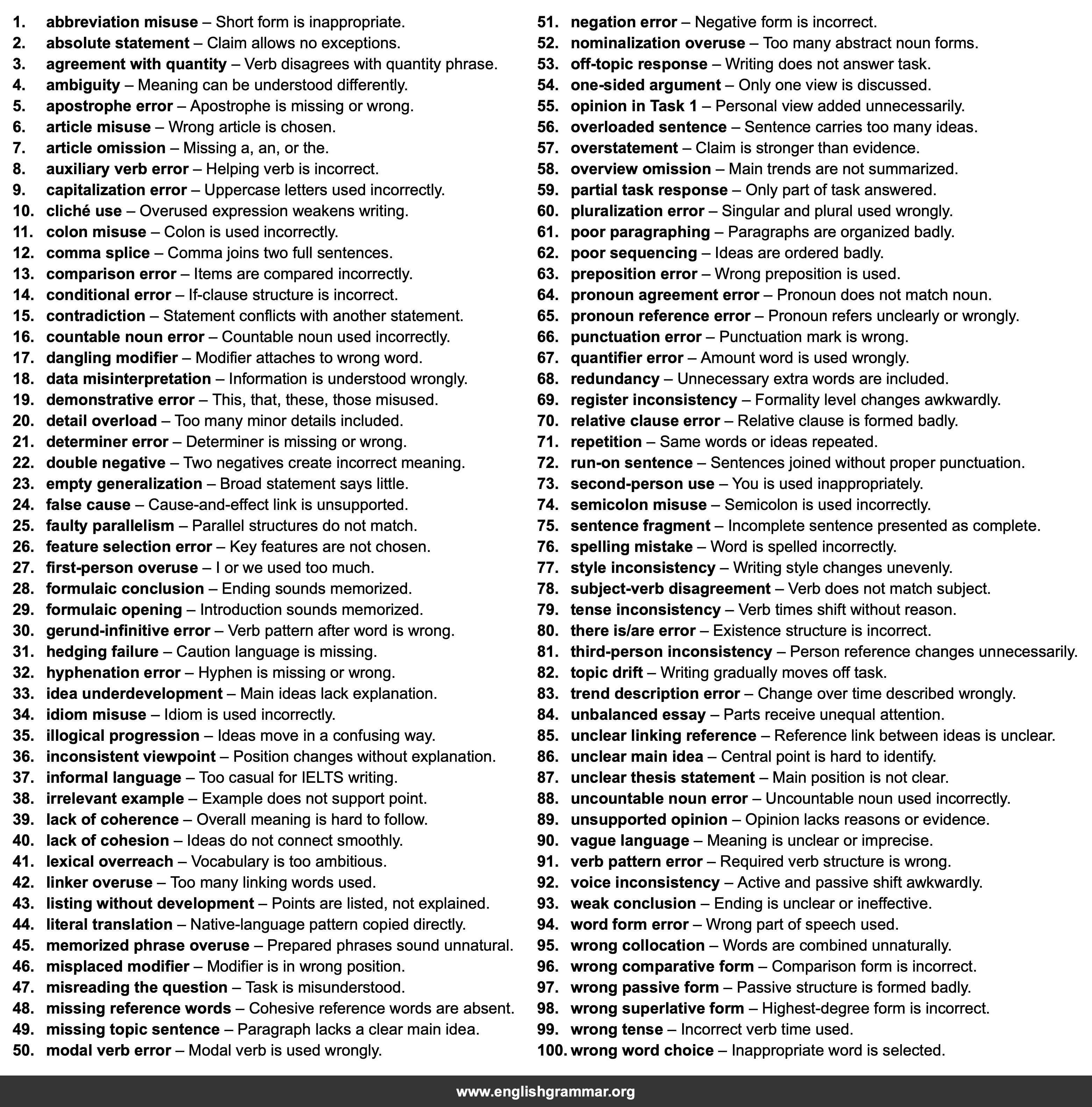
| No. | Item | Definition |
|---|---|---|
| 1. | abbreviation misuse | Short form is inappropriate. |
| 2. | absolute statement | Claim allows no exceptions. |
| 3. | agreement with quantity | Verb disagrees with quantity phrase. |
| 4. | ambiguity | Meaning can be understood differently. |
| 5. | apostrophe error | Apostrophe is missing or wrong. |
| 6. | article misuse | Wrong article is chosen. |
| 7. | article omission | Missing a, an, or the. |
| 8. | auxiliary verb error | Helping verb is incorrect. |
| 9. | capitalization error | Uppercase letters used incorrectly. |
| 10. | cliché use | Overused expression weakens writing. |
| 11. | colon misuse | Colon is used incorrectly. |
| 12. | comma splice | Comma joins two full sentences. |
| 13. | comparison error | Items are compared incorrectly. |
| 14. | conditional error | If-clause structure is incorrect. |
| 15. | contradiction | Statement conflicts with another statement. |
| 16. | countable noun error | Countable noun used incorrectly. |
| 17. | dangling modifier | Modifier attaches to wrong word. |
| 18. | data misinterpretation | Information is understood wrongly. |
| 19. | demonstrative error | This, that, these, those misused. |
| 20. | detail overload | Too many minor details included. |
| 21. | determiner error | Determiner is missing or wrong. |
| 22. | double negative | Two negatives create incorrect meaning. |
| 23. | empty generalization | Broad statement says little. |
| 24. | false cause | Cause-and-effect link is unsupported. |
| 25. | faulty parallelism | Parallel structures do not match. |
| 26. | feature selection error | Key features are not chosen. |
| 27. | first-person overuse | I or we used too much. |
| 28. | formulaic conclusion | Ending sounds memorized. |
| 29. | formulaic opening | Introduction sounds memorized. |
| 30. | gerund-infinitive error | Verb pattern after word is wrong. |
| 31. | hedging failure | Caution language is missing. |
| 32. | hyphenation error | Hyphen is missing or wrong. |
| 33. | idea underdevelopment | Main ideas lack explanation. |
| 34. | idiom misuse | Idiom is used incorrectly. |
| 35. | illogical progression | Ideas move in a confusing way. |
| 36. | inconsistent viewpoint | Position changes without explanation. |
| 37. | informal language | Too casual for IELTS writing. |
| 38. | irrelevant example | Example does not support point. |
| 39. | lack of coherence | Overall meaning is hard to follow. |
| 40. | lack of cohesion | Ideas do not connect smoothly. |
| 41. | lexical overreach | Vocabulary is too ambitious. |
| 42. | linker overuse | Too many linking words used. |
| 43. | listing without development | Points are listed, not explained. |
| 44. | literal translation | Native-language pattern copied directly. |
| 45. | memorized phrase overuse | Prepared phrases sound unnatural. |
| 46. | misplaced modifier | Modifier is in wrong position. |
| 47. | misreading the question | Task is misunderstood. |
| 48. | missing reference words | Cohesive reference words are absent. |
| 49. | missing topic sentence | Paragraph lacks a clear main idea. |
| 50. | modal verb error | Modal verb is used wrongly. |
| 51. | negation error | Negative form is incorrect. |
| 52. | nominalization overuse | Too many abstract noun forms. |
| 53. | off-topic response | Writing does not answer task. |
| 54. | one-sided argument | Only one view is discussed. |
| 55. | opinion in Task 1 | Personal view added unnecessarily. |
| 56. | overloaded sentence | Sentence carries too many ideas. |
| 57. | overstatement | Claim is stronger than evidence. |
| 58. | overview omission | Main trends are not summarized. |
| 59. | partial task response | Only part of task answered. |
| 60. | pluralization error | Singular and plural used wrongly. |
| 61. | poor paragraphing | Paragraphs are organized badly. |
| 62. | poor sequencing | Ideas are ordered badly. |
| 63. | preposition error | Wrong preposition is used. |
| 64. | pronoun agreement error | Pronoun does not match noun. |
| 65. | pronoun reference error | Pronoun refers unclearly or wrongly. |
| 66. | punctuation error | Punctuation mark is wrong. |
| 67. | quantifier error | Amount word is used wrongly. |
| 68. | redundancy | Unnecessary extra words are included. |
| 69. | register inconsistency | Formality level changes awkwardly. |
| 70. | relative clause error | Relative clause is formed badly. |
| 71. | repetition | Same words or ideas repeated. |
| 72. | run-on sentence | Sentences joined without proper punctuation. |
| 73. | second-person use | You is used inappropriately. |
| 74. | semicolon misuse | Semicolon is used incorrectly. |
| 75. | sentence fragment | Incomplete sentence presented as complete. |
| 76. | spelling mistake | Word is spelled incorrectly. |
| 77. | style inconsistency | Writing style changes unevenly. |
| 78. | subject-verb disagreement | Verb does not match subject. |
| 79. | tense inconsistency | Verb times shift without reason. |
| 80. | there is/are error | Existence structure is incorrect. |
| 81. | third-person inconsistency | Person reference changes unnecessarily. |
| 82. | topic drift | Writing gradually moves off task. |
| 83. | trend description error | Change over time described wrongly. |
| 84. | unbalanced essay | Parts receive unequal attention. |
| 85. | unclear linking reference | Reference link between ideas is unclear. |
| 86. | unclear main idea | Central point is hard to identify. |
| 87. | unclear thesis statement | Main position is not clear. |
| 88. | uncountable noun error | Uncountable noun used incorrectly. |
| 89. | unsupported opinion | Opinion lacks reasons or evidence. |
| 90. | vague language | Meaning is unclear or imprecise. |
| 91. | verb pattern error | Required verb structure is wrong. |
| 92. | voice inconsistency | Active and passive shift awkwardly. |
| 93. | weak conclusion | Ending is unclear or ineffective. |
| 94. | word form error | Wrong part of speech used. |
| 95. | wrong collocation | Words are combined unnaturally. |
| 96. | wrong comparative form | Comparison form is incorrect. |
| 97. | wrong passive form | Passive structure is formed badly. |
| 98. | wrong superlative form | Highest-degree form is incorrect. |
| 99. | wrong tense | Incorrect verb time used. |
| 100. | wrong word choice | Inappropriate word is selected. |