
• Skip to primary navigation
  • Skip to main content
  • Skip to primary sidebar
Home of English Grammar
  • Home
  • Course
  • Exercises
  • Grammar Rules
  • Matches
  • Posts
  • Tools
    • Grammar Checker
    • Very Replacer
    • Word Counter
  • Vocabulary Lists
  • Archives
    • Social Media Posts
    • Writing Guides
  • Sign in
  • Join free

Why coyote comes from Nahuatl

May 14, 2026

Coyote comes from Nahuatl

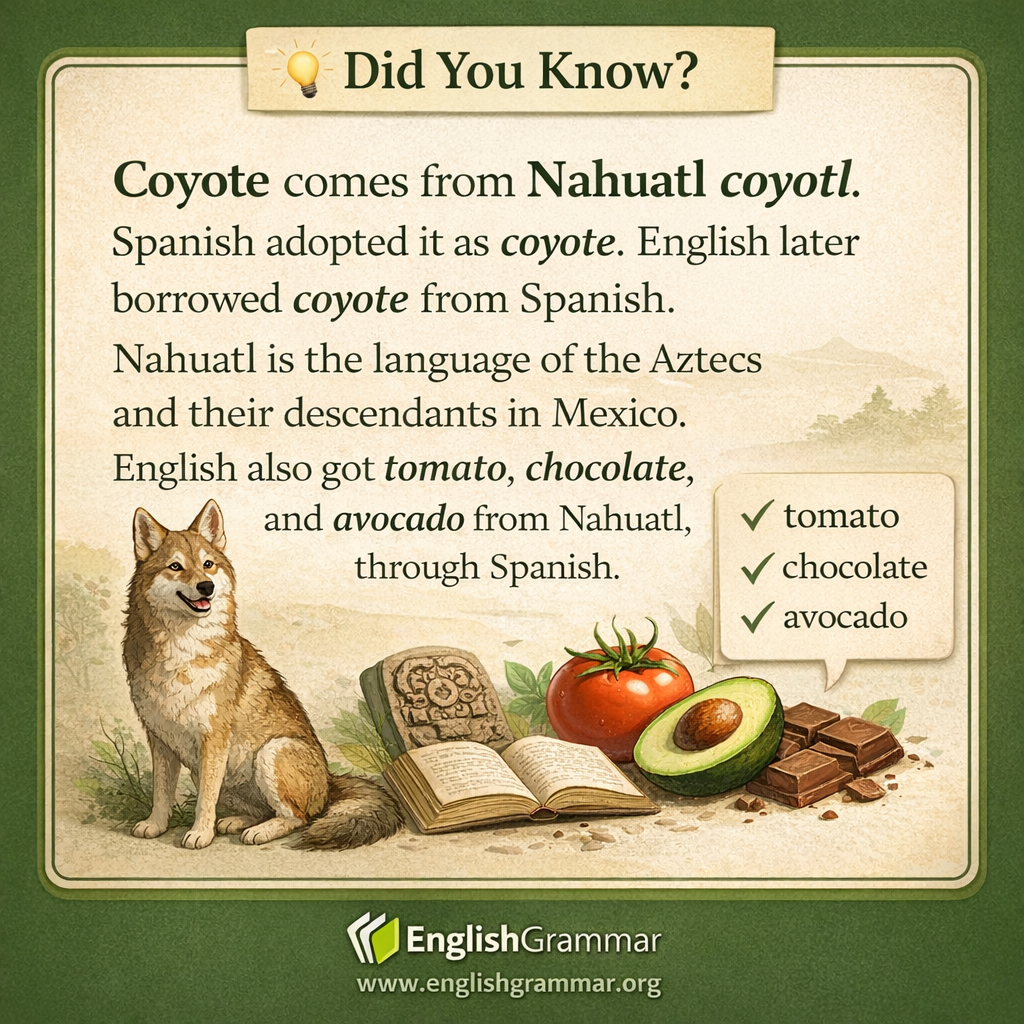
Coyote did not begin as an English word. English borrowed it from Spanish, where it appears as coyote. The Spanish word itself came from Nahuatl coyotl, an Indigenous language of Mexico that is strongly associated with the Aztecs and is still spoken today.

This kind of word history is common in the Americas. When Spanish speakers encountered animals, foods, and local objects that were new to them, they often adopted existing Indigenous names. Later, English borrowed some of those Spanish forms.

  • coyotl became Spanish coyote, then English coyote
  • tomatl helped give English tomato, through Spanish tomate
  • chocolatl is an early Nahuatl source linked to English chocolate
  • ahuacatl led to Spanish aguacate, which gave English avocado

So when you say coyote, you are using a word with a long path: Nahuatl to Spanish to English. That small history also reflects a larger story about language contact in Mexico and the spread of words across cultures.

Improve your English grammar, vocabulary and writing

We take you step by step from beginner to advanced, even if you struggled with English at school or have always had trouble remembering the rules.

  • 10 modules, 112 lessons and 730 questions
  • Just log in and learn anytime and anywhere
  • Your progress is saved in your account
  • Download the 2027 Grammar Guide (PDF)
Join free

Already have an account? Sign in

See what’s in the course

Primary Sidebar

2.4M760.9K165.9K

Free 2027 Grammar Guide

  • Download Grammar Guide (PDF)
  • Online grammar course, A1 to C2
  • Weekly exercises and vocabulary
  • Join over 3 million English learners

We respect your privacy. Unsubscribe anytime.

Already have an account? Sign in

Grammar Checker - Try Now

Latest Posts

  • 100 Best Synonyms for “Vary” November 3, 2026
  • 100 Best Synonyms for “Individuals” November 3, 2026
  • Temporary vs. passing vs. fleeting vs. transient vs. ephemeral vs. evanescent November 3, 2026
  • 100 Best Synonyms for “Restless” November 3, 2026
  • Hard, firm, solid, rigid, stiff and unyielding: How to choose November 3, 2026
  • The origin of “out of the blue” November 3, 2026
  • 100 Best Synonyms for “Individualised” November 3, 2026
  • 100 Best Synonyms for “Varied” November 3, 2026
  • Fewer vs. less: counting things and measuring amounts November 3, 2026
  • 100 Phrases for Starting a Meeting Confidently November 3, 2026
Home of English Grammar

Free English grammar exercises, rules and vocabulary lists, with new exercises every week. Join the leading English grammar site with over 3 million followers.

Join free

Learn

  • Exercises
  • Matches
  • Grammar rules
  • Vocabulary lists
  • Writing guides
  • Online tools

More

  • Top social media posts
  • Various posts
  • Contact

Account

  • Join free
  • Grammar Course
  • Free grammar guide (PDF)

Copyright © 2026 EnglishGrammar.org

  • Disclaimer
  • Privacy policy
  • Terms
  • Sitemap