
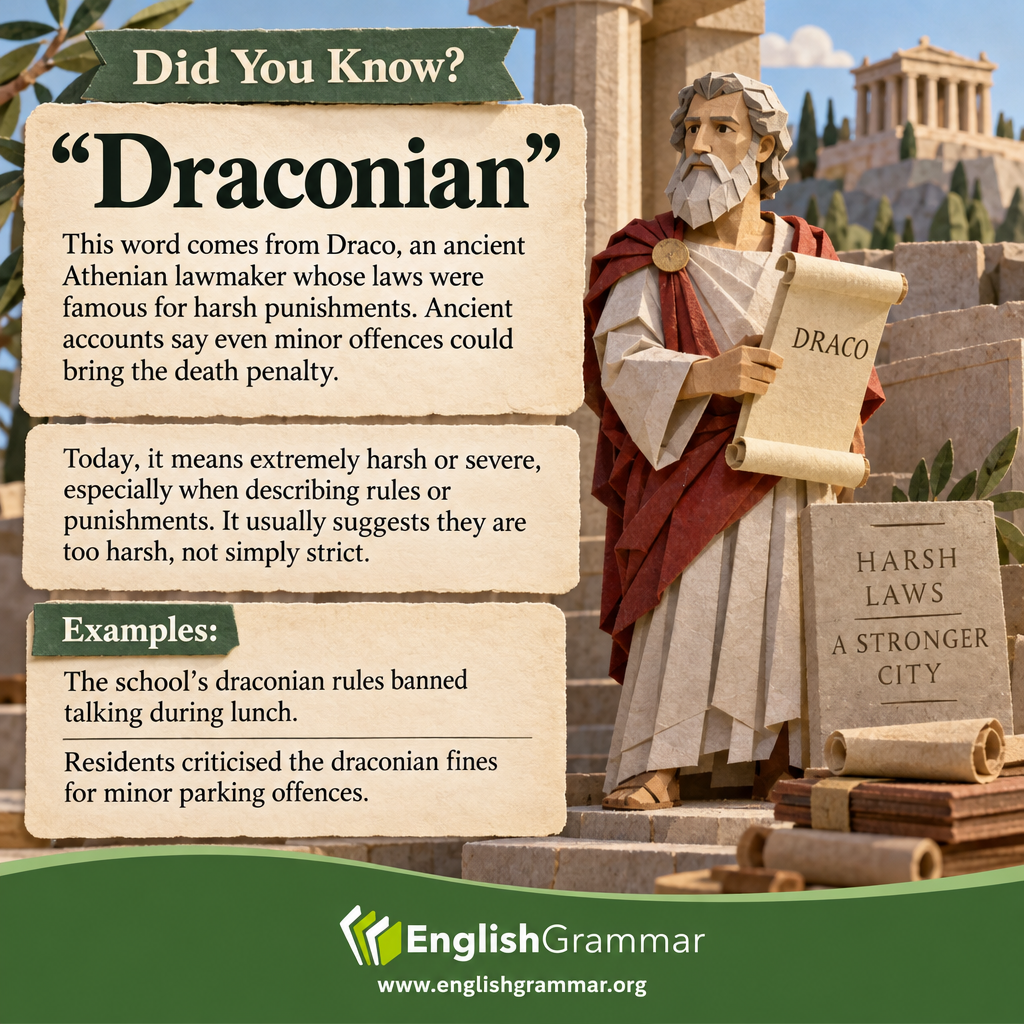
“Draconian” comes from the name of Draco, an ancient Athenian lawmaker. His written laws became famous for their harsh punishments. Ancient accounts describe the death penalty being used even for minor offences, such as stealing small amounts of food. That reputation explains the connection between his name and the word’s modern meaning.
Today, the adjective means extremely harsh or severe, especially when describing laws, rules, restrictions, or punishments. It usually expresses criticism: the speaker thinks a measure goes too far or imposes a punishment that is too harsh for the offence.
The word is not limited to government policy. People also use it when discussing schools, workplaces, and other organisations:
- Parents criticised the school’s draconian punishment for arriving five minutes late.
- The company introduced draconian restrictions on employees’ internet use.
In the first example, the parents consider the punishment excessive. In the second, the restrictions are presented as unusually severe, not merely inconvenient.
Strict is a milder word. A strict teacher may enforce reasonable rules consistently. Describing a teacher’s rules as draconian suggests that the rules themselves, or the penalties for breaking them, are far too harsh.
Because it carries strong criticism, this adjective is useful when you want to emphasise severity. If you only mean that a rule is firmly enforced, strict may be the more accurate choice.
