
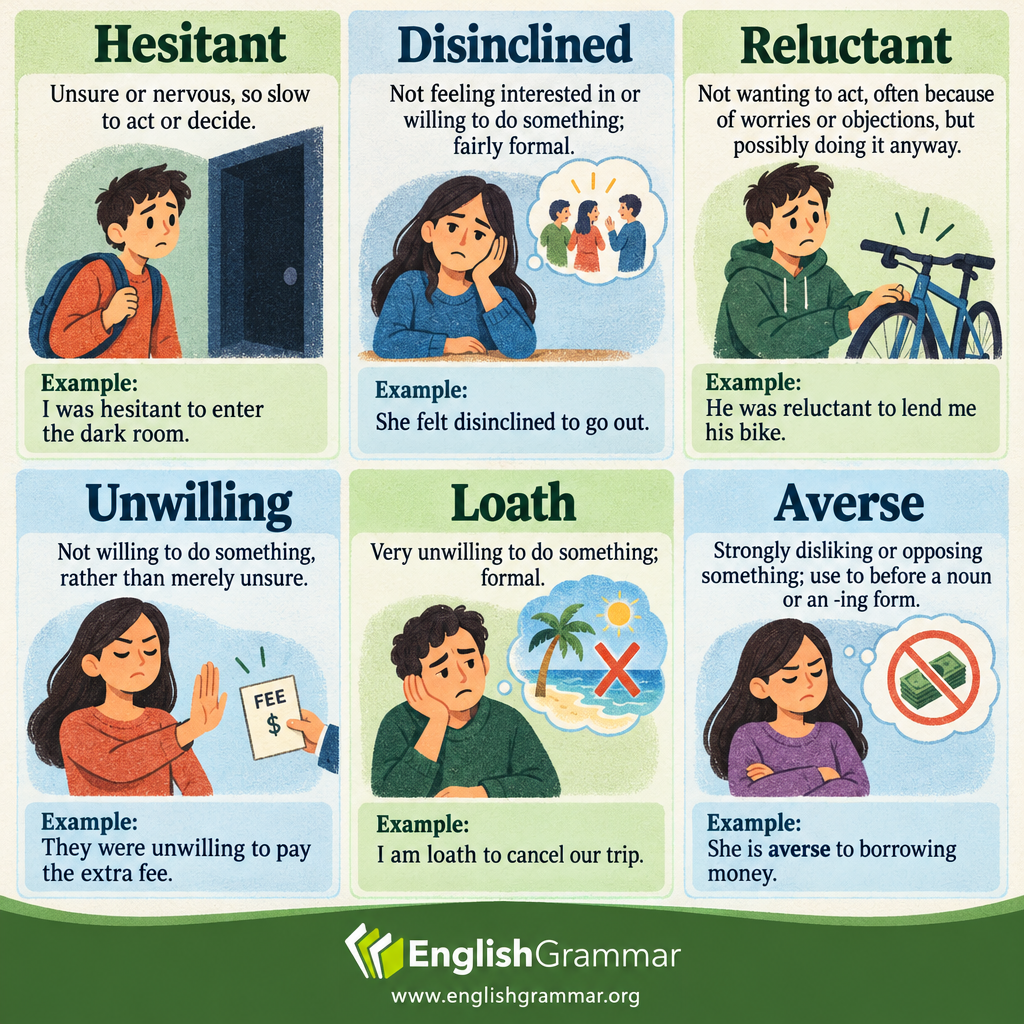
These six adjectives overlap, but they highlight different reasons for not doing something. Someone may feel unsure, lack interest, resist an action, or strongly dislike it. Choose the word that fits the situation, not just the one that sounds strongest.
- Hesitant suggests uncertainty or nervousness that makes someone pause. He was hesitant to ask another question. He may want to ask but lack confidence.
- Disinclined means not feeling interested in or willing to do something. It is fairly formal and often sounds restrained. I am disinclined to discuss work tonight.
- Reluctant suggests resistance, often because of worries or objections. The person may still act. She reluctantly agreed to sell the car. Her agreement does not mean she welcomed it.
- Unwilling directly states that someone is not willing to act. The landlord was unwilling to reduce the rent. This is clearer about willingness than uncertainty.
- Loath is a formal word for very unwilling. We were loath to interrupt their celebration. It is different from loathe, a verb meaning to hate.
- Averse means having a strong dislike of or opposition to something. He is averse to taking unnecessary risks. Here, to is followed by an -ing form.
The first five commonly take to + verb, as in reluctant to leave. With averse to, use a noun or an -ing form. Context matters: these words do not form a fixed scale of increasing resistance.