
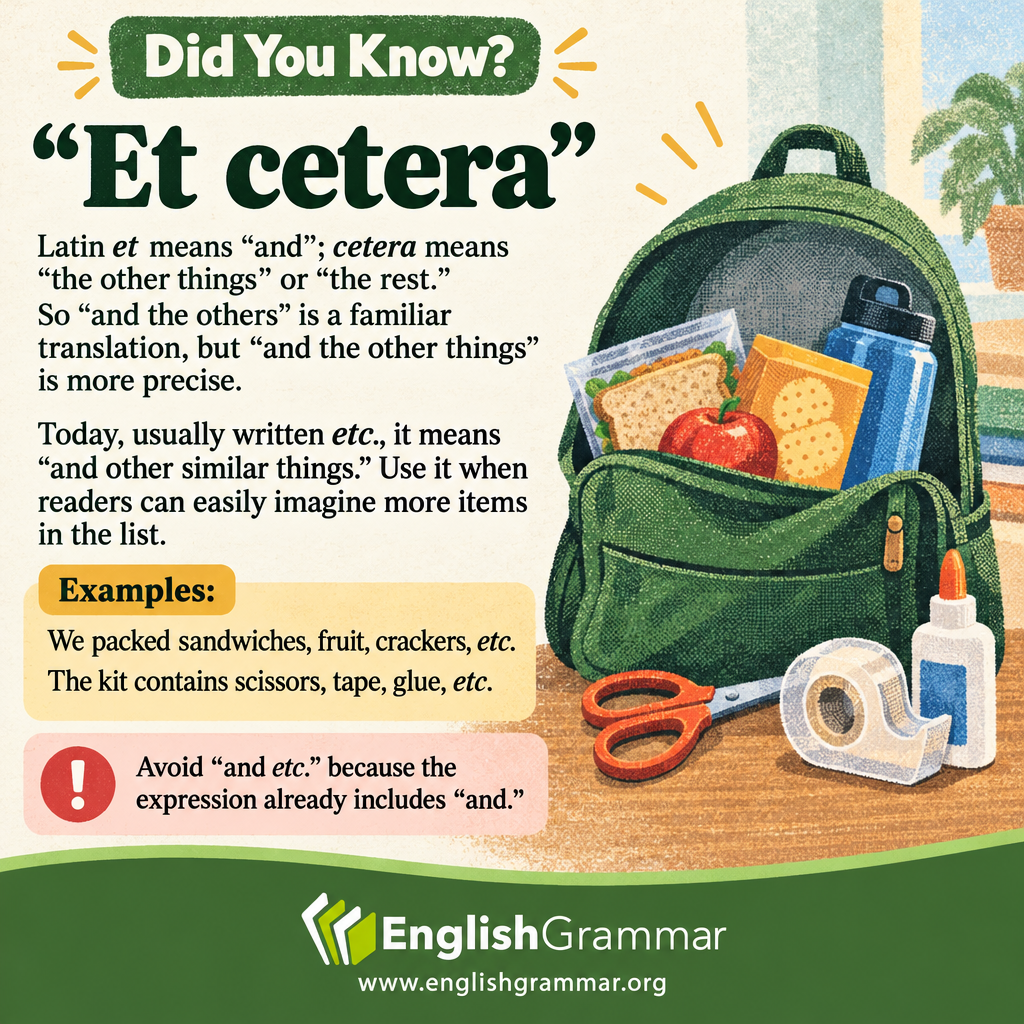
Et cetera comes from Latin: et means “and,” and cetera means “the other things” or “the rest.” The familiar translation “and the others” captures the general idea, but “and the other things” is more precise.
In modern English, the expression means “and other similar things” or “and so on.” It usually appears at the end of a list, most often as the abbreviation etc. It tells readers that you could name more items of the same kind.
- “The shop sells notebooks, folders, envelopes, etc.” The list could continue with other stationery items.
- “We discussed rent, electricity, water, etc.” The speaker is referring to other similar household costs.
Use it when the examples make the group clear. A list such as “notebooks, folders, envelopes” gives readers a useful pattern. A vague instruction such as “Bring the necessary things, etc.” does not explain what anyone should bring.
Because the Latin already includes “and,” avoid and etc. in careful writing. Write “pens, pencils, etc.” rather than “pens, pencils, and etc.”
The abbreviation keeps its period. If it ends a sentence, that period also ends the sentence; do not add another one. In instructions, contracts, or other writing where every item matters, give the complete list instead of asking readers to guess what has been left out.