
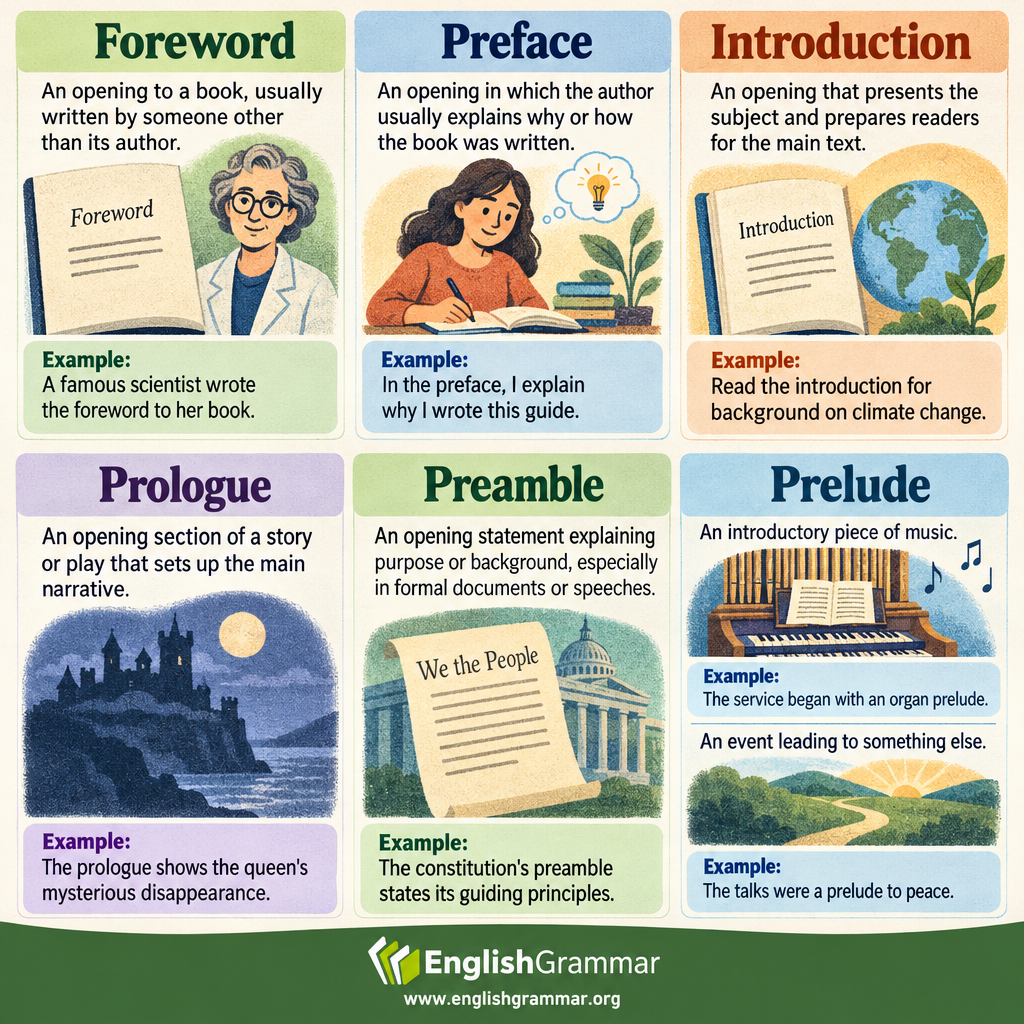
These six words describe beginnings, but they are not interchangeable. Choose according to who is writing, what is beginning, and what the opening does.
- Foreword: Usually written by someone other than the author, this opening often recommends the book or explains its importance. A respected historian writes a foreword for a new biography.
- Preface: Usually the author’s account of why or how the book was written. It may explain the project’s background or thank people who helped. The author describes ten years of research in her preface.
- Introduction: Presents the subject and gives readers background they need for the main text. The introduction explains the basic ideas used throughout the textbook.
- Prologue: An opening section of a story or play that sets up the main narrative. It may show an earlier event, but it does not have to. The prologue reveals a secret that the main character has not yet discovered.
- Preamble: An opening statement, especially in a formal document or speech, that explains its purpose or background. The agreement’s preamble states the parties’ shared aims.
- Prelude: An introductory piece of music, or an event that leads to something else. A short piano prelude opens the concert. The disagreement was a prelude to a larger conflict.
These are common conventions, not fixed rules. A book can contain several kinds of opening, and publishers may use the headings differently. In particular, a preface usually discusses the book’s creation, while an introduction usually starts teaching its subject.