
• Skip to primary navigation
  • Skip to main content
  • Skip to primary sidebar
Home of English Grammar
  • Home
  • Course
  • Exercises
  • Grammar Rules
  • Matches
  • Posts
  • Tools
    • Grammar Checker
    • Very Replacer
    • Word Counter
  • Vocabulary Lists
  • Archives
    • Social Media Posts
    • Writing Guides
  • Sign in
  • Join free

Morpheme vs. syllable: Meaning and sound

November 10, 2026

Morpheme vs. Syllable

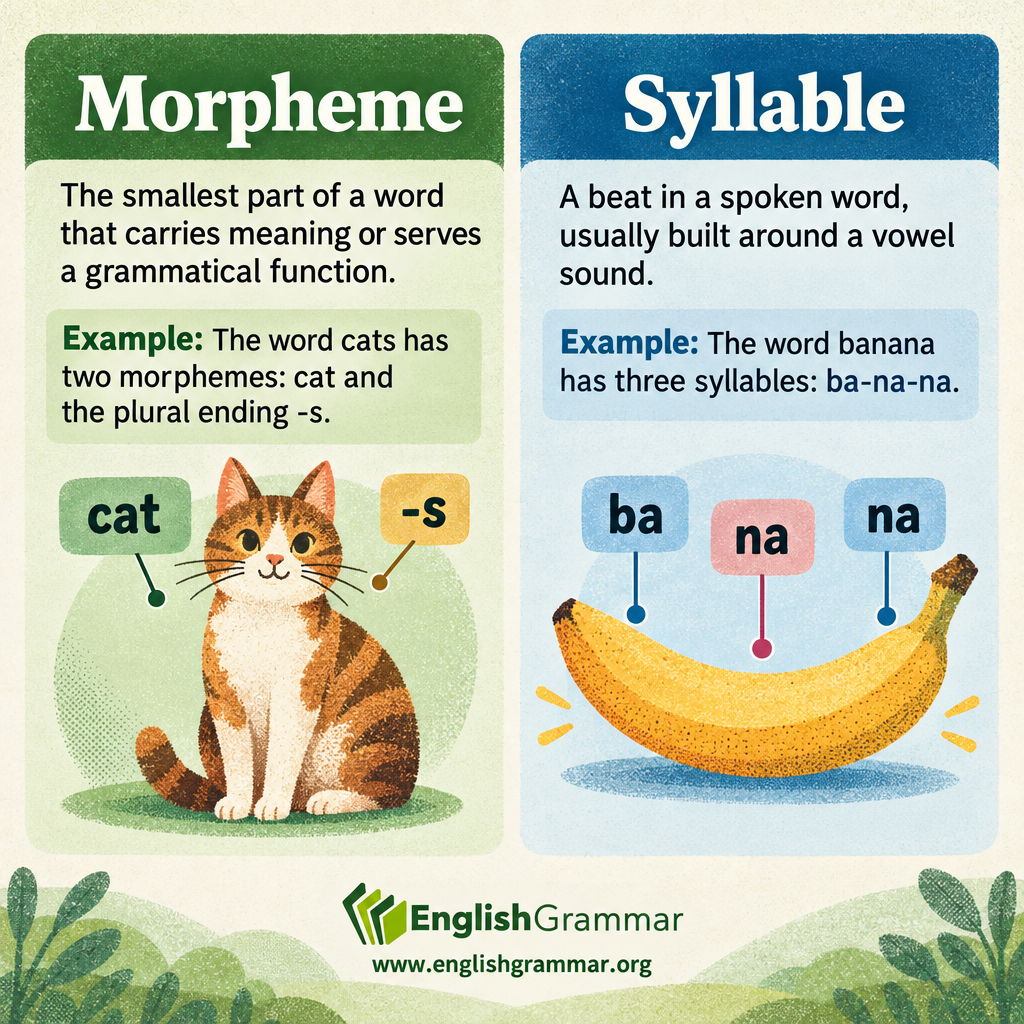
A morpheme and a syllable are different kinds of word units. One helps explain how words carry meaning or grammatical information. The other helps explain how words are pronounced.

A morpheme is the smallest part of a word that carries meaning or serves a grammatical function. Some can stand alone as words, such as dog. Others must attach to another part, such as the plural ending -s.

  • Dogs has two morphemes: dog and -s. The ending tells us there is more than one.
  • Teacher also has two: teach and -er. Here, the ending identifies a person who does the activity.

A syllable is a beat in a spoken word, usually built around a vowel sound. Syllables do not need to carry meaning. Count what you hear, not the written vowel letters.

  • Dogs has just one syllable, although it has two meaningful parts.
  • Elephant has three syllables but only one morpheme. Its separate spoken beats do not each contribute a meaning.

Use morpheme when discussing word building, prefixes, suffixes, or grammatical endings. Use syllable when discussing pronunciation, word stress, or rhythm. The counts sometimes match, but that does not make the units interchangeable. A sound boundary is not necessarily a boundary between meaningful parts.

Improve your English grammar, vocabulary and writing

We take you step by step from beginner to advanced, even if you struggled with English at school or have always had trouble remembering the rules.

  • 11 modules, 124 lessons and 812 questions
  • Just log in and learn anytime and anywhere
  • Your progress is saved in your account
  • Download the 2027 Grammar Guide (PDF)
Join free

Already have an account? Sign in

See what’s in the course

Primary Sidebar

2.4M760.9K165.9K

Free 2027 Grammar Guide

  • Download Grammar Guide (PDF)
  • Online grammar course, A1 to C2
  • Weekly exercises and vocabulary
  • Join over 3 million English learners

We respect your privacy. Unsubscribe anytime.

Already have an account? Sign in

Grammar Checker - Try Now

Matches Rankings

    No results yet. Be the first to finish today’s Daily.

      No results yet. Be the first to finish today’s Daily.

        No results yet. Be the first to finish today’s Daily.

          No results yet. Be the first to finish today’s Daily.

          Play Matches

          Latest Posts

          • Morpheme vs. syllable: Meaning and sound November 10, 2026
          • Vicious vs. viscous: how to choose the right word November 10, 2026
          • 100 Best Synonyms for “Offer” November 10, 2026
          • 100 Best Synonyms for “Sentiments” November 10, 2026
          • 100 Best Synonyms for “Increasing” November 10, 2026
          • Stable, steady, consistent, constant, uniform and unvarying: how to choose November 10, 2026
          • 100 Words Every Google Docs User Should Know November 10, 2026
          • Litotes: saying less to mean more November 10, 2026
          • Introducing Other People Exercise November 10, 2026
          • 100 Best Synonyms for “Imposition” November 10, 2026
          Home of English Grammar

          Free exercises, a step-by-step grammar course, rules and vocabulary lists, with new exercises every week. Join the leading English grammar site with over 3 million followers.

          Join free

          Learn

          • Exercises
          • Grammar course
          • Level test
          • Matches
          • Grammar rules
          • Vocabulary lists
          • Writing guides
          • Online tools

          More

          • Top social media posts
          • Various posts
          • Contact

          Account

          • Join free
          • Free grammar guide (PDF)

          Copyright © 2026 EnglishGrammar.org

          • Disclaimer
          • Privacy policy
          • Terms
          • Sitemap