
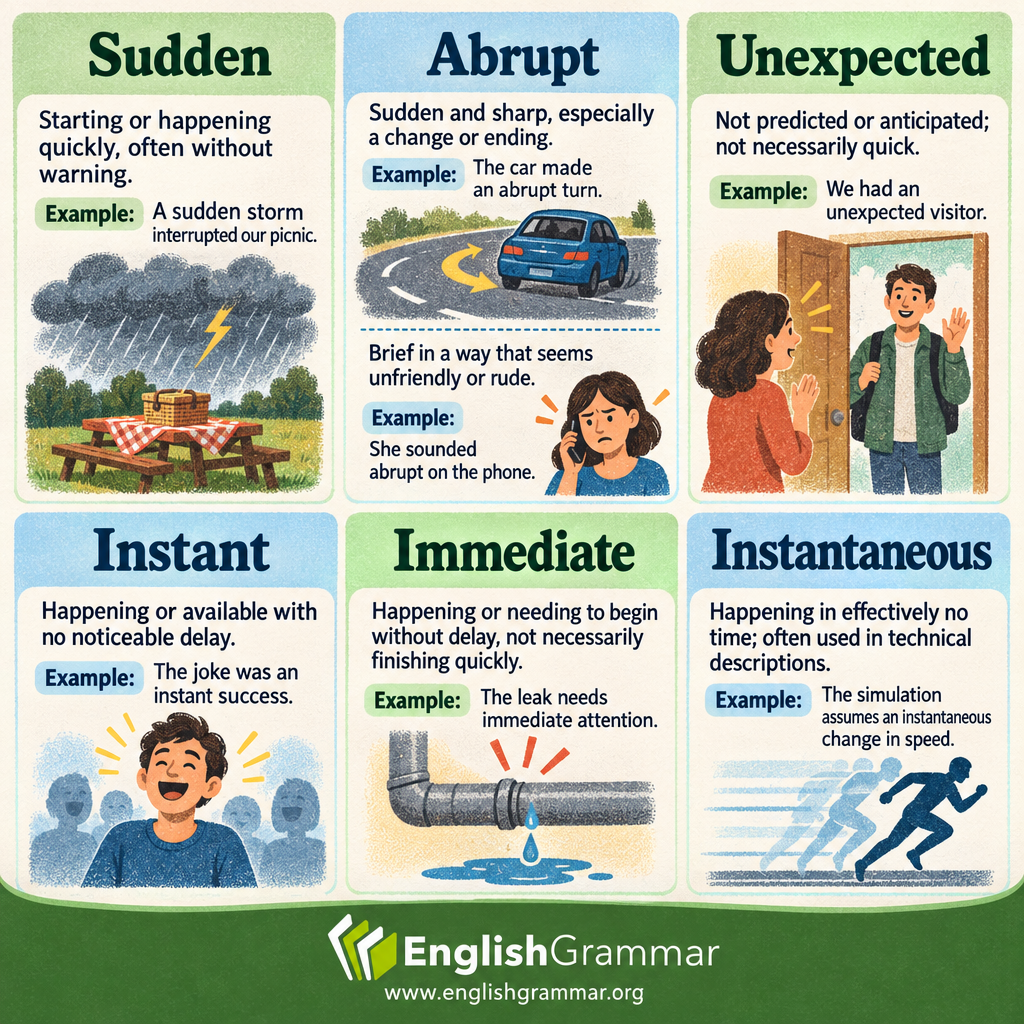
These six adjectives overlap, but they answer different questions: Was something surprising? Did it change sharply? Was there a delay?
- Sudden describes something that starts or happens quickly, often without warning. A sudden noise woke the baby. The focus is on how quickly it happened, not simply whether someone predicted it.
- Abrupt often describes a sudden, sharp change or ending. The discussion came to an abrupt end. It can also describe speech or behavior that seems unfriendly because it is too brief: His abrupt reply upset her.
- Unexpected means not predicted or anticipated. The team celebrated an unexpected victory. A result can be unexpected even when the event takes hours.
- Instant commonly describes something happening or becoming available with no noticeable delay. The photo received instant approval. It is common in everyday descriptions of reactions, results and access.
- Immediate emphasizes that something happens or needs to begin without delay. The injury required immediate treatment. Treatment should start straight away, but it may take a long time to finish.
- Instantaneous emphasizes effectively zero duration or delay, often in scientific or technical descriptions. The model treats the transfer as instantaneous. In real situations, use nearly or almost when appropriate.
Context matters more than a rigid ranking of speed. An immediate response begins promptly; an instantaneous response is described as taking effectively no time. In everyday language, instant and immediate can overlap.