
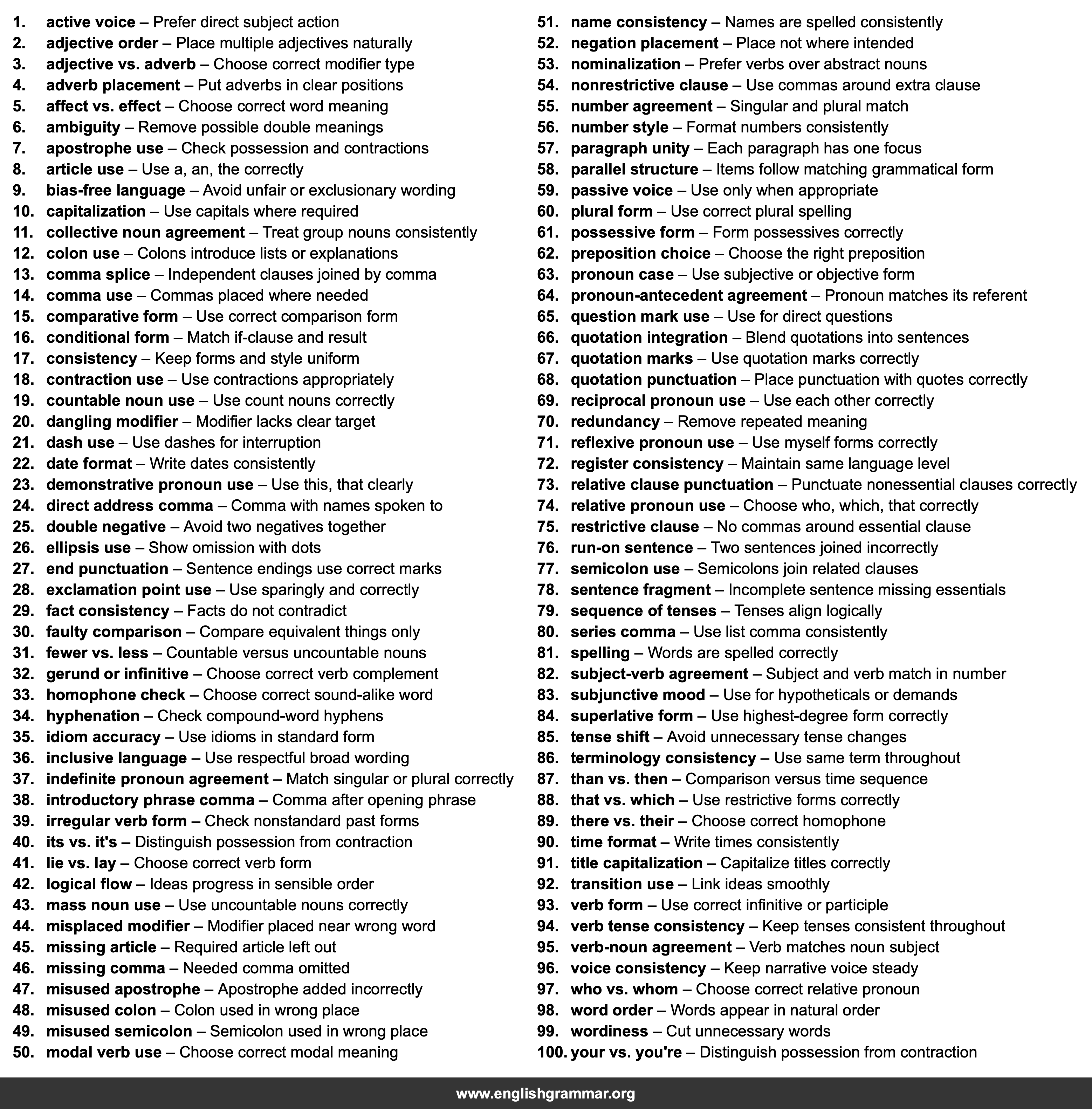
| No. | Item | Definition |
|---|---|---|
| 1. | active voice | Prefer direct subject action |
| 2. | adjective order | Place multiple adjectives naturally |
| 3. | adjective vs. adverb | Choose correct modifier type |
| 4. | adverb placement | Put adverbs in clear positions |
| 5. | affect vs. effect | Choose correct word meaning |
| 6. | ambiguity | Remove possible double meanings |
| 7. | apostrophe use | Check possession and contractions |
| 8. | article use | Use a, an, the correctly |
| 9. | bias-free language | Avoid unfair or exclusionary wording |
| 10. | capitalization | Use capitals where required |
| 11. | collective noun agreement | Treat group nouns consistently |
| 12. | colon use | Colons introduce lists or explanations |
| 13. | comma splice | Independent clauses joined by comma |
| 14. | comma use | Commas placed where needed |
| 15. | comparative form | Use correct comparison form |
| 16. | conditional form | Match if-clause and result |
| 17. | consistency | Keep forms and style uniform |
| 18. | contraction use | Use contractions appropriately |
| 19. | countable noun use | Use count nouns correctly |
| 20. | dangling modifier | Modifier lacks clear target |
| 21. | dash use | Use dashes for interruption |
| 22. | date format | Write dates consistently |
| 23. | demonstrative pronoun use | Use this, that clearly |
| 24. | direct address comma | Comma with names spoken to |
| 25. | double negative | Avoid two negatives together |
| 26. | ellipsis use | Show omission with dots |
| 27. | end punctuation | Sentence endings use correct marks |
| 28. | exclamation point use | Use sparingly and correctly |
| 29. | fact consistency | Facts do not contradict |
| 30. | faulty comparison | Compare equivalent things only |
| 31. | fewer vs. less | Countable versus uncountable nouns |
| 32. | gerund or infinitive | Choose correct verb complement |
| 33. | homophone check | Choose correct sound-alike word |
| 34. | hyphenation | Check compound-word hyphens |
| 35. | idiom accuracy | Use idioms in standard form |
| 36. | inclusive language | Use respectful broad wording |
| 37. | indefinite pronoun agreement | Match singular or plural correctly |
| 38. | introductory phrase comma | Comma after opening phrase |
| 39. | irregular verb form | Check nonstandard past forms |
| 40. | its vs. it’s | Distinguish possession from contraction |
| 41. | lie vs. lay | Choose correct verb form |
| 42. | logical flow | Ideas progress in sensible order |
| 43. | mass noun use | Use uncountable nouns correctly |
| 44. | misplaced modifier | Modifier placed near wrong word |
| 45. | missing article | Required article left out |
| 46. | missing comma | Needed comma omitted |
| 47. | misused apostrophe | Apostrophe added incorrectly |
| 48. | misused colon | Colon used in wrong place |
| 49. | misused semicolon | Semicolon used in wrong place |
| 50. | modal verb use | Choose correct modal meaning |
| 51. | name consistency | Names are spelled consistently |
| 52. | negation placement | Place not where intended |
| 53. | nominalization | Prefer verbs over abstract nouns |
| 54. | nonrestrictive clause | Use commas around extra clause |
| 55. | number agreement | Singular and plural match |
| 56. | number style | Format numbers consistently |
| 57. | paragraph unity | Each paragraph has one focus |
| 58. | parallel structure | Items follow matching grammatical form |
| 59. | passive voice | Use only when appropriate |
| 60. | plural form | Use correct plural spelling |
| 61. | possessive form | Form possessives correctly |
| 62. | preposition choice | Choose the right preposition |
| 63. | pronoun case | Use subjective or objective form |
| 64. | pronoun-antecedent agreement | Pronoun matches its referent |
| 65. | question mark use | Use for direct questions |
| 66. | quotation integration | Blend quotations into sentences |
| 67. | quotation marks | Use quotation marks correctly |
| 68. | quotation punctuation | Place punctuation with quotes correctly |
| 69. | reciprocal pronoun use | Use each other correctly |
| 70. | redundancy | Remove repeated meaning |
| 71. | reflexive pronoun use | Use myself forms correctly |
| 72. | register consistency | Maintain same language level |
| 73. | relative clause punctuation | Punctuate nonessential clauses correctly |
| 74. | relative pronoun use | Choose who, which, that correctly |
| 75. | restrictive clause | No commas around essential clause |
| 76. | run-on sentence | Two sentences joined incorrectly |
| 77. | semicolon use | Semicolons join related clauses |
| 78. | sentence fragment | Incomplete sentence missing essentials |
| 79. | sequence of tenses | Tenses align logically |
| 80. | series comma | Use list comma consistently |
| 81. | spelling | Words are spelled correctly |
| 82. | subject-verb agreement | Subject and verb match in number |
| 83. | subjunctive mood | Use for hypotheticals or demands |
| 84. | superlative form | Use highest-degree form correctly |
| 85. | tense shift | Avoid unnecessary tense changes |
| 86. | terminology consistency | Use same term throughout |
| 87. | than vs. then | Comparison versus time sequence |
| 88. | that vs. which | Use restrictive forms correctly |
| 89. | there vs. their | Choose correct homophone |
| 90. | time format | Write times consistently |
| 91. | title capitalization | Capitalize titles correctly |
| 92. | transition use | Link ideas smoothly |
| 93. | verb form | Use correct infinitive or participle |
| 94. | verb tense consistency | Keep tenses consistent throughout |
| 95. | verb-noun agreement | Verb matches noun subject |
| 96. | voice consistency | Keep narrative voice steady |
| 97. | who vs. whom | Choose correct relative pronoun |
| 98. | word order | Words appear in natural order |
| 99. | wordiness | Cut unnecessary words |
| 100. | your vs. you’re | Distinguish possession from contraction |