
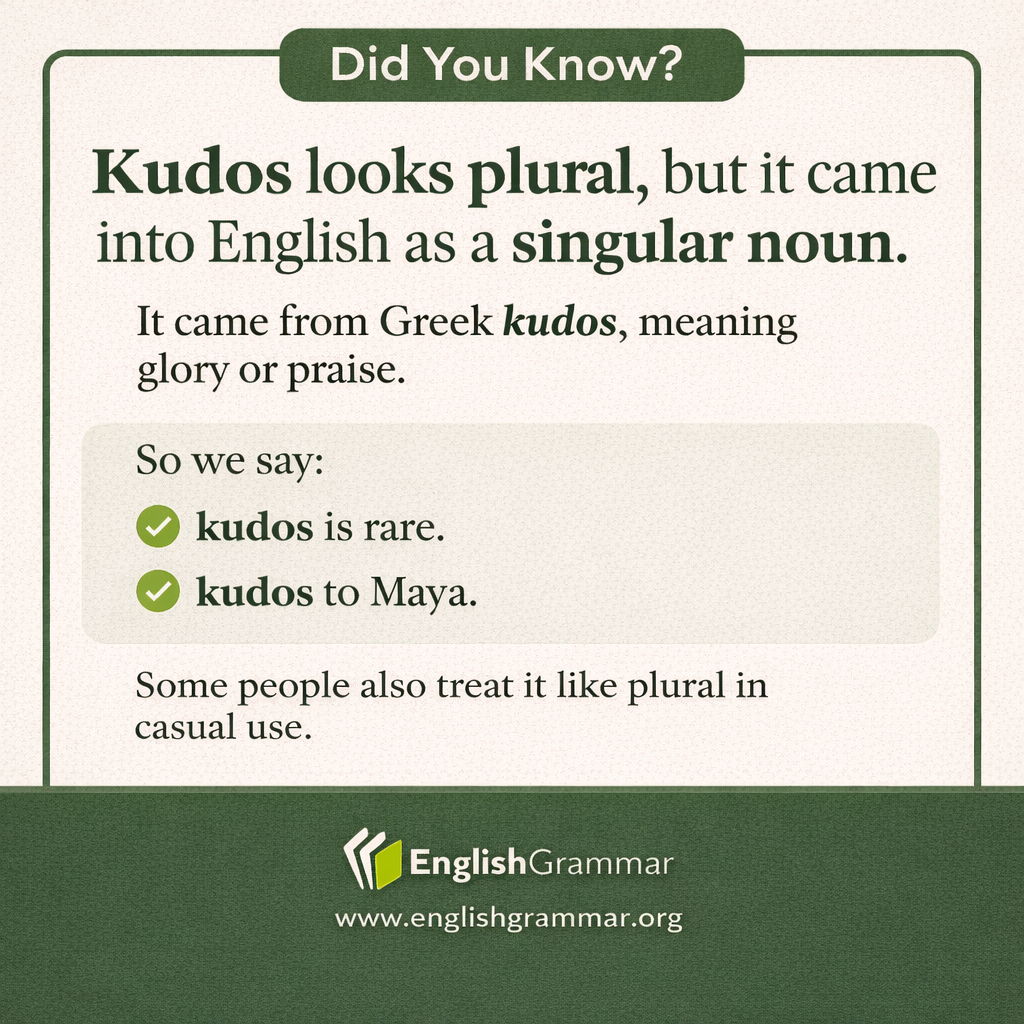
Kudos often looks plural because it ends in s. But historically, English borrowed it as a singular noun from Greek kudos, meaning glory, fame, or praise.
That history explains why careful usage has often treated it as singular. You might see a sentence like, The highest kudos is reserved for the lead researcher. In that kind of use, kudos means praise or acclaim in a general sense.
However, modern English also uses it in a very common set phrase: kudos to Alex for solving the problem. In this expression, people usually do not stop to think about singular or plural grammar. They simply use kudos to mean praise or credit.
Because the word looks plural, some speakers now treat it as plural in casual English. That is why you may occasionally hear something like those kudos are well deserved. Many editors and dictionaries still prefer singular treatment in formal writing, but everyday usage is more mixed than it once was.
- Historical form: Kudos is hard won.
- Common modern phrase: Kudos to Nina for her clear explanation.
- Key point: it looks plural, but it did not start out that way in English.
