
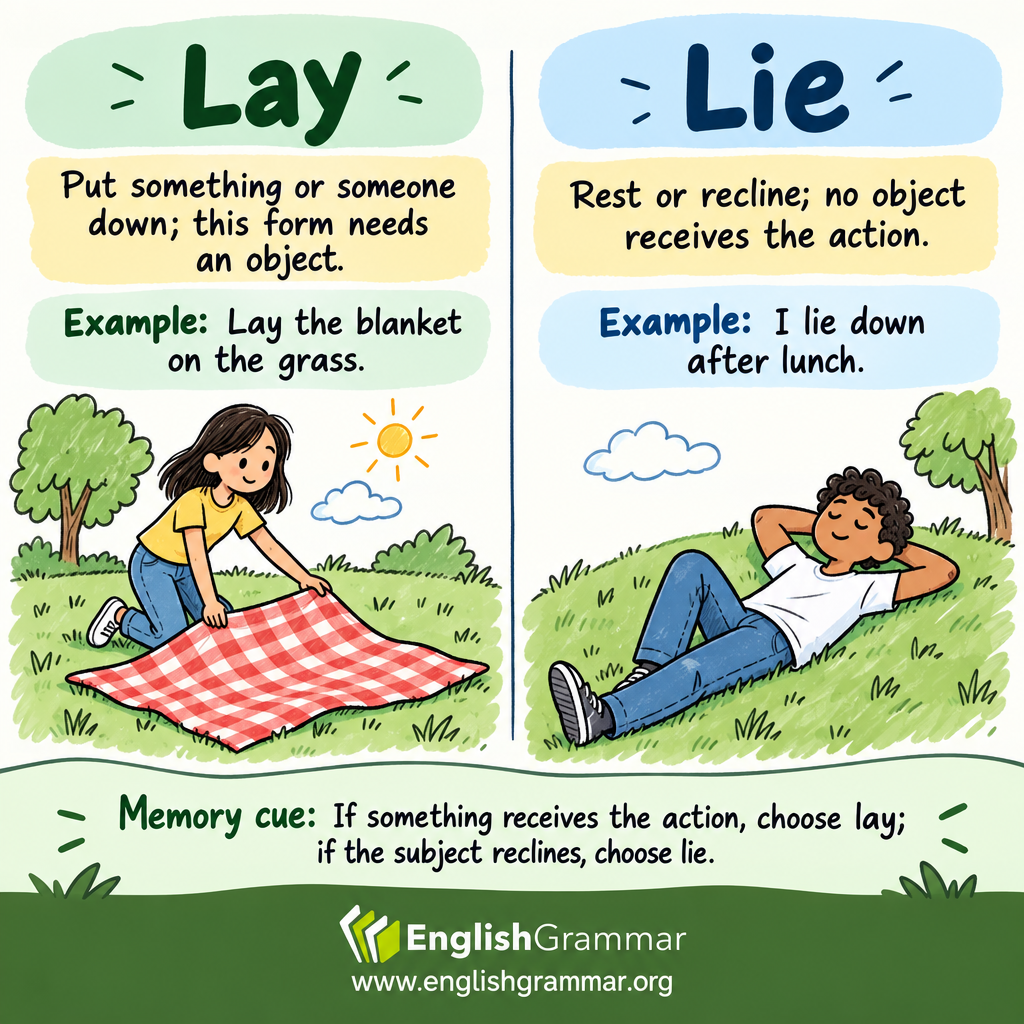
Lay and lie can both describe placing something in a resting position, but they work differently.
Use lay when someone puts a person or thing somewhere. In this meaning, the verb has an object—the person or thing being moved. For example, She lays the book beside her phone. The book receives the action.
Use lie when the subject rests or reclines without moving a separate object. For example, The dog lies near the door every afternoon.
The past-tense forms cause much of the confusion:
- Lay, laid, laid: Today I lay the papers on the desk. Yesterday I laid them there. I have laid them there before.
- Lie, lay, lain: Today I lie on the sofa. Yesterday I lay there. I have lain there for an hour.
This means lay can have two roles. It is the present form of lay, as in Please lay your coat on the chair. It is also the past form of lie, as in He lay awake last night.
The continuous forms are also different: laying belongs to lay, while lying belongs to lie. Compare They are laying tiles with They are lying on the beach.
In informal speech, some speakers use lay where standard edited English uses lie. For school, professional, and formal writing, keeping the traditional distinction is the safest choice.