
• Skip to primary navigation
  • Skip to main content
  • Skip to primary sidebar
Home of English Grammar
  • Home
  • Course
  • Exercises
  • Grammar Rules
  • Matches
  • Posts
  • Tools
    • Grammar Checker
    • Very Replacer
    • Word Counter
  • Vocabulary Lists
  • Archives
    • Social Media Posts
    • Writing Guides
  • Join free

What “like a moth to a flame” means, and where it comes from

September 23, 2026

The origin of "like a moth to a flame"

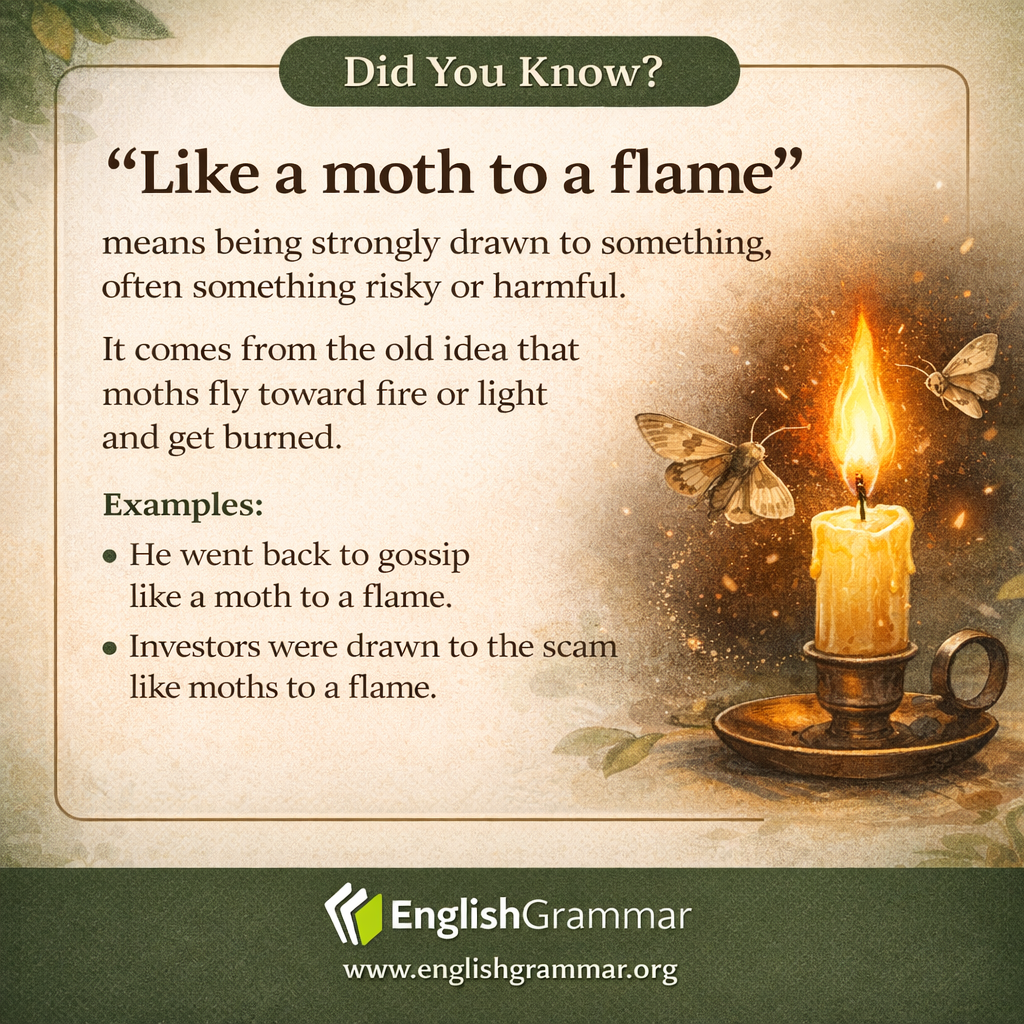
“Like a moth to a flame” describes a person who is powerfully attracted to something, usually even though it may be harmful, risky, or unwise. The idea is not just attraction. It often suggests poor judgment, temptation, or a pattern someone cannot resist.

The image comes from the old observation that moths fly toward light or fire. In the traditional picture, the moth is so drawn to the flame that it gets too close and is burned. That is why the expression often carries a warning, not just a neutral meaning.

People use it for many kinds of situations:

  • Romance: Someone keeps returning to a bad relationship.
  • Trouble: A person is attracted to drama, gossip, or conflict.
  • Risk: People rush toward a dangerous trend or a suspicious investment.

For example, you might say, He is drawn to online arguments like a moth to a flame. You could also say, Tourists gathered around the street performer like moths to a flame. In the second sentence, the tone is lighter, but the expression still suggests a strong, almost automatic pull.

So when you hear this idiom, think of irresistible attraction with a hint of danger.

Improve your English grammar, vocabulary and writing

We take you step by step from beginner to advanced, even if you struggled with English at school or always had trouble remembering the rules.

  • 10 modules, 105 lessons and 688 questions
  • Just log in and learn anytime and from anywhere
  • Your personal progress stored in your account
  • Download the 2026 Grammar Guide (PDF)
Join free

Already have an account? Sign in

See what’s in the course

Primary Sidebar

2.4M761.4K165.8K

Free 2026 Grammar Guide

  • Download Grammar Guide (PDF)
  • Online grammar course, A1 to C2
  • Weekly exercises and vocabulary
  • Join over 3 million English learners

We respect your privacy. Unsubscribe anytime.

Already have an account? Sign in

Grammar Checker - Try Now

Latest Posts

  • Ease vs. alleviate vs. mitigate vs. abate vs. palliate October 15, 2026
  • Look, see, watch, observe, gaze and stare: choosing the right verb October 15, 2026
  • 100 Best Synonyms for “Caused” October 15, 2026
  • 100 Best Synonyms for “Relatability” October 15, 2026
  • 100 Best Synonyms for “Placate” October 15, 2026
  • 100 Best Synonyms for “Unfulfilled” October 15, 2026
  • 100 Best Synonyms for “Cared” October 15, 2026
  • 100 Best Synonyms for “Petulance” October 15, 2026
  • Capitonyms: when capitalization changes meaning October 15, 2026
  • 100 Best Synonyms for “Reiteration” October 15, 2026
Home of English Grammar

Free English grammar exercises, rules and vocabulary lists, with new exercises every week. Join the leading English grammar site with over 3 million followers.

Join free

Learn

  • Exercises
  • Matches
  • Grammar rules
  • Vocabulary lists
  • Writing guides
  • Online tools

More

  • Top social media posts
  • Various posts
  • Contact

Account

  • Join free
  • Grammar Course
  • Free grammar guide (PDF)

Copyright © 2026 EnglishGrammar.org

  • Disclaimer
  • Privacy policy
  • Terms
  • Sitemap