
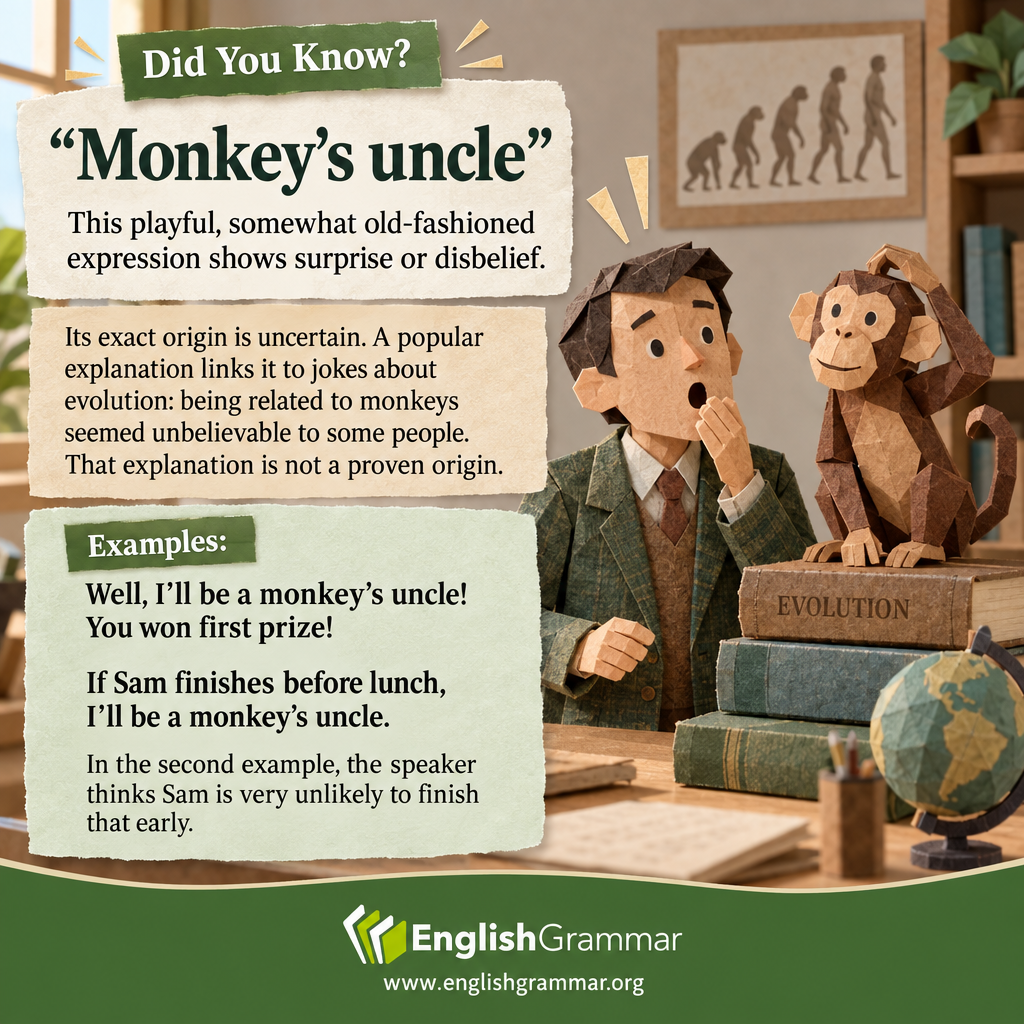
“Monkey’s uncle” is a humorous expression used mainly to show surprise or disbelief. The familiar form is “Well, I’ll be a monkey’s uncle!” It means something like “I’m really surprised!” rather than describing anyone’s actual family.
Its exact origin is uncertain. A popular explanation connects it to jokes about evolution and the idea that humans are related to monkeys. For someone who found that relationship unbelievable, imagining themselves as a monkey’s uncle could express how unlikely something seemed. However, this explanation should not be treated as a proven account of how the expression began.
There is also an important scientific distinction: humans did not descend from the monkeys alive today. Humans and other primates share ancestors. The expression reflects a comic image, not an accurate explanation of evolution.
In modern English, you may encounter two closely related uses:
- Surprise after a discovery: “Well, I’ll be a monkey’s uncle! That old watch still works.” The speaker has discovered something unexpected.
- Disbelief about a possibility: “If Leo gets here before eight, I’ll be a monkey’s uncle.” The speaker thinks Leo is very unlikely to arrive that early.
The expression sounds playful and somewhat old-fashioned. It fits light conversation, jokes, or storytelling better than formal writing. For a more neutral reaction, you can simply say “That’s surprising!” or “I can hardly believe it!”
