
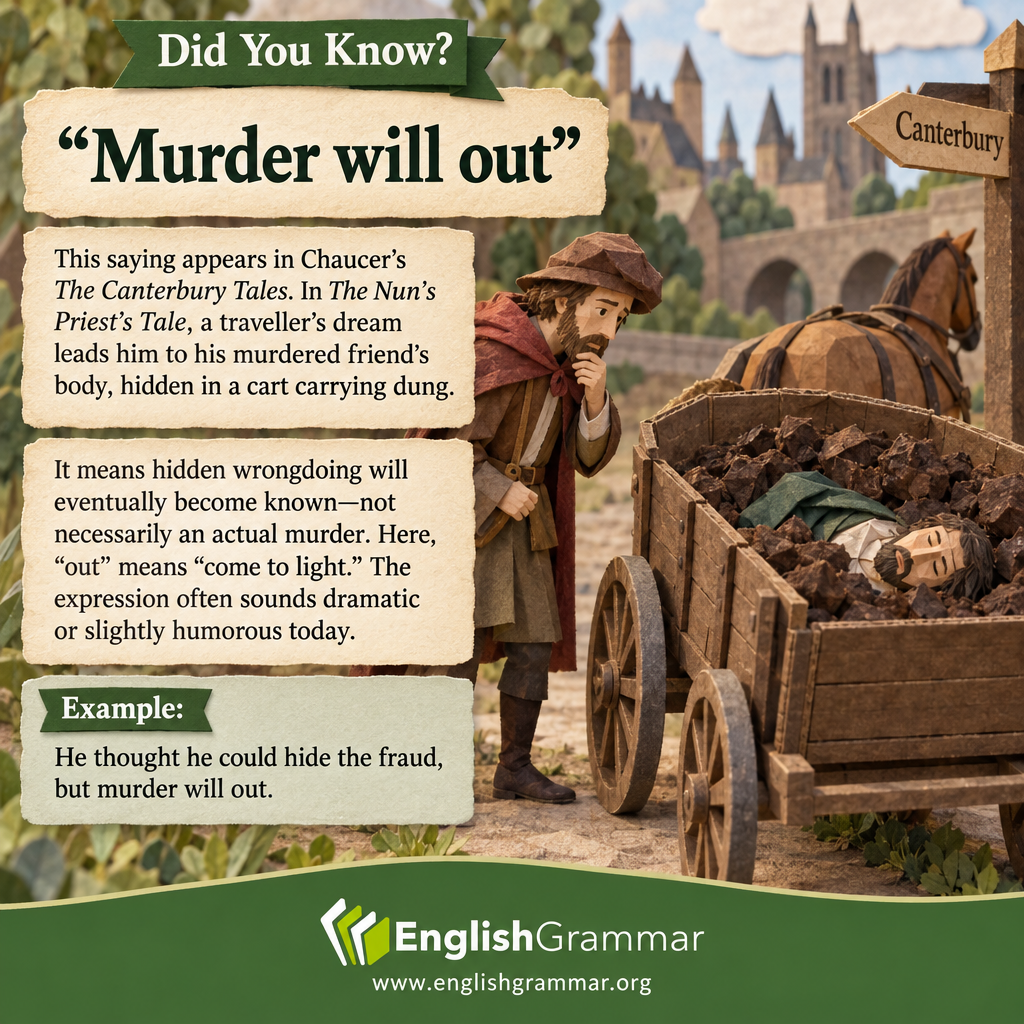
This old saying means that hidden wrongdoing will eventually become known. Although it mentions murder, people also use it about fraud, lies, and other dishonest acts. It expresses the belief that a secret cannot stay hidden forever—not a guarantee that every crime will be solved.
A medieval connection
The expression appears in Geoffrey Chaucer’s The Canterbury Tales, written in the late fourteenth century. In The Nun’s Priest’s Tale, a story about two travelling companions illustrates the idea. One traveller dreams that his friend has been murdered and that the body is hidden in a cart carrying dung. He investigates and discovers the body.
The hidden killing is brought to light, which makes the expression’s meaning concrete. Chaucer’s use shows that the saying is centuries old; it does not prove that he invented it.
What does “out” mean?
Here, out means “become known” or “come to light.” The wording is old-fashioned, but the expression is still used today, often with a dramatic or slightly humorous tone.
Modern examples
- “She deleted the messages to conceal the scam, but murder will out.”
- “The missing money was eventually traced to the manager: murder will out.”
Neither example involves an actual killing. Both use the saying figuratively because someone’s wrongdoing has been exposed. For a small, harmless secret, a simpler expression such as “the secret came out” will usually sound more natural.
