
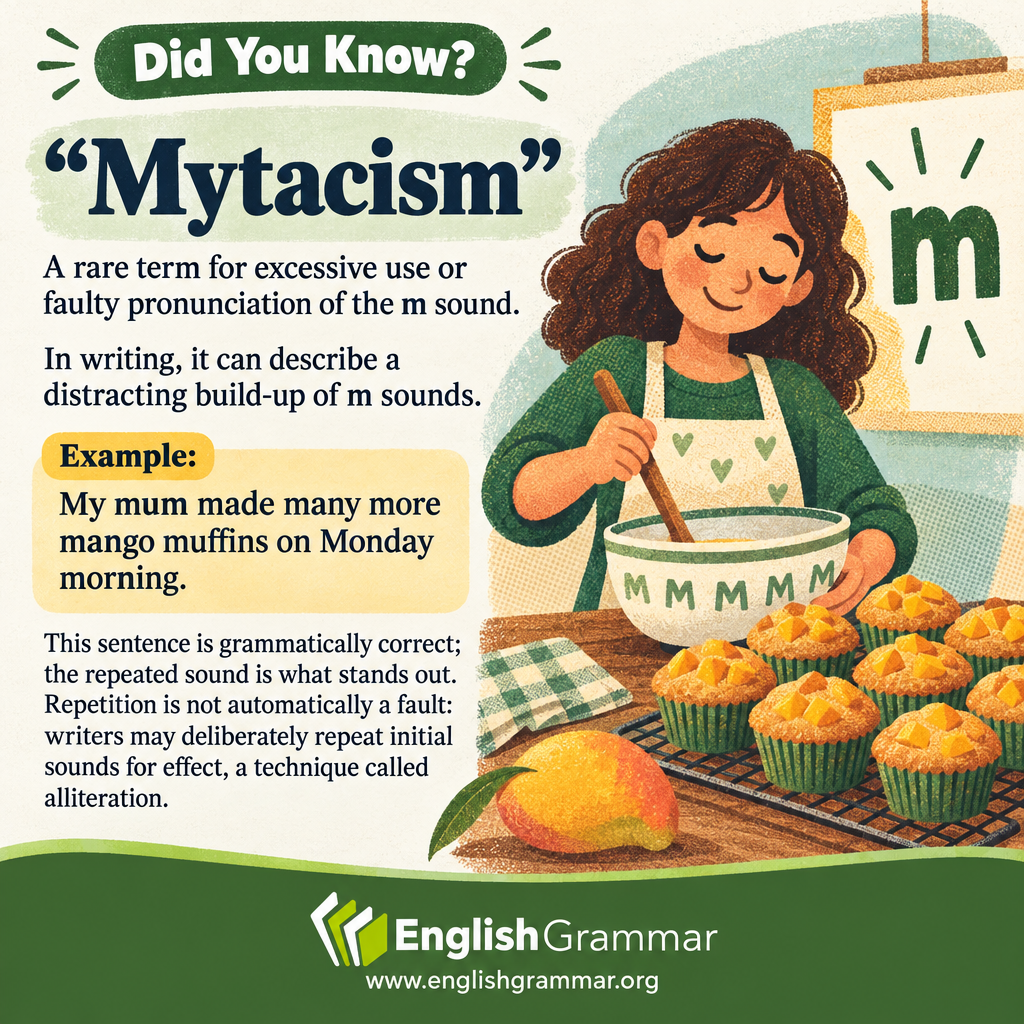
Mytacism is a rare term for excessive use or faulty pronunciation of the m sound. In writing, the concern is how repeated sounds affect a sentence when it is spoken aloud—not simply how many times the letter appears on the page.
Consider this deliberately m-heavy sentence:
- My mum made many more mango muffins on Monday morning.
The sentence is grammatically correct and easy to understand, but its repeated m sounds are very noticeable. If that repetition feels distracting or awkward in context, it could illustrate the excessive-use sense of the term.
A less repetitive version might be:
- On Monday, my mum baked another batch of mango muffins.
The revision keeps the main information while spreading out the repeated sounds. It is not automatically better: the right choice depends on the writer’s purpose.
Repetition is not always a fault. Repeating initial consonant sounds in nearby words is called alliteration. Writers use it deliberately in poems, advertisements, and playful sentences. A phrase such as “moonlit mountain” may create exactly the effect a writer wants.
The faulty-pronunciation sense concerns how the sound is produced, rather than how often it occurs. These are different concerns, so context matters when interpreting the word.
For everyday editing, read the sentence aloud. Decide whether the repeated sound supports the tone or draws unwanted attention away from the message.