
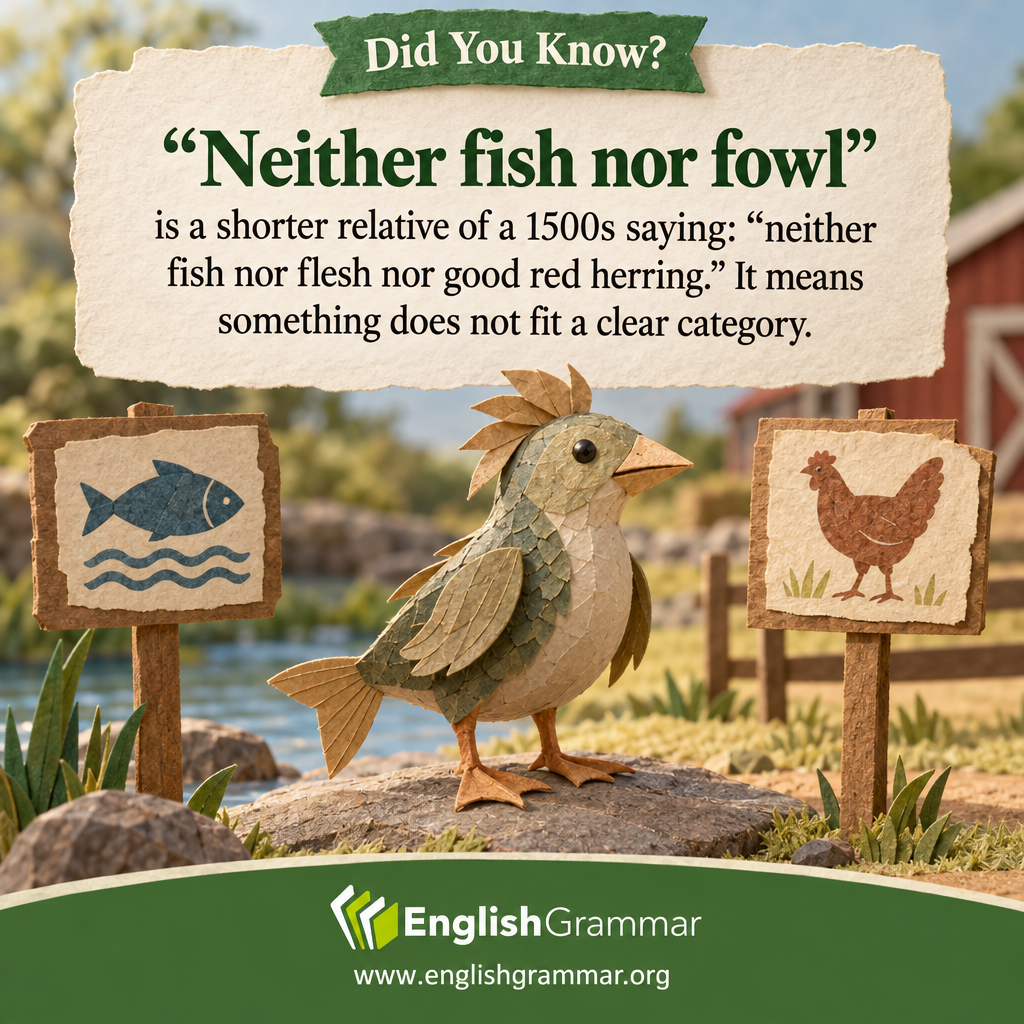
“Neither fish nor fowl” has a longer, fishier relative. An earlier expression, recorded in the sixteenth century, was “neither fish nor flesh nor good red herring.” The modern phrase belongs to this old family of sayings about things that do not fit familiar categories.
The food words make the comparison concrete. Flesh here means meat, while fowl means birds, especially those kept or hunted for food. A red herring was a strongly cured, smoked fish. The older saying used a list of familiar foods to suggest that something belonged to none of the expected groups.
Today, the expression usually has nothing to do with food. Use it when something is hard to classify, especially when it sits awkwardly between two kinds of thing. It can suggest criticism: the speaker may think the mixture does not work well.
- Example: “The film is neither fish nor fowl: it is too serious to be a comedy but too silly to be a convincing drama.”
- Contrast: “The film combines comedy and drama successfully.” This describes a mixture without suggesting that it fails to fit.
The idiom is therefore not simply another way to say “different.” It points to an unclear identity or category. A thing can be unusual and still be easy to classify; this expression suggests that the usual labels do not quite suit it.
