

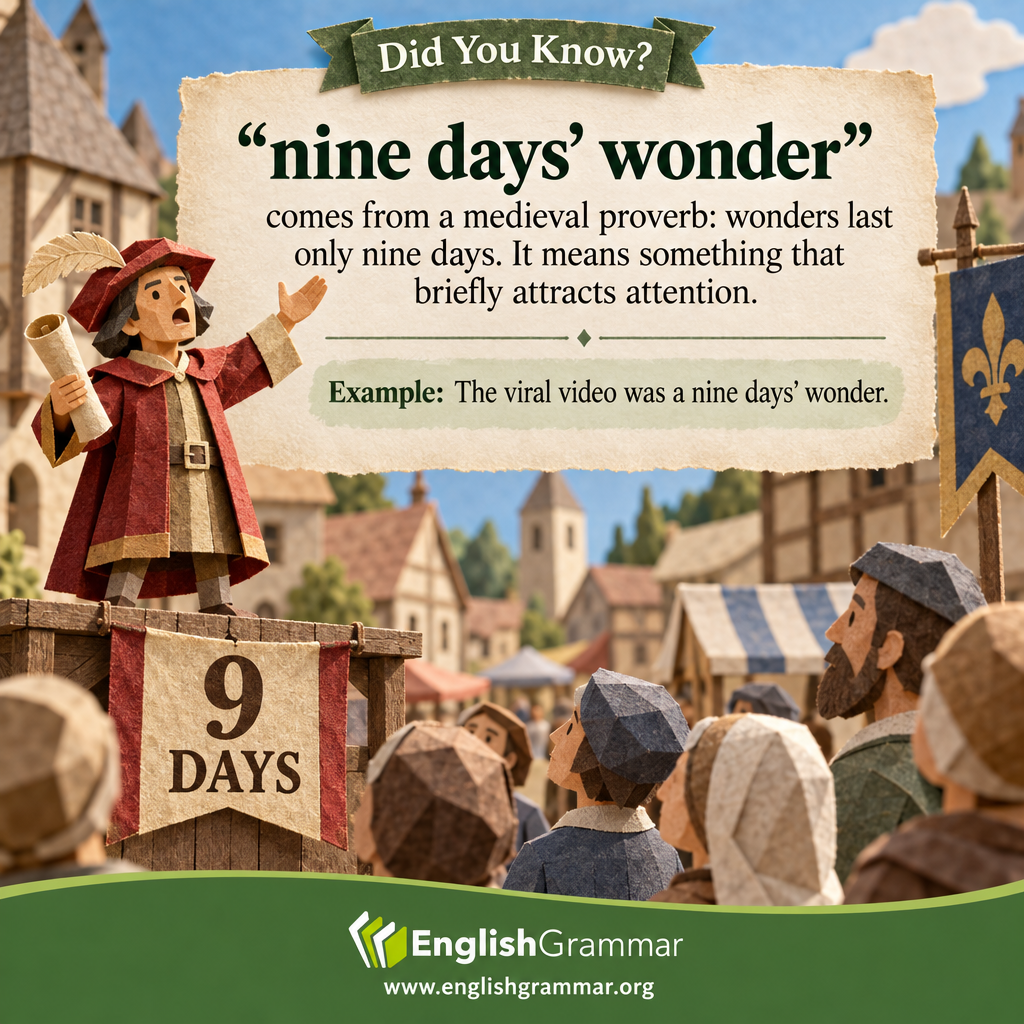
A “nine days’ wonder” is something that attracts a lot of attention but is soon forgotten. Despite sounding like a description of modern internet fame, the expression has medieval roots.
It grew out of an old proverb expressing the idea that a wonder lasts only nine days. Here, wonder means something surprising or remarkable that people talk about. Chaucer’s Troilus and Criseyde, written in the late fourteenth century, includes a version of this saying. The idea was already familiar long before social media could make a story famous overnight.
The number nine is not a literal deadline in everyday use. You do not need to count how many days the attention lasts. The expression’s useful meaning is that the excitement fades quickly. The proverb records that idea, but it does not establish exactly why nine was originally chosen.
- Example: “The viral video was a nine days’ wonder; a week later, everyone had moved on.”
- Contrast: “Her first song was no nine days’ wonder: people were still listening to it years later.”
Use the expression when you want to emphasise the gap between a big initial reaction and a short-lived impact. It often suggests that something seemed more important or impressive at first than it proved to be.
