Home of English Grammar

Grammar Guide
  • Home
  • Exercises
  • Matches
  • Rules
  • Tools
    • Grammar Checker
    • Very Replacer
    • Word Counter
  • Top Social Media Posts
  • Various Posts
  • Vocabulary
  • Writing Guides
  • Contact

The origin of “lame duck” and what it means now

September 13, 2026 - pdf

The origin of "lame duck"

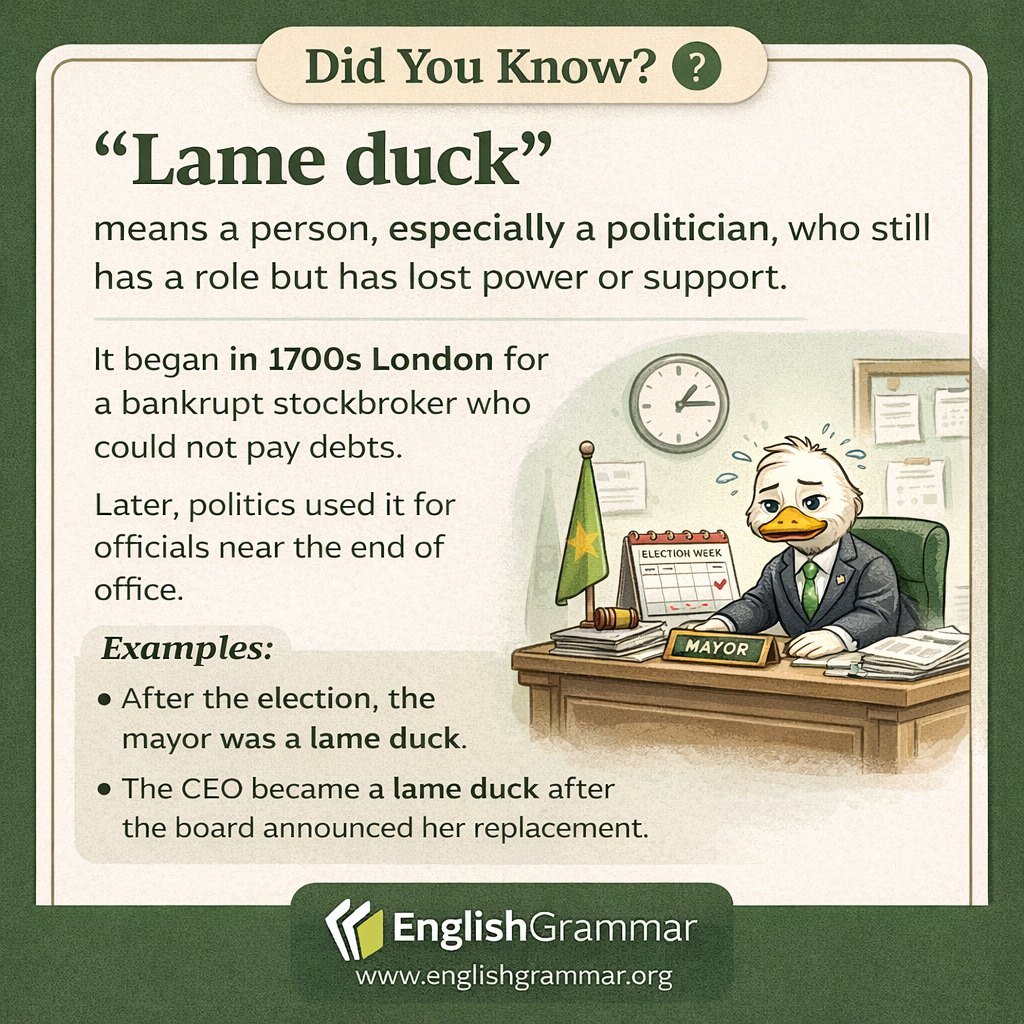
“Lame duck” now usually means someone who still holds an official position but has lost real influence, support, or authority. It is especially common in politics. A president, mayor, or other officeholder may be called this after losing an election, announcing retirement, or reaching the final period of a term.

The expression did not begin in politics. In 1700s London, it was used for a stockbroker who could not pay debts. The image was of someone weakened and unable to move effectively. That idea later shifted into political language, where it came to describe officials who were still in office but no longer strong enough to lead freely.

Today, the phrase is often used in these situations:

  • After an election loss: The senator became a lame duck after voters chose her successor.
  • Near the end of a final term: With only weeks left in office, he was seen as a lame duck.
  • After a replacement is announced: Once the board named a new director, the old director looked like a lame duck.

The key idea is not physical injury. It is reduced power. The person may still have the title, but others know the influence is fading.

  • Share
  • Post
  • Post
  • Reddit
  • Email
  • WhatsApp
NEW: Try Matches, our daily vocabulary challenge. Pick a topic and level and match words with definitions to boost your vocabulary.
2,485,429 
761,532 
Improve Your Grammar
  • Download 2026 Grammar Guide (PDF)
  • Free Weekly Exercises & Vocabulary
  • Join over 3 Million English Learners
We respect your privacy. Unsubscribe anytime.

Grammar Checker

GrammarCheck.net - Try online
Hint → Bookmark GrammarCheck for future use.

Latest Posts

  • The origin of “lame duck” and what it means now September 13, 2026
  • 100 Best Synonyms for “Offended” September 13, 2026
  • 100 Best Synonyms for “Encompasses” September 13, 2026
  • 100 Best Synonyms for “Familiar” September 12, 2026
  • 100 Words Every Script Supervisor Should Know September 12, 2026
  • 100 Best Synonyms for “Lovable” September 12, 2026
  • Forward vs. foreword: what is the difference? September 12, 2026

Copyright © 2026 · EnglishGrammar.org
Disclaimer · Pro · Privacy Policy · Refund Policy · Sitemap · Terms

Improve Your Grammar
  • Download 2026 Grammar Guide (PDF)
  • Free Weekly Exercises & Vocabulary
  • Join over 3 Million English Learners
We respect your privacy. Unsubscribe anytime.