
• Skip to primary navigation
  • Skip to main content
  • Skip to primary sidebar
Home of English Grammar
  • Home
  • Course
  • Exercises
  • Grammar Rules
  • Vocabulary Matches
  • Posts
  • Tools
    • Grammar Checker
    • Very Replacer
    • Word Counter
  • Vocabulary Lists
  • Archives
    • Social Media Posts
    • Writing Guides
  • Sign in
  • Join free

The origin of “steal someone’s thunder”

May 10, 2026

The origin of "steal someone’s thunder"

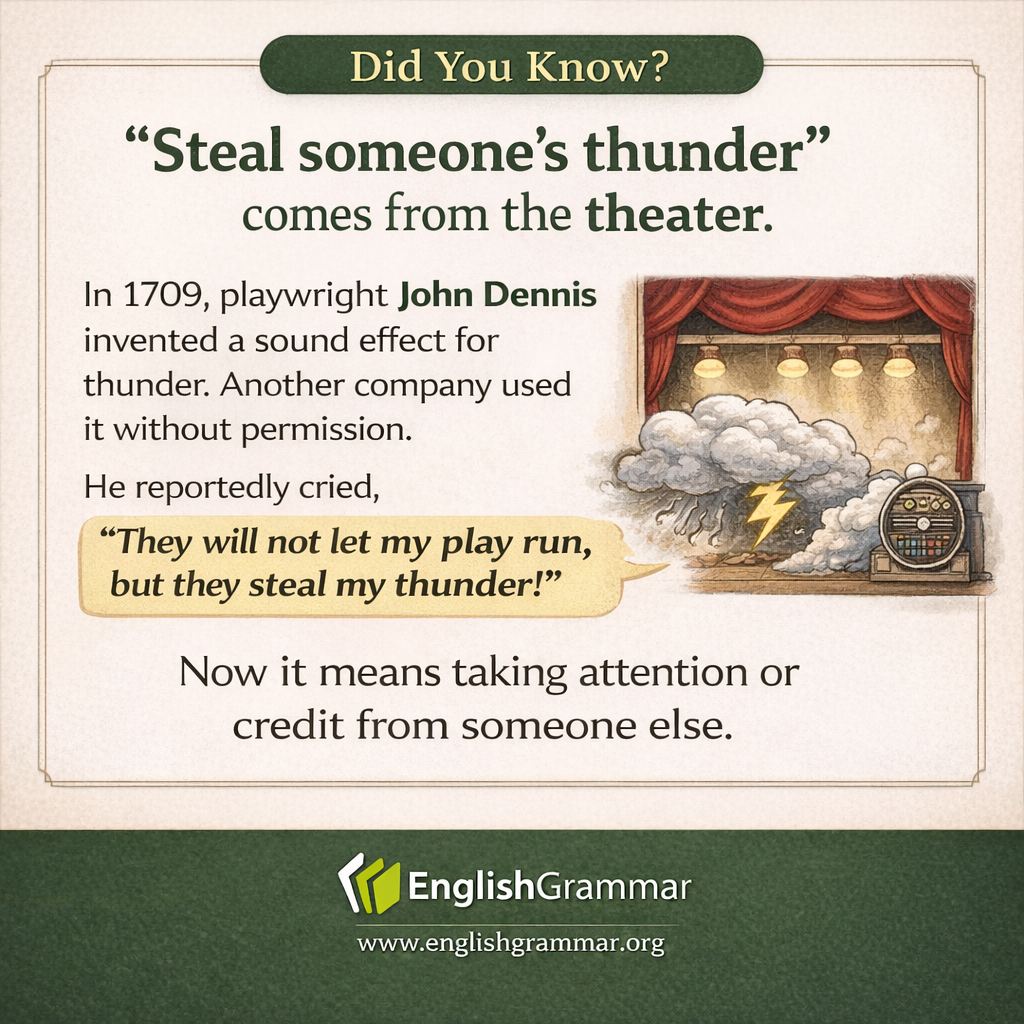
“Steal someone’s thunder” has a wonderfully literal origin. It is usually traced to the English playwright John Dennis, who created a new method for making thunder sounds in the theater in 1709. His play did not succeed, but another theater company reportedly used his thunder effect anyway.

According to the famous story, Dennis complained, “They will not let my play run, but they steal my thunder!” That complaint is where the idiom comes from. At first, it referred quite directly to taking someone else’s idea or stage effect. Over time, the meaning widened.

Today, the phrase usually means taking attention, praise, or impact away from someone else, especially at the wrong moment.

  • Taking attention: Announcing your promotion at your friend’s party can steal their thunder.
  • Taking credit: Presenting a coworker’s idea as your own can steal their thunder.
  • Ruining a reveal: Sharing the ending of someone’s story before they tell it can steal their thunder.

So the idiom started with actual thunder, but now it is used for any moment when one person unfairly takes the spotlight from another.

Improve your English grammar, vocabulary and writing

We take you step by step from beginner to advanced, even if you struggled with English at school or have always had trouble remembering the rules.

  • 10 modules, 112 lessons and 730 questions
  • Just log in and learn anytime and anywhere
  • Your progress is saved in your account
  • Download the 2027 Grammar Guide (PDF)
Join free

Already have an account? Sign in

See what’s in the course

Primary Sidebar

2.4M760.9K165.9K

Free 2027 Grammar Guide

  • Download Grammar Guide (PDF)
  • Online grammar course, A1 to C2
  • Weekly exercises and vocabulary
  • Join over 3 million English learners

We respect your privacy. Unsubscribe anytime.

Already have an account? Sign in

Grammar Checker - Try Now

Latest Posts

  • Must and Have To for Obligation Exercise November 4, 2026
  • 100 Best Synonyms for “Chic” November 4, 2026
  • 100 Best Synonyms for “Vision” November 4, 2026
  • 100 Best Synonyms for “Inevitable” November 4, 2026
  • 100 Best Synonyms for “Retributive” November 3, 2026
  • 100 Best Synonyms for “Vary” November 3, 2026
  • 100 Best Synonyms for “Individuals” November 3, 2026
  • Temporary vs. passing vs. fleeting vs. transient vs. ephemeral vs. evanescent November 3, 2026
  • 100 Best Synonyms for “Restless” November 3, 2026
  • Hard, firm, solid, rigid, stiff and unyielding: How to choose November 3, 2026
Home of English Grammar

Free English grammar exercises, rules and vocabulary lists, with new exercises every week. Join the leading English grammar site with over 3 million followers.

Join free

Learn

  • Exercises
  • Matches
  • Grammar rules
  • Vocabulary lists
  • Writing guides
  • Online tools

More

  • Top social media posts
  • Various posts
  • Contact

Account

  • Join free
  • Grammar Course
  • Free grammar guide (PDF)

Copyright © 2026 EnglishGrammar.org

  • Disclaimer
  • Privacy policy
  • Terms
  • Sitemap