
Home of English Grammar

Grammar Guide
  • Home
  • Exercises
  • Matches
  • Rules
  • Tools
    • Grammar Checker
    • Very Replacer
    • Word Counter
  • Top Social Media Posts
  • Various Posts
  • Vocabulary
  • Writing Guides
  • Contact

How pea was created by mistake

April 8, 2026 - pdf

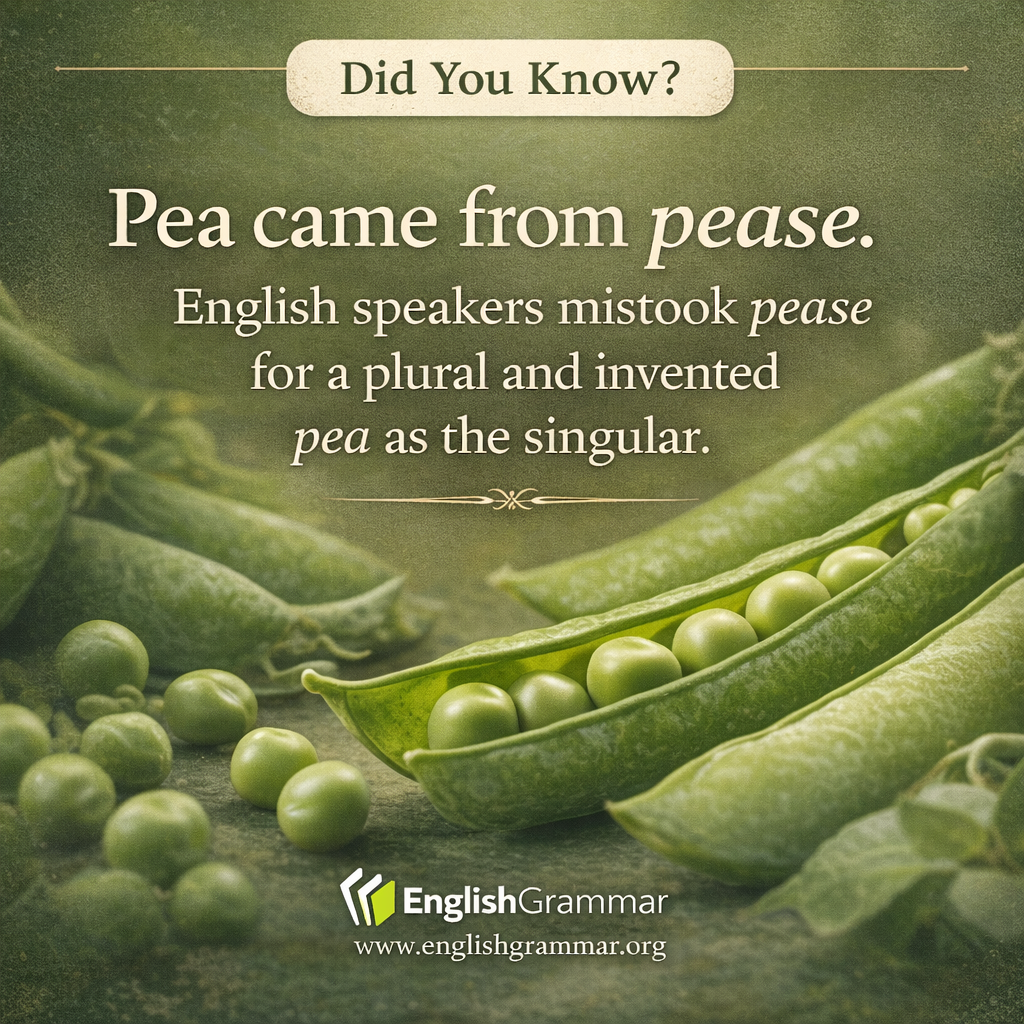
"Pea" was created by mistake.

Pea feels like the obvious singular of peas, but historically it was created by mistake. The older English word was pease, a mass noun, much like rice or oatmeal. People could talk about some pease, not just one pea.

Over time, speakers began to hear the final s in pease as a plural ending. Once that happened, English naturally formed a new singular by removing the s, giving us pea. Linguists call this process back formation, when a new word is made by taking away what seems to be an ending.

A simple contrast shows the change:

  • Older usage: I ate some pease.
  • Later usage: I ate a pea. and I ate some peas.

This kind of change is common in language. Speakers look for familiar patterns, and sometimes they reshape older words to fit them. So pea is standard modern English, but it exists because people reanalyzed pease as if it were already plural.

  • Share
  • Post
  • Post
  • Email
NEW: Try Matches, our daily vocabulary challenge. Pick a topic and level and match words with definitions to boost your vocabulary.
2,485,429 
761,532 
Improve Your Grammar
  • Download 2026 Grammar Guide (PDF)
  • Free Weekly Exercises & Vocabulary
  • Join over 3 Million English Learners
We respect your privacy. Unsubscribe anytime.

Grammar Checker

GrammarCheck.net - Try online
Hint → Bookmark GrammarCheck for future use.

Latest Posts

  • 100 One-Word Substitutions to Describe Feelings May 1, 2026
  • 100 Homophones You Should Know May 1, 2026
  • 100 Words to Describe Hope May 1, 2026
  • Hither, thither, whither: old direction words in English May 1, 2026
  • 100 Examples of Simple Sentences May 1, 2026
  • 100 Other Words for “Careless” May 1, 2026
  • 100 Words Every Sailor Should Know May 1, 2026

Copyright © 2026 · EnglishGrammar.org
Disclaimer · Privacy Policy · Sitemap · Terms

Improve Your Grammar
  • Download 2026 Grammar Guide (PDF)
  • Free Weekly Exercises & Vocabulary
  • Join over 3 Million English Learners
We respect your privacy. Unsubscribe anytime.