
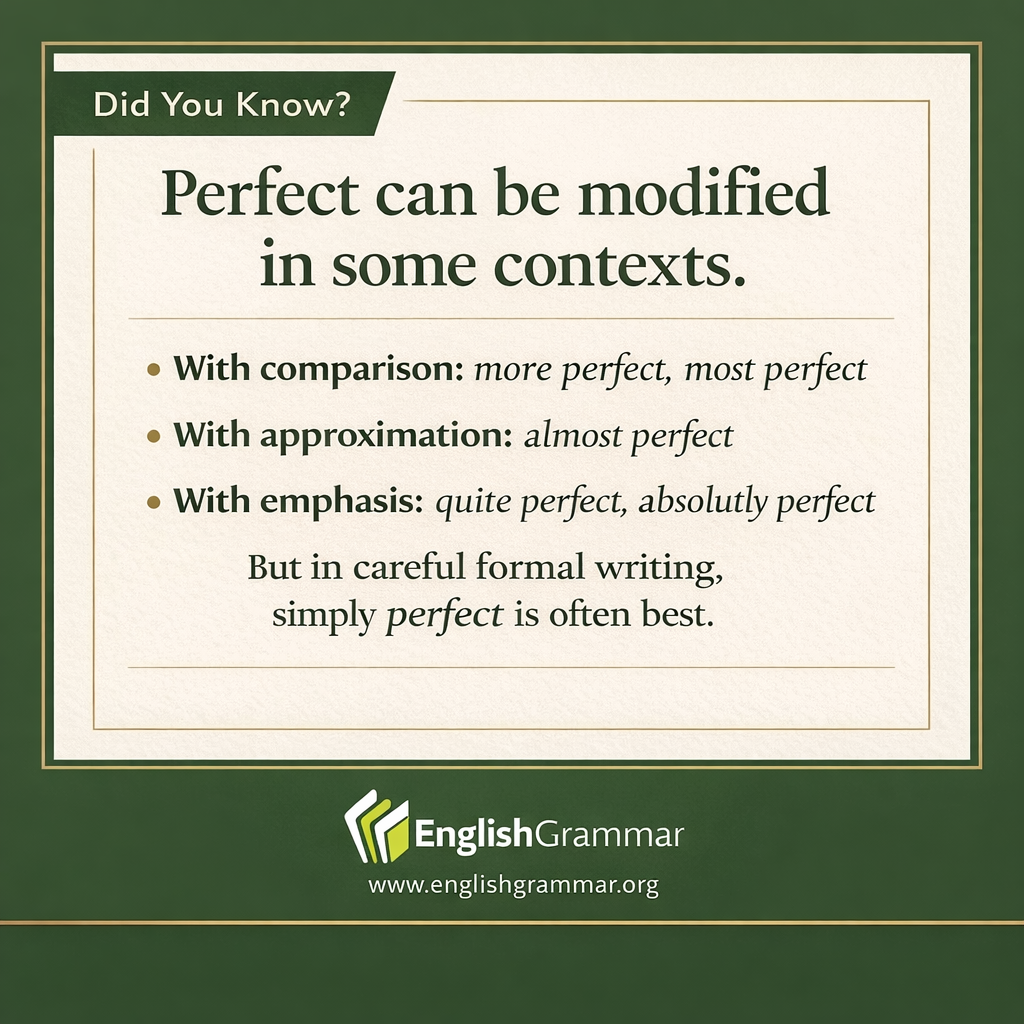
Perfect is often described as an absolute adjective, meaning it already expresses a complete idea: something is perfect, not partly perfect. That is why many style guides prefer perfect on its own in careful formal writing.
But actual English is more flexible. Speakers and writers sometimes modify perfect for clear reasons.
- Comparison: people may say more perfect or most perfect when comparing two very strong versions of the same quality. A famous example is a more perfect Union.
- Approximation: phrases like almost perfect mean something is very close to perfection, but not fully there.
- Emphasis: expressions such as quite perfect or absolutely perfect are used to intensify the idea.
So is more perfect wrong? Not always. It can sound natural in rhetoric, literature, conversation, and some comparisons. Still, if you want the safest formal choice, use perfect alone unless the modifier adds a real meaning. For example, The solution is perfect is usually cleaner than The solution is very perfect.
