
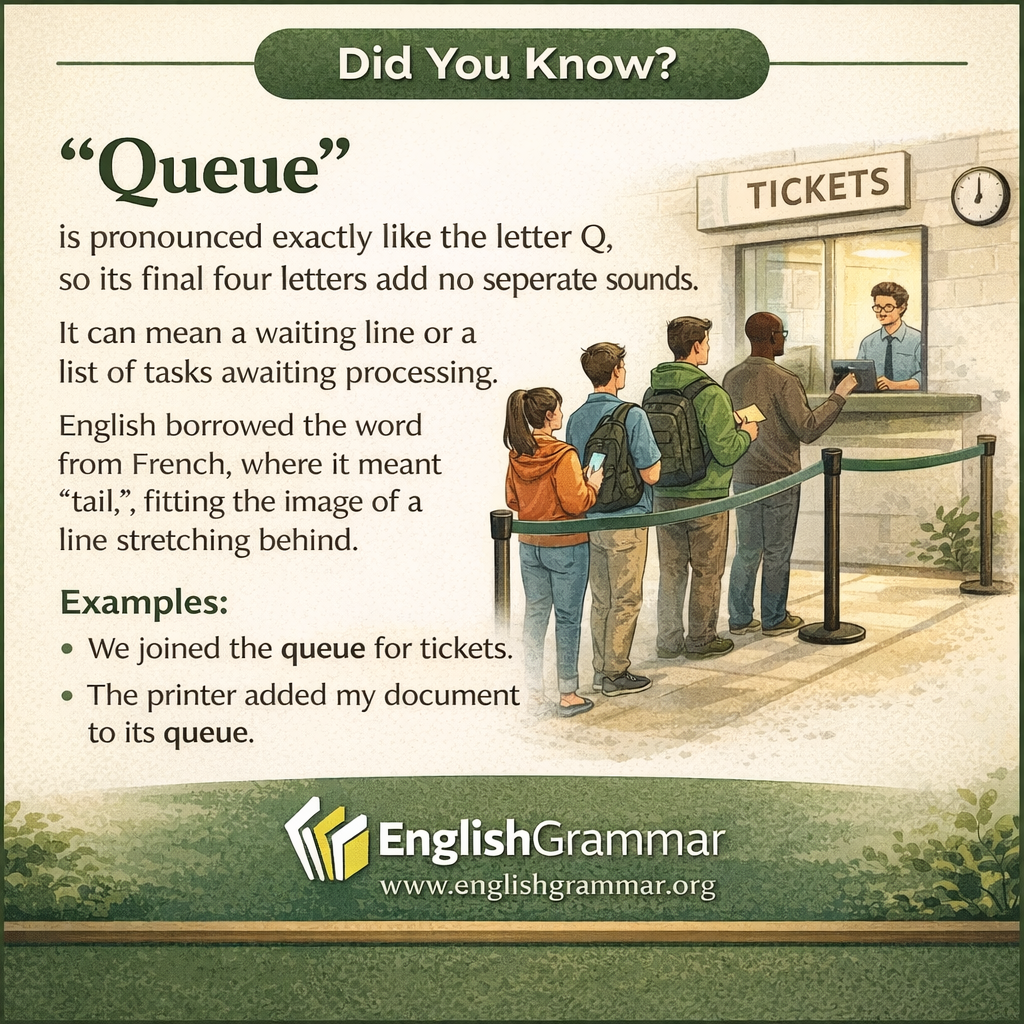
“Queue” is pronounced exactly like the English letter Q. The final ueue is not separately heard, which creates the familiar description of Q followed by four silent letters. That description is useful wordplay rather than a strict linguistic analysis. In English spelling, several letters can work together to represent a sound, so linguists do not always assign one sound to each letter.
The spelling has a historical explanation. English borrowed the word from French, where it meant “tail.” In English, it also referred to a braid hanging behind the head. The later sense of a waiting line fits the same visual idea: one person or object follows another like a tail. This history helps explain why the spelling contains letters that are no longer obvious in its pronunciation.
Today, the noun has two especially common uses. In everyday British English, it often means a line of people or vehicles waiting their turn. In computing and office systems, it means an ordered list of jobs, messages, or files waiting to be handled. As a verb, it can mean to join a line or place something on a waiting list.
- We joined the queue outside the theater.
- Three documents are waiting in the printer queue.
- Please queue the songs for tonight’s event.
American English often uses line for people waiting, but queue remains familiar, especially in technology. In every context, the central idea is order: each person or item waits until its turn arrives.