
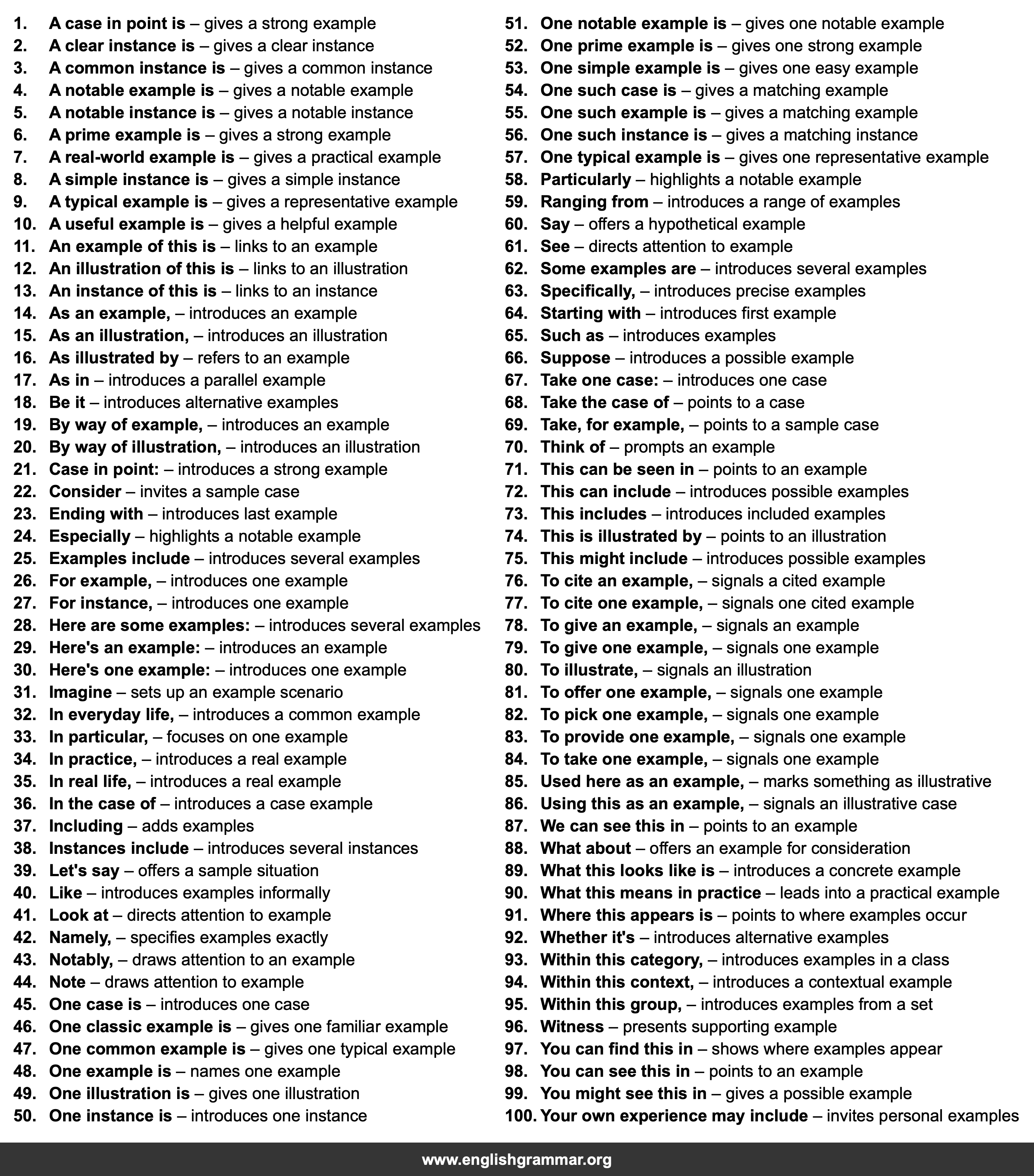
| No. | Item | Definition |
|---|---|---|
| 1. | A case in point is | gives a strong example |
| 2. | A clear instance is | gives a clear instance |
| 3. | A common instance is | gives a common instance |
| 4. | A notable example is | gives a notable example |
| 5. | A notable instance is | gives a notable instance |
| 6. | A prime example is | gives a strong example |
| 7. | A real-world example is | gives a practical example |
| 8. | A simple instance is | gives a simple instance |
| 9. | A typical example is | gives a representative example |
| 10. | A useful example is | gives a helpful example |
| 11. | An example of this is | links to an example |
| 12. | An illustration of this is | links to an illustration |
| 13. | An instance of this is | links to an instance |
| 14. | As an example, | introduces an example |
| 15. | As an illustration, | introduces an illustration |
| 16. | As illustrated by | refers to an example |
| 17. | As in | introduces a parallel example |
| 18. | Be it | introduces alternative examples |
| 19. | By way of example, | introduces an example |
| 20. | By way of illustration, | introduces an illustration |
| 21. | Case in point: | introduces a strong example |
| 22. | Consider | invites a sample case |
| 23. | Ending with | introduces last example |
| 24. | Especially | highlights a notable example |
| 25. | Examples include | introduces several examples |
| 26. | For example, | introduces one example |
| 27. | For instance, | introduces one example |
| 28. | Here are some examples: | introduces several examples |
| 29. | Here’s an example: | introduces an example |
| 30. | Here’s one example: | introduces one example |
| 31. | Imagine | sets up an example scenario |
| 32. | In everyday life, | introduces a common example |
| 33. | In particular, | focuses on one example |
| 34. | In practice, | introduces a real example |
| 35. | In real life, | introduces a real example |
| 36. | In the case of | introduces a case example |
| 37. | Including | adds examples |
| 38. | Instances include | introduces several instances |
| 39. | Let’s say | offers a sample situation |
| 40. | Like | introduces examples informally |
| 41. | Look at | directs attention to example |
| 42. | Namely, | specifies examples exactly |
| 43. | Notably, | draws attention to an example |
| 44. | Note | draws attention to example |
| 45. | One case is | introduces one case |
| 46. | One classic example is | gives one familiar example |
| 47. | One common example is | gives one typical example |
| 48. | One example is | names one example |
| 49. | One illustration is | gives one illustration |
| 50. | One instance is | introduces one instance |
| 51. | One notable example is | gives one notable example |
| 52. | One prime example is | gives one strong example |
| 53. | One simple example is | gives one easy example |
| 54. | One such case is | gives a matching example |
| 55. | One such example is | gives a matching example |
| 56. | One such instance is | gives a matching instance |
| 57. | One typical example is | gives one representative example |
| 58. | Particularly | highlights a notable example |
| 59. | Ranging from | introduces a range of examples |
| 60. | Say | offers a hypothetical example |
| 61. | See | directs attention to example |
| 62. | Some examples are | introduces several examples |
| 63. | Specifically, | introduces precise examples |
| 64. | Starting with | introduces first example |
| 65. | Such as | introduces examples |
| 66. | Suppose | introduces a possible example |
| 67. | Take one case: | introduces one case |
| 68. | Take the case of | points to a case |
| 69. | Take, for example, | points to a sample case |
| 70. | Think of | prompts an example |
| 71. | This can be seen in | points to an example |
| 72. | This can include | introduces possible examples |
| 73. | This includes | introduces included examples |
| 74. | This is illustrated by | points to an illustration |
| 75. | This might include | introduces possible examples |
| 76. | To cite an example, | signals a cited example |
| 77. | To cite one example, | signals one cited example |
| 78. | To give an example, | signals an example |
| 79. | To give one example, | signals one example |
| 80. | To illustrate, | signals an illustration |
| 81. | To offer one example, | signals one example |
| 82. | To pick one example, | signals one example |
| 83. | To provide one example, | signals one example |
| 84. | To take one example, | signals one example |
| 85. | Used here as an example, | marks something as illustrative |
| 86. | Using this as an example, | signals an illustrative case |
| 87. | We can see this in | points to an example |
| 88. | What about | offers an example for consideration |
| 89. | What this looks like is | introduces a concrete example |
| 90. | What this means in practice | leads into a practical example |
| 91. | Where this appears is | points to where examples occur |
| 92. | Whether it’s | introduces alternative examples |
| 93. | Within this category, | introduces examples in a class |
| 94. | Within this context, | introduces a contextual example |
| 95. | Within this group, | introduces examples from a set |
| 96. | Witness | presents supporting example |
| 97. | You can find this in | shows where examples appear |
| 98. | You can see this in | points to an example |
| 99. | You might see this in | gives a possible example |
| 100. | Your own experience may include | invites personal examples |