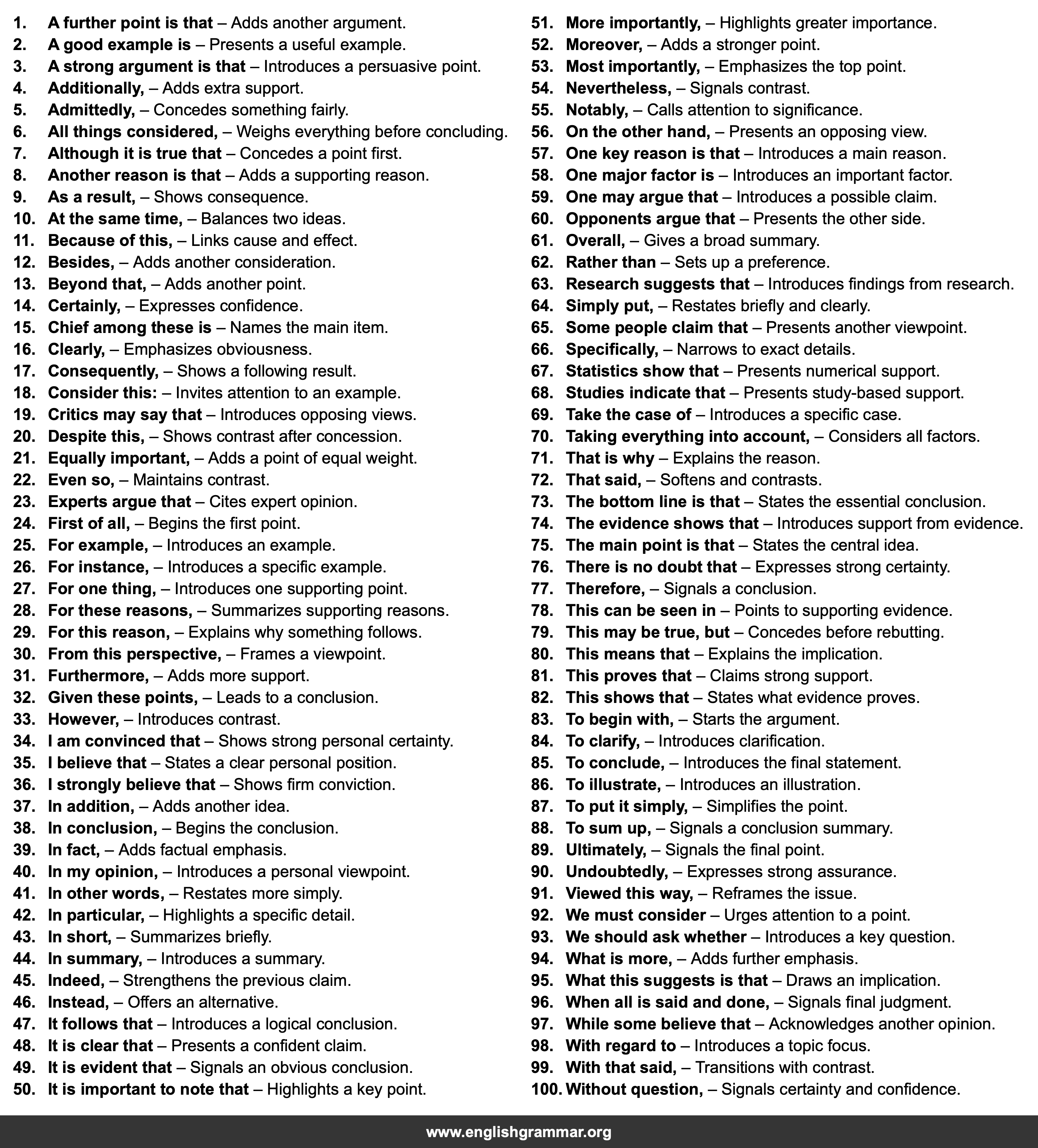
| No. | Item | Definition |
|---|---|---|
| 1. | A further point is that | Adds another argument. |
| 2. | A good example is | Presents a useful example. |
| 3. | A strong argument is that | Introduces a persuasive point. |
| 4. | Additionally, | Adds extra support. |
| 5. | Admittedly, | Concedes something fairly. |
| 6. | All things considered, | Weighs everything before concluding. |
| 7. | Although it is true that | Concedes a point first. |
| 8. | Another reason is that | Adds a supporting reason. |
| 9. | As a result, | Shows consequence. |
| 10. | At the same time, | Balances two ideas. |
| 11. | Because of this, | Links cause and effect. |
| 12. | Besides, | Adds another consideration. |
| 13. | Beyond that, | Adds another point. |
| 14. | Certainly, | Expresses confidence. |
| 15. | Chief among these is | Names the main item. |
| 16. | Clearly, | Emphasizes obviousness. |
| 17. | Consequently, | Shows a following result. |
| 18. | Consider this: | Invites attention to an example. |
| 19. | Critics may say that | Introduces opposing views. |
| 20. | Despite this, | Shows contrast after concession. |
| 21. | Equally important, | Adds a point of equal weight. |
| 22. | Even so, | Maintains contrast. |
| 23. | Experts argue that | Cites expert opinion. |
| 24. | First of all, | Begins the first point. |
| 25. | For example, | Introduces an example. |
| 26. | For instance, | Introduces a specific example. |
| 27. | For one thing, | Introduces one supporting point. |
| 28. | For these reasons, | Summarizes supporting reasons. |
| 29. | For this reason, | Explains why something follows. |
| 30. | From this perspective, | Frames a viewpoint. |
| 31. | Furthermore, | Adds more support. |
| 32. | Given these points, | Leads to a conclusion. |
| 33. | However, | Introduces contrast. |
| 34. | I am convinced that | Shows strong personal certainty. |
| 35. | I believe that | States a clear personal position. |
| 36. | I strongly believe that | Shows firm conviction. |
| 37. | In addition, | Adds another idea. |
| 38. | In conclusion, | Begins the conclusion. |
| 39. | In fact, | Adds factual emphasis. |
| 40. | In my opinion, | Introduces a personal viewpoint. |
| 41. | In other words, | Restates more simply. |
| 42. | In particular, | Highlights a specific detail. |
| 43. | In short, | Summarizes briefly. |
| 44. | In summary, | Introduces a summary. |
| 45. | Indeed, | Strengthens the previous claim. |
| 46. | Instead, | Offers an alternative. |
| 47. | It follows that | Introduces a logical conclusion. |
| 48. | It is clear that | Presents a confident claim. |
| 49. | It is evident that | Signals an obvious conclusion. |
| 50. | It is important to note that | Highlights a key point. |
| 51. | More importantly, | Highlights greater importance. |
| 52. | Moreover, | Adds a stronger point. |
| 53. | Most importantly, | Emphasizes the top point. |
| 54. | Nevertheless, | Signals contrast. |
| 55. | Notably, | Calls attention to significance. |
| 56. | On the other hand, | Presents an opposing view. |
| 57. | One key reason is that | Introduces a main reason. |
| 58. | One major factor is | Introduces an important factor. |
| 59. | One may argue that | Introduces a possible claim. |
| 60. | Opponents argue that | Presents the other side. |
| 61. | Overall, | Gives a broad summary. |
| 62. | Rather than | Sets up a preference. |
| 63. | Research suggests that | Introduces findings from research. |
| 64. | Simply put, | Restates briefly and clearly. |
| 65. | Some people claim that | Presents another viewpoint. |
| 66. | Specifically, | Narrows to exact details. |
| 67. | Statistics show that | Presents numerical support. |
| 68. | Studies indicate that | Presents study-based support. |
| 69. | Take the case of | Introduces a specific case. |
| 70. | Taking everything into account, | Considers all factors. |
| 71. | That is why | Explains the reason. |
| 72. | That said, | Softens and contrasts. |
| 73. | The bottom line is that | States the essential conclusion. |
| 74. | The evidence shows that | Introduces support from evidence. |
| 75. | The main point is that | States the central idea. |
| 76. | There is no doubt that | Expresses strong certainty. |
| 77. | Therefore, | Signals a conclusion. |
| 78. | This can be seen in | Points to supporting evidence. |
| 79. | This may be true, but | Concedes before rebutting. |
| 80. | This means that | Explains the implication. |
| 81. | This proves that | Claims strong support. |
| 82. | This shows that | States what evidence proves. |
| 83. | To begin with, | Starts the argument. |
| 84. | To clarify, | Introduces clarification. |
| 85. | To conclude, | Introduces the final statement. |
| 86. | To illustrate, | Introduces an illustration. |
| 87. | To put it simply, | Simplifies the point. |
| 88. | To sum up, | Signals a conclusion summary. |
| 89. | Ultimately, | Signals the final point. |
| 90. | Undoubtedly, | Expresses strong assurance. |
| 91. | Viewed this way, | Reframes the issue. |
| 92. | We must consider | Urges attention to a point. |
| 93. | We should ask whether | Introduces a key question. |
| 94. | What is more, | Adds further emphasis. |
| 95. | What this suggests is that | Draws an implication. |
| 96. | When all is said and done, | Signals final judgment. |
| 97. | While some believe that | Acknowledges another opinion. |
| 98. | With regard to | Introduces a topic focus. |
| 99. | With that said, | Transitions with contrast. |
| 100. | Without question, | Signals certainty and confidence. |
