
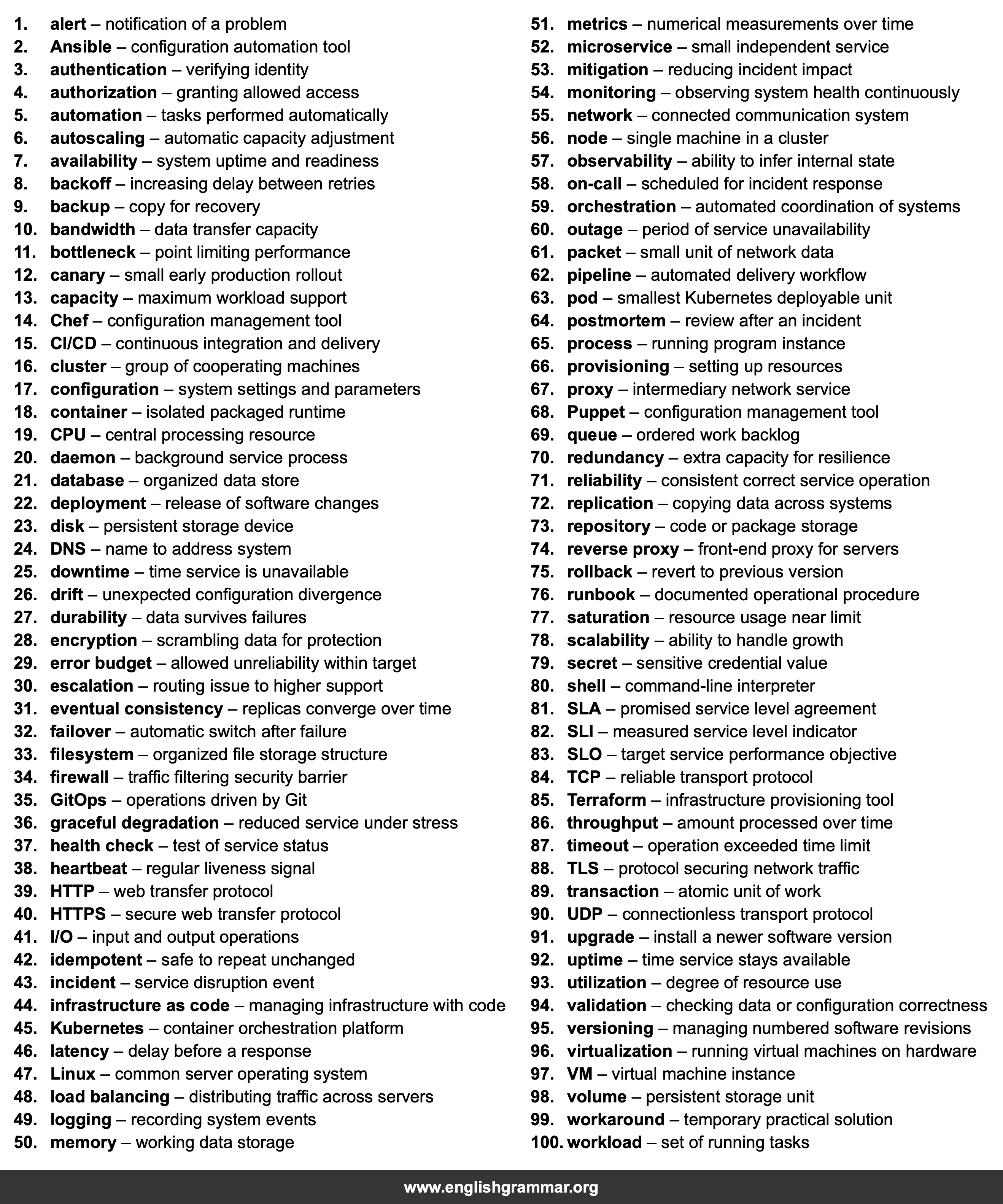
| No. | Item | Definition |
|---|---|---|
| 1. | alert | notification of a problem |
| 2. | Ansible | configuration automation tool |
| 3. | authentication | verifying identity |
| 4. | authorization | granting allowed access |
| 5. | automation | tasks performed automatically |
| 6. | autoscaling | automatic capacity adjustment |
| 7. | availability | system uptime and readiness |
| 8. | backoff | increasing delay between retries |
| 9. | backup | copy for recovery |
| 10. | bandwidth | data transfer capacity |
| 11. | bottleneck | point limiting performance |
| 12. | canary | small early production rollout |
| 13. | capacity | maximum workload support |
| 14. | Chef | configuration management tool |
| 15. | CI/CD | continuous integration and delivery |
| 16. | cluster | group of cooperating machines |
| 17. | configuration | system settings and parameters |
| 18. | container | isolated packaged runtime |
| 19. | CPU | central processing resource |
| 20. | daemon | background service process |
| 21. | database | organized data store |
| 22. | deployment | release of software changes |
| 23. | disk | persistent storage device |
| 24. | DNS | name to address system |
| 25. | downtime | time service is unavailable |
| 26. | drift | unexpected configuration divergence |
| 27. | durability | data survives failures |
| 28. | encryption | scrambling data for protection |
| 29. | error budget | allowed unreliability within target |
| 30. | escalation | routing issue to higher support |
| 31. | eventual consistency | replicas converge over time |
| 32. | failover | automatic switch after failure |
| 33. | filesystem | organized file storage structure |
| 34. | firewall | traffic filtering security barrier |
| 35. | GitOps | operations driven by Git |
| 36. | graceful degradation | reduced service under stress |
| 37. | health check | test of service status |
| 38. | heartbeat | regular liveness signal |
| 39. | HTTP | web transfer protocol |
| 40. | HTTPS | secure web transfer protocol |
| 41. | I/O | input and output operations |
| 42. | idempotent | safe to repeat unchanged |
| 43. | incident | service disruption event |
| 44. | infrastructure as code | managing infrastructure with code |
| 45. | Kubernetes | container orchestration platform |
| 46. | latency | delay before a response |
| 47. | Linux | common server operating system |
| 48. | load balancing | distributing traffic across servers |
| 49. | logging | recording system events |
| 50. | memory | working data storage |
| 51. | metrics | numerical measurements over time |
| 52. | microservice | small independent service |
| 53. | mitigation | reducing incident impact |
| 54. | monitoring | observing system health continuously |
| 55. | network | connected communication system |
| 56. | node | single machine in a cluster |
| 57. | observability | ability to infer internal state |
| 58. | on-call | scheduled for incident response |
| 59. | orchestration | automated coordination of systems |
| 60. | outage | period of service unavailability |
| 61. | packet | small unit of network data |
| 62. | pipeline | automated delivery workflow |
| 63. | pod | smallest Kubernetes deployable unit |
| 64. | postmortem | review after an incident |
| 65. | process | running program instance |
| 66. | provisioning | setting up resources |
| 67. | proxy | intermediary network service |
| 68. | Puppet | configuration management tool |
| 69. | queue | ordered work backlog |
| 70. | redundancy | extra capacity for resilience |
| 71. | reliability | consistent correct service operation |
| 72. | replication | copying data across systems |
| 73. | repository | code or package storage |
| 74. | reverse proxy | front-end proxy for servers |
| 75. | rollback | revert to previous version |
| 76. | runbook | documented operational procedure |
| 77. | saturation | resource usage near limit |
| 78. | scalability | ability to handle growth |
| 79. | secret | sensitive credential value |
| 80. | shell | command-line interpreter |
| 81. | SLA | promised service level agreement |
| 82. | SLI | measured service level indicator |
| 83. | SLO | target service performance objective |
| 84. | TCP | reliable transport protocol |
| 85. | Terraform | infrastructure provisioning tool |
| 86. | throughput | amount processed over time |
| 87. | timeout | operation exceeded time limit |
| 88. | TLS | protocol securing network traffic |
| 89. | transaction | atomic unit of work |
| 90. | UDP | connectionless transport protocol |
| 91. | upgrade | install a newer software version |
| 92. | uptime | time service stays available |
| 93. | utilization | degree of resource use |
| 94. | validation | checking data or configuration correctness |
| 95. | versioning | managing numbered software revisions |
| 96. | virtualization | running virtual machines on hardware |
| 97. | VM | virtual machine instance |
| 98. | volume | persistent storage unit |
| 99. | workaround | temporary practical solution |
| 100. | workload | set of running tasks |