
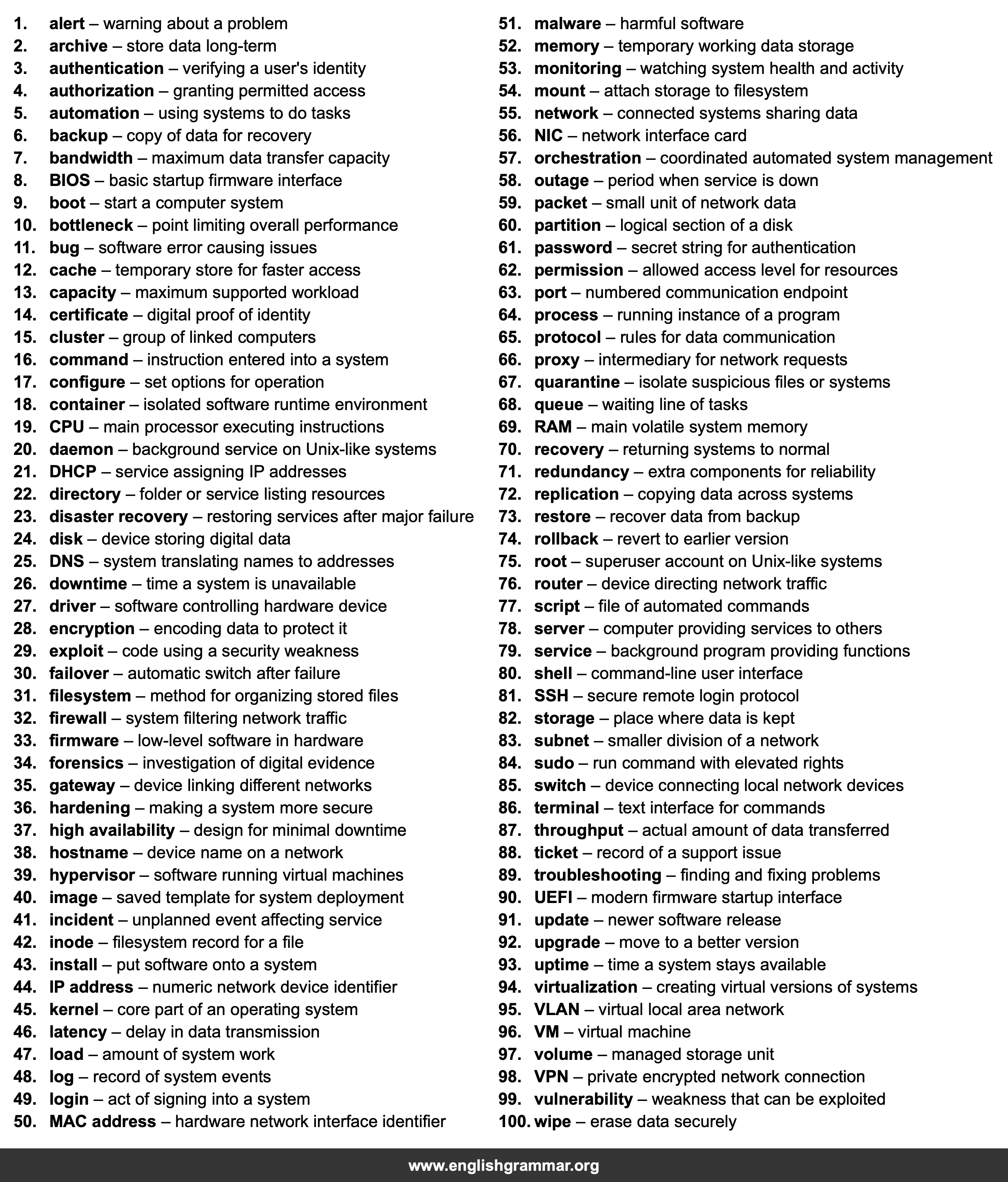
| No. | Item | Definition |
|---|---|---|
| 1. | alert | warning about a problem |
| 2. | archive | store data long-term |
| 3. | authentication | verifying a user’s identity |
| 4. | authorization | granting permitted access |
| 5. | automation | using systems to do tasks |
| 6. | backup | copy of data for recovery |
| 7. | bandwidth | maximum data transfer capacity |
| 8. | BIOS | basic startup firmware interface |
| 9. | boot | start a computer system |
| 10. | bottleneck | point limiting overall performance |
| 11. | bug | software error causing issues |
| 12. | cache | temporary store for faster access |
| 13. | capacity | maximum supported workload |
| 14. | certificate | digital proof of identity |
| 15. | cluster | group of linked computers |
| 16. | command | instruction entered into a system |
| 17. | configure | set options for operation |
| 18. | container | isolated software runtime environment |
| 19. | CPU | main processor executing instructions |
| 20. | daemon | background service on Unix-like systems |
| 21. | DHCP | service assigning IP addresses |
| 22. | directory | folder or service listing resources |
| 23. | disaster recovery | restoring services after major failure |
| 24. | disk | device storing digital data |
| 25. | DNS | system translating names to addresses |
| 26. | downtime | time a system is unavailable |
| 27. | driver | software controlling hardware device |
| 28. | encryption | encoding data to protect it |
| 29. | exploit | code using a security weakness |
| 30. | failover | automatic switch after failure |
| 31. | filesystem | method for organizing stored files |
| 32. | firewall | system filtering network traffic |
| 33. | firmware | low-level software in hardware |
| 34. | forensics | investigation of digital evidence |
| 35. | gateway | device linking different networks |
| 36. | hardening | making a system more secure |
| 37. | high availability | design for minimal downtime |
| 38. | hostname | device name on a network |
| 39. | hypervisor | software running virtual machines |
| 40. | image | saved template for system deployment |
| 41. | incident | unplanned event affecting service |
| 42. | inode | filesystem record for a file |
| 43. | install | put software onto a system |
| 44. | IP address | numeric network device identifier |
| 45. | kernel | core part of an operating system |
| 46. | latency | delay in data transmission |
| 47. | load | amount of system work |
| 48. | log | record of system events |
| 49. | login | act of signing into a system |
| 50. | MAC address | hardware network interface identifier |
| 51. | malware | harmful software |
| 52. | memory | temporary working data storage |
| 53. | monitoring | watching system health and activity |
| 54. | mount | attach storage to filesystem |
| 55. | network | connected systems sharing data |
| 56. | NIC | network interface card |
| 57. | orchestration | coordinated automated system management |
| 58. | outage | period when service is down |
| 59. | packet | small unit of network data |
| 60. | partition | logical section of a disk |
| 61. | password | secret string for authentication |
| 62. | permission | allowed access level for resources |
| 63. | port | numbered communication endpoint |
| 64. | process | running instance of a program |
| 65. | protocol | rules for data communication |
| 66. | proxy | intermediary for network requests |
| 67. | quarantine | isolate suspicious files or systems |
| 68. | queue | waiting line of tasks |
| 69. | RAM | main volatile system memory |
| 70. | recovery | returning systems to normal |
| 71. | redundancy | extra components for reliability |
| 72. | replication | copying data across systems |
| 73. | restore | recover data from backup |
| 74. | rollback | revert to earlier version |
| 75. | root | superuser account on Unix-like systems |
| 76. | router | device directing network traffic |
| 77. | script | file of automated commands |
| 78. | server | computer providing services to others |
| 79. | service | background program providing functions |
| 80. | shell | command-line user interface |
| 81. | SSH | secure remote login protocol |
| 82. | storage | place where data is kept |
| 83. | subnet | smaller division of a network |
| 84. | sudo | run command with elevated rights |
| 85. | switch | device connecting local network devices |
| 86. | terminal | text interface for commands |
| 87. | throughput | actual amount of data transferred |
| 88. | ticket | record of a support issue |
| 89. | troubleshooting | finding and fixing problems |
| 90. | UEFI | modern firmware startup interface |
| 91. | update | newer software release |
| 92. | upgrade | move to a better version |
| 93. | uptime | time a system stays available |
| 94. | virtualization | creating virtual versions of systems |
| 95. | VLAN | virtual local area network |
| 96. | VM | virtual machine |
| 97. | volume | managed storage unit |
| 98. | VPN | private encrypted network connection |
| 99. | vulnerability | weakness that can be exploited |
| 100. | wipe | erase data securely |