
• Skip to primary navigation
  • Skip to main content
  • Skip to primary sidebar
Home of English Grammar
  • Home
  • Course
  • Exercises
  • Grammar Rules
  • Matches
  • Posts
  • Tools
    • Grammar Checker
    • Very Replacer
    • Word Counter
  • Vocabulary Lists
  • Archives
    • Social Media Posts
    • Writing Guides
  • Sign in
  • Join free

What “clean as a whistle” means and where it likely came from

May 16, 2026

The origin of "clean as a whistle"

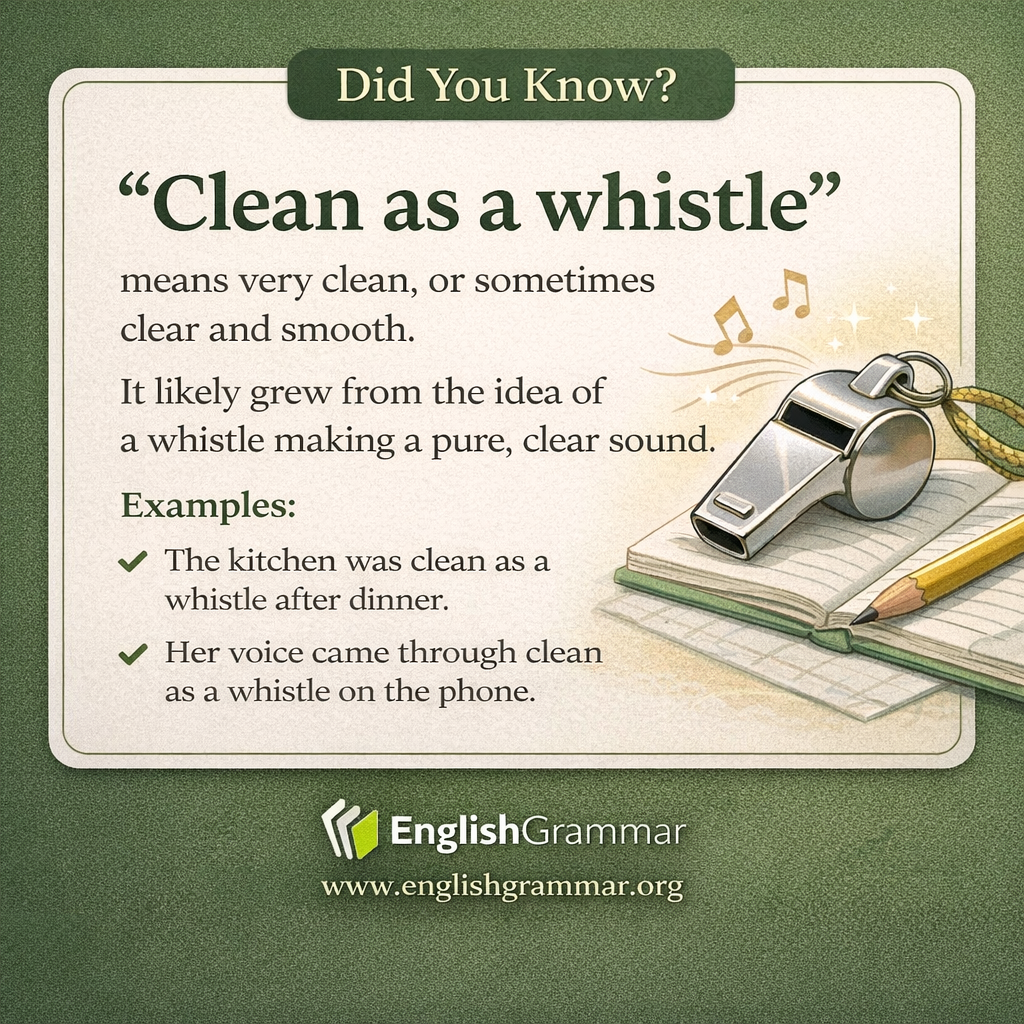
“Clean as a whistle” usually means very clean. If a room, dish, car, or shirt is described this way, the speaker means it is spotless or neatly cleaned.

The expression can also mean clear, smooth, or pure, especially in older or broader use. That second sense helps explain the likely origin. A whistle produces a sharp, pure sound, so the phrase probably developed from the idea of something being clear and free from roughness or dirt.

Some people assume the phrase refers to the shape or polished surface of a whistle, but the clearer link is probably the sound. In English, clean has long been used for things that are pure, exact, or unobstructed, not only physically tidy.

  • The kitchen was clean as a whistle after the party.
  • His final note was clean as a whistle.

So in modern English, the most common meaning is simply very clean. In some contexts, especially with sound or movement, it can still suggest something clear and smooth.

Improve your English grammar, vocabulary and writing

We take you step by step from beginner to advanced, even if you struggled with English at school or have always had trouble remembering the rules.

  • 10 modules, 112 lessons and 730 questions
  • Just log in and learn anytime and anywhere
  • Your progress is saved in your account
  • Download the 2027 Grammar Guide (PDF)
Join free

Already have an account? Sign in

See what’s in the course

Primary Sidebar

2.4M760.9K165.9K

Free 2027 Grammar Guide

  • Download Grammar Guide (PDF)
  • Online grammar course, A1 to C2
  • Weekly exercises and vocabulary
  • Join over 3 million English learners

We respect your privacy. Unsubscribe anytime.

Already have an account? Sign in

Grammar Checker - Try Now

Latest Posts

  • The origin of “out of left field” November 2, 2026
  • Creepy, spooky, eerie, sinister, macabre, and bloodcurdling: What’s the difference? November 2, 2026
  • 100 Best Synonyms for “Improvement” November 2, 2026
  • 100 Best Synonyms for “Understood” November 2, 2026
  • Perspicacious vs. perspicuous: understanding the difference November 2, 2026
  • 100 Best Synonyms for “Resent” November 2, 2026
  • 100 Best Synonyms for “Heavenly” November 2, 2026
  • 100 Best Synonyms for “Underpinned” November 2, 2026
  • 100 Best Synonyms for “Improved” November 2, 2026
  • 100 Best Synonyms for “Redeem” November 2, 2026
Home of English Grammar

Free English grammar exercises, rules and vocabulary lists, with new exercises every week. Join the leading English grammar site with over 3 million followers.

Join free

Learn

  • Exercises
  • Matches
  • Grammar rules
  • Vocabulary lists
  • Writing guides
  • Online tools

More

  • Top social media posts
  • Various posts
  • Contact

Account

  • Join free
  • Grammar Course
  • Free grammar guide (PDF)

Copyright © 2026 EnglishGrammar.org

  • Disclaimer
  • Privacy policy
  • Terms
  • Sitemap