
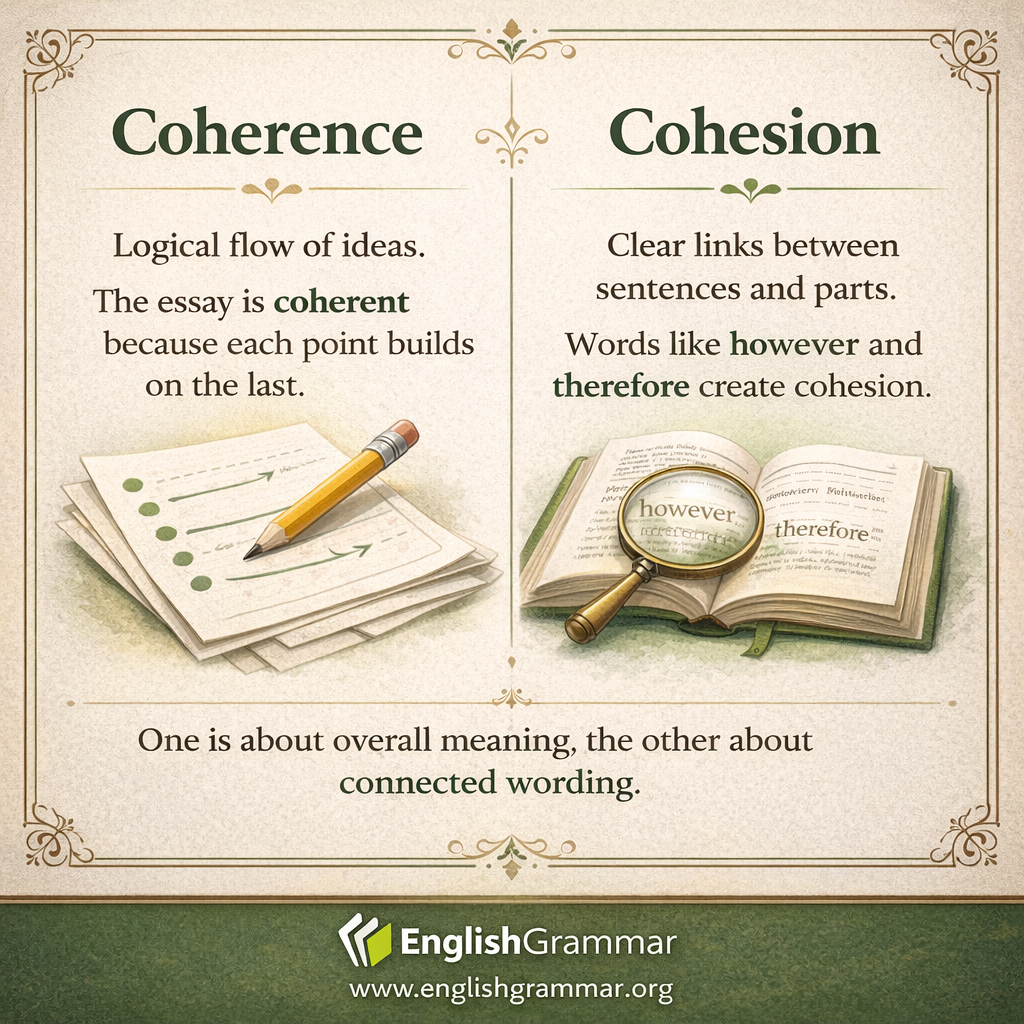
Coherence and cohesion both help writing feel clear, but they work at different levels.
Coherence is the overall logic of a piece. A coherent paragraph makes sense as a whole, with ideas arranged in a clear order. Readers can follow the main point without feeling lost.
Cohesion is the connection between sentences and parts of a text. It comes from linking words, repeated key terms, pronouns, and other language choices that tie ideas together.
A text can be cohesive without being coherent. For example, a paragraph may use words like however, therefore, and then, but still jump between unrelated ideas. It can also be coherent with only simple cohesive devices if the ideas are well organized.
- Use coherence when talking about overall meaning and structure.
- Use cohesion when talking about sentence level and paragraph level links.
- Think of it this way: coherence is the big picture, cohesion is the glue.
Example: “The essay is coherent because each paragraph supports the thesis.” “Words like however and for example add cohesion between sentences.”
