
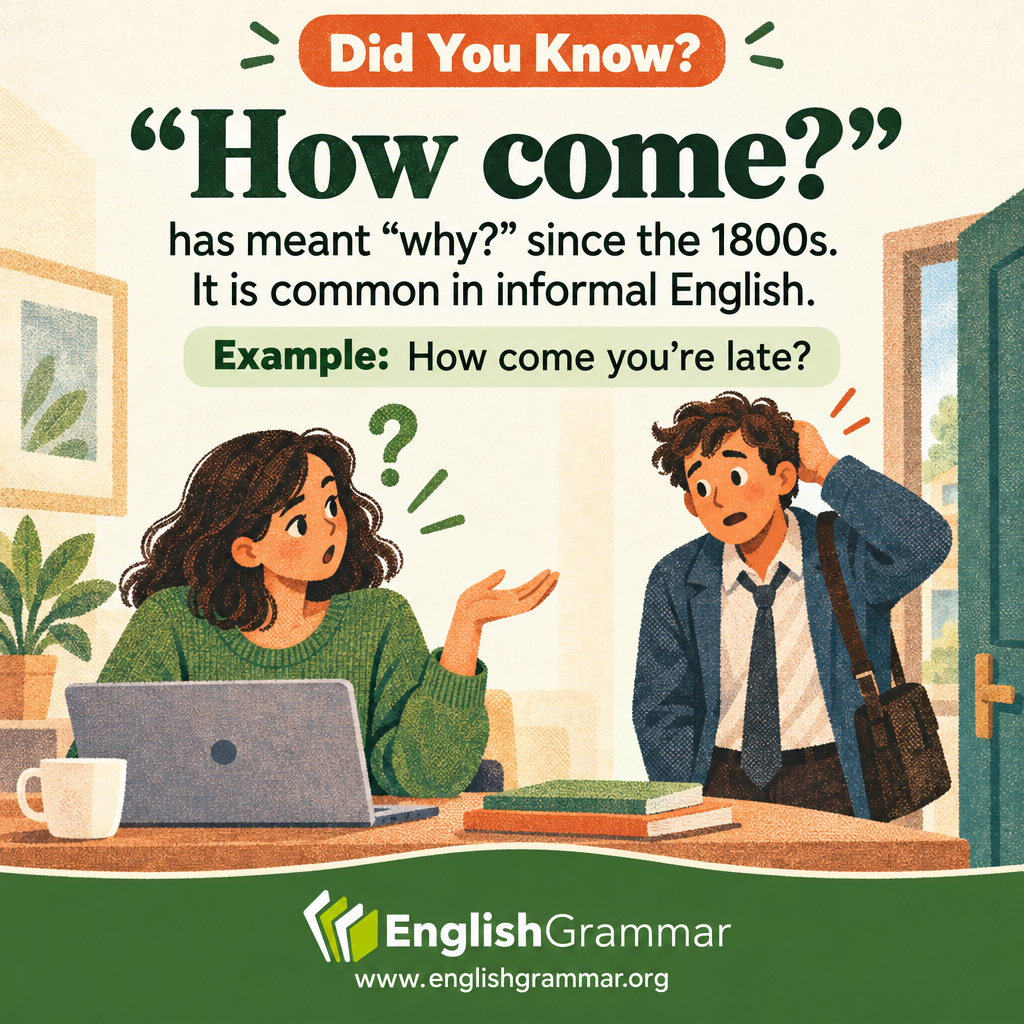
“How come?” has meant “why?” since the 1800s. It may sound like a modern conversational shortcut, but written examples go back to the nineteenth century. Its use today continues a long-established way of asking for a reason.
In everyday English, how come asks why something happens or why something is true. For example, “How come the shop is closed?” asks for the reason the shop is not open. The speaker might simply want information or might be expressing surprise.
The useful grammar difference is the word order. After how come, the subject usually comes before the verb, just as it does in a statement. Compare these questions:
- “Why are you leaving early?”
- “How come you are leaving early?”
Both ask for a reason. Notice that you are stays in that order in the second question. You would not normally say, “How come are you leaving early?”
The same pattern works with other verbs: “How come Maya takes the bus?” Compare that with “Why does Maya take the bus?” The question with how come does not need the extra does.
This expression is common in informal conversation and casual writing. In formal writing, why is usually the more neutral choice. Being old does not make an expression formal: this one has a long history but still sounds conversational.