
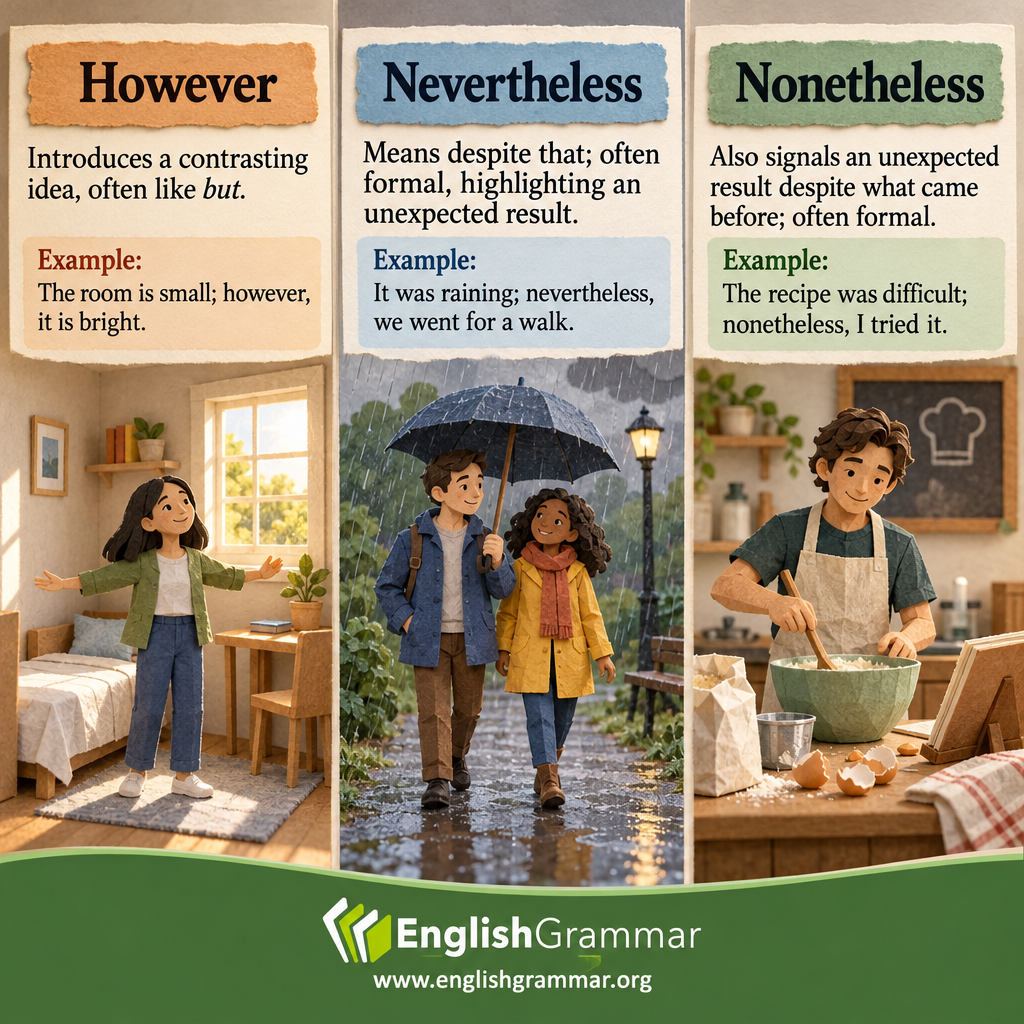
However, nevertheless, and nonetheless connect contrasting ideas. They often overlap, but the contrast is not always the same.
However introduces a contrast and often works like but. It can compare two facts without suggesting that one should prevent the other: “Lena prefers tea; however, her brother prefers coffee.” Neither preference makes the other surprising. It is a flexible choice in both everyday and formal writing.
Nevertheless means despite that. Choose it when the first fact might lead you to expect a different result: “The tickets were expensive; nevertheless, we bought them.” The price might have discouraged the purchase, but it did not.
Nonetheless also means despite that: “The instructions were confusing; nonetheless, Maya completed the task.” The difficulty did not prevent success. Nevertheless and nonetheless are usually interchangeable, and both often sound more formal than but. There is no firm rule that gives them different levels of contrast.
- For a simple difference between facts, however is usually the best fit of the three.
- For an unexpected result despite a difficulty, all three may work.
- Choose between nevertheless and nonetheless mainly for style and flow, not a strict meaning difference.
Punctuation matters. These words do not join complete sentences with just a comma. Use a full stop or semicolon before them: “I was tired. However, I kept working.” A comma usually follows the connector in this position.
