
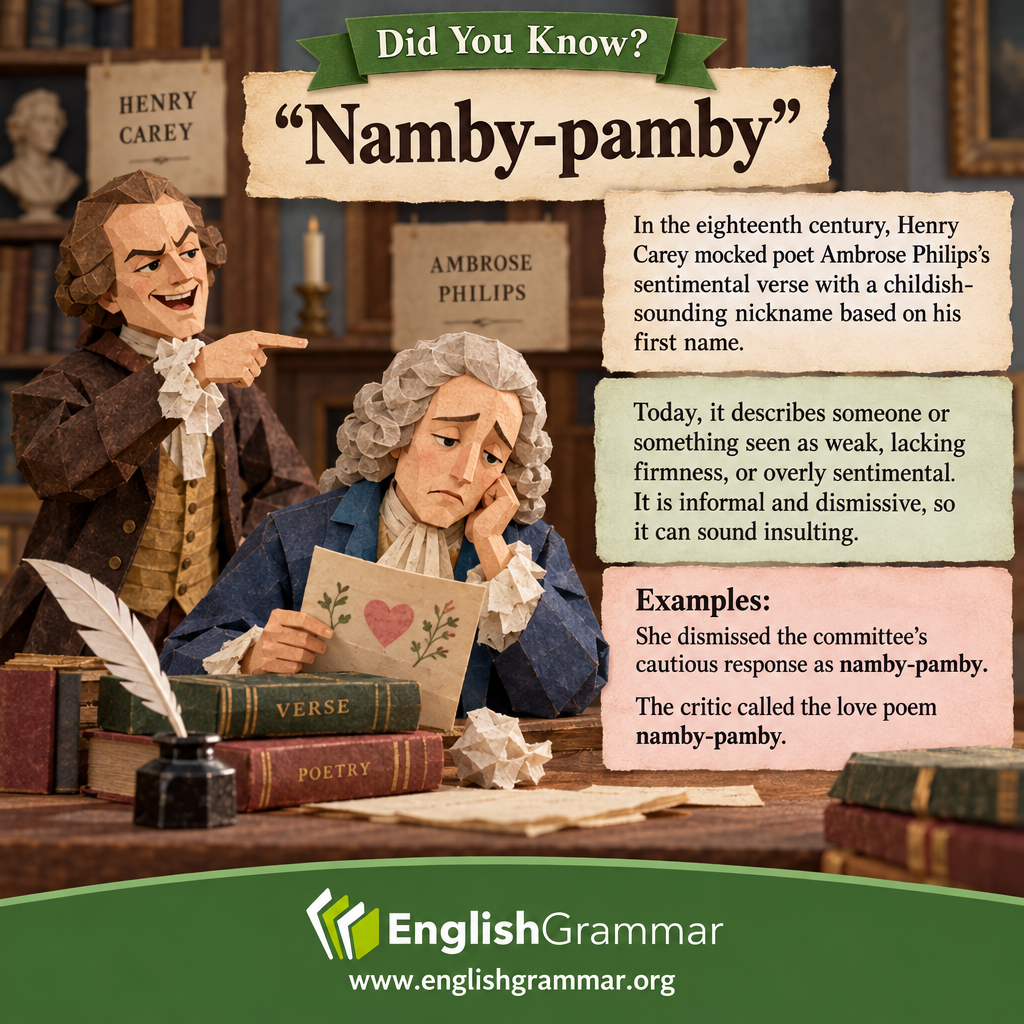
“Namby-pamby” began as a joke at a poet’s expense. In the eighteenth century, Henry Carey used the nickname to mock fellow poet Ambrose Philips and his sentimental verse, particularly poems addressed to children. The nickname played on Philips’s first name, Ambrose, with a childish, singsong sound.
Carey’s mockery helped turn a personal nickname into a general expression of criticism. Rather than referring only to Philips, the word came to describe writing considered overly sweet or childish. Its meaning later broadened beyond poetry.
Today, it usually means weak, lacking firmness, or too sentimental. Someone might use it to criticize a decision that seems timid, an approach that avoids necessary action, or language that feels excessively sweet. It expresses the speaker’s judgment, not an objective fact.
- The manager rejected the proposal as namby-pamby because it avoided making any difficult decisions.
- He thought the film’s ending was namby-pamby, with everyone forgiving each other instantly.
In the first example, the criticism concerns a lack of firmness. In the second, it concerns excessive sentimentality. These are related uses: both suggest that something is softer than the speaker thinks it should be.
Use it carefully. The word is informal and dismissive, and calling a person this can sound insulting. In a neutral discussion, choose a more precise description, such as too cautious, not firm enough, or overly sentimental, depending on what you mean.
