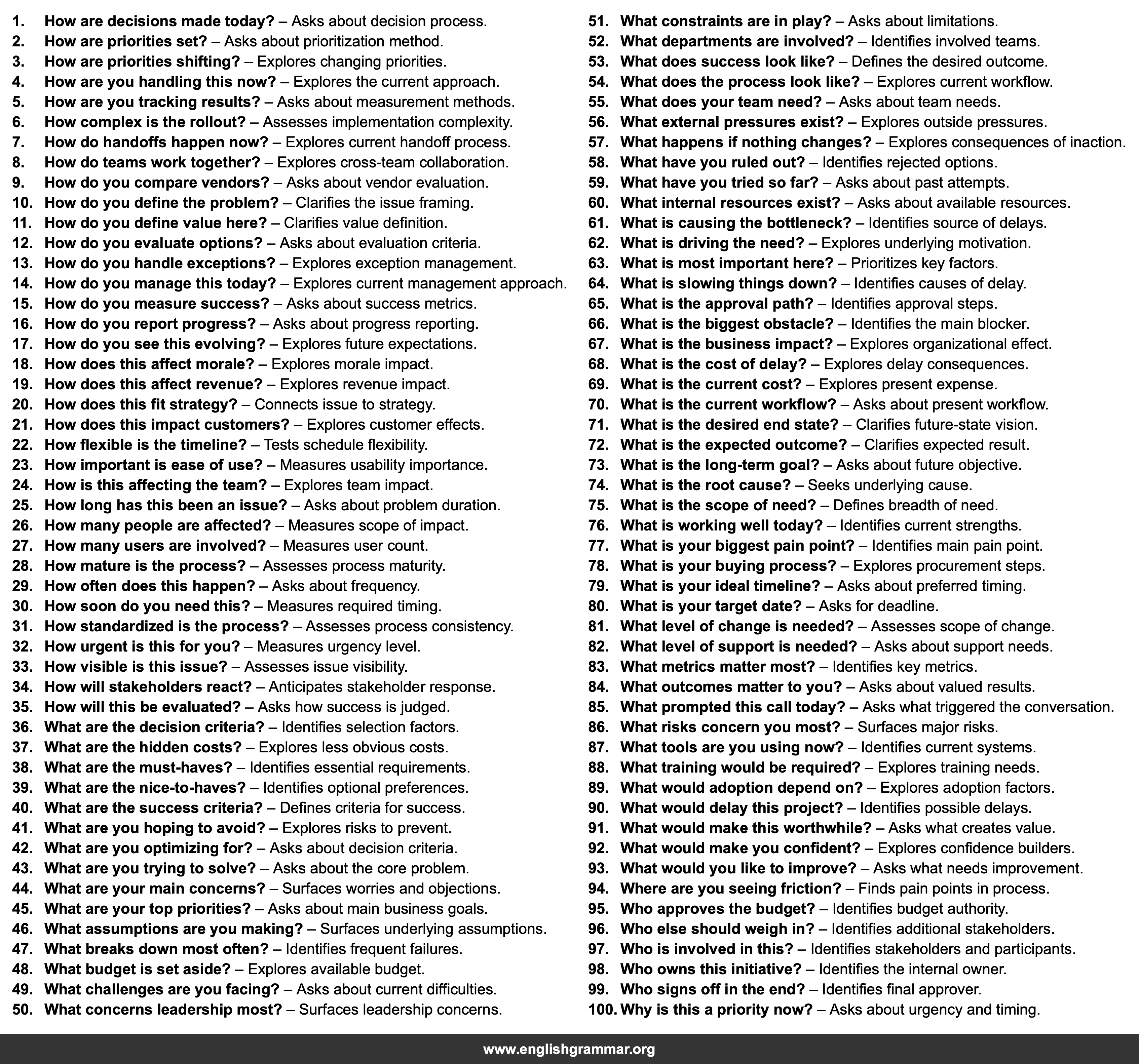
| No. | Item | Definition |
|---|---|---|
| 1. | How are decisions made today? | Asks about decision process. |
| 2. | How are priorities set? | Asks about prioritization method. |
| 3. | How are priorities shifting? | Explores changing priorities. |
| 4. | How are you handling this now? | Explores the current approach. |
| 5. | How are you tracking results? | Asks about measurement methods. |
| 6. | How complex is the rollout? | Assesses implementation complexity. |
| 7. | How do handoffs happen now? | Explores current handoff process. |
| 8. | How do teams work together? | Explores cross-team collaboration. |
| 9. | How do you compare vendors? | Asks about vendor evaluation. |
| 10. | How do you define the problem? | Clarifies the issue framing. |
| 11. | How do you define value here? | Clarifies value definition. |
| 12. | How do you evaluate options? | Asks about evaluation criteria. |
| 13. | How do you handle exceptions? | Explores exception management. |
| 14. | How do you manage this today? | Explores current management approach. |
| 15. | How do you measure success? | Asks about success metrics. |
| 16. | How do you report progress? | Asks about progress reporting. |
| 17. | How do you see this evolving? | Explores future expectations. |
| 18. | How does this affect morale? | Explores morale impact. |
| 19. | How does this affect revenue? | Explores revenue impact. |
| 20. | How does this fit strategy? | Connects issue to strategy. |
| 21. | How does this impact customers? | Explores customer effects. |
| 22. | How flexible is the timeline? | Tests schedule flexibility. |
| 23. | How important is ease of use? | Measures usability importance. |
| 24. | How is this affecting the team? | Explores team impact. |
| 25. | How long has this been an issue? | Asks about problem duration. |
| 26. | How many people are affected? | Measures scope of impact. |
| 27. | How many users are involved? | Measures user count. |
| 28. | How mature is the process? | Assesses process maturity. |
| 29. | How often does this happen? | Asks about frequency. |
| 30. | How soon do you need this? | Measures required timing. |
| 31. | How standardized is the process? | Assesses process consistency. |
| 32. | How urgent is this for you? | Measures urgency level. |
| 33. | How visible is this issue? | Assesses issue visibility. |
| 34. | How will stakeholders react? | Anticipates stakeholder response. |
| 35. | How will this be evaluated? | Asks how success is judged. |
| 36. | What are the decision criteria? | Identifies selection factors. |
| 37. | What are the hidden costs? | Explores less obvious costs. |
| 38. | What are the must-haves? | Identifies essential requirements. |
| 39. | What are the nice-to-haves? | Identifies optional preferences. |
| 40. | What are the success criteria? | Defines criteria for success. |
| 41. | What are you hoping to avoid? | Explores risks to prevent. |
| 42. | What are you optimizing for? | Asks about decision criteria. |
| 43. | What are you trying to solve? | Asks about the core problem. |
| 44. | What are your main concerns? | Surfaces worries and objections. |
| 45. | What are your top priorities? | Asks about main business goals. |
| 46. | What assumptions are you making? | Surfaces underlying assumptions. |
| 47. | What breaks down most often? | Identifies frequent failures. |
| 48. | What budget is set aside? | Explores available budget. |
| 49. | What challenges are you facing? | Asks about current difficulties. |
| 50. | What concerns leadership most? | Surfaces leadership concerns. |
| 51. | What constraints are in play? | Asks about limitations. |
| 52. | What departments are involved? | Identifies involved teams. |
| 53. | What does success look like? | Defines the desired outcome. |
| 54. | What does the process look like? | Explores current workflow. |
| 55. | What does your team need? | Asks about team needs. |
| 56. | What external pressures exist? | Explores outside pressures. |
| 57. | What happens if nothing changes? | Explores consequences of inaction. |
| 58. | What have you ruled out? | Identifies rejected options. |
| 59. | What have you tried so far? | Asks about past attempts. |
| 60. | What internal resources exist? | Asks about available resources. |
| 61. | What is causing the bottleneck? | Identifies source of delays. |
| 62. | What is driving the need? | Explores underlying motivation. |
| 63. | What is most important here? | Prioritizes key factors. |
| 64. | What is slowing things down? | Identifies causes of delay. |
| 65. | What is the approval path? | Identifies approval steps. |
| 66. | What is the biggest obstacle? | Identifies the main blocker. |
| 67. | What is the business impact? | Explores organizational effect. |
| 68. | What is the cost of delay? | Explores delay consequences. |
| 69. | What is the current cost? | Explores present expense. |
| 70. | What is the current workflow? | Asks about present workflow. |
| 71. | What is the desired end state? | Clarifies future-state vision. |
| 72. | What is the expected outcome? | Clarifies expected result. |
| 73. | What is the long-term goal? | Asks about future objective. |
| 74. | What is the root cause? | Seeks underlying cause. |
| 75. | What is the scope of need? | Defines breadth of need. |
| 76. | What is working well today? | Identifies current strengths. |
| 77. | What is your biggest pain point? | Identifies main pain point. |
| 78. | What is your buying process? | Explores procurement steps. |
| 79. | What is your ideal timeline? | Asks about preferred timing. |
| 80. | What is your target date? | Asks for deadline. |
| 81. | What level of change is needed? | Assesses scope of change. |
| 82. | What level of support is needed? | Asks about support needs. |
| 83. | What metrics matter most? | Identifies key metrics. |
| 84. | What outcomes matter to you? | Asks about valued results. |
| 85. | What prompted this call today? | Asks what triggered the conversation. |
| 86. | What risks concern you most? | Surfaces major risks. |
| 87. | What tools are you using now? | Identifies current systems. |
| 88. | What training would be required? | Explores training needs. |
| 89. | What would adoption depend on? | Explores adoption factors. |
| 90. | What would delay this project? | Identifies possible delays. |
| 91. | What would make this worthwhile? | Asks what creates value. |
| 92. | What would make you confident? | Explores confidence builders. |
| 93. | What would you like to improve? | Asks what needs improvement. |
| 94. | Where are you seeing friction? | Finds pain points in process. |
| 95. | Who approves the budget? | Identifies budget authority. |
| 96. | Who else should weigh in? | Identifies additional stakeholders. |
| 97. | Who is involved in this? | Identifies stakeholders and participants. |
| 98. | Who owns this initiative? | Identifies the internal owner. |
| 99. | Who signs off in the end? | Identifies final approver. |
| 100. | Why is this a priority now? | Asks about urgency and timing. |
